


It’s the early 1960s and Dizzy Gillespie is playing at The Embers, which boasted “the most exciting music and food in New York.”
Gillespie had already cemented himself as one of the quintessential names of jazz. He pioneered bebop, then fused modern American jazz with Latin and African rhythms. Few patrons could have boasted a stature as mythic as the cat onstage.
There was at least one: Adam Clayton Powell Jr. He was the first Black person elected to Congress from the northeast, he had helped kill school segregation and the poll tax — he was a legend.
During a break in his set, Gillespie made his way over to Powell’s table. The Congressman offered the musician a cigar and Gillespie, in turn, produced a massive custom-made Zippo: Six inches tall and four inches wide. As he lit the cigars, Powell noticed the inscription on the side.
“The HNIC, what does that mean?” Powell asked.1
“Oh, come on Adam, you know what HNIC means,” Gillespie responded. Clearly, the congressman didn’t. Gillespie leaned over to whisper in the politician’s ear: “That means ‘Head N----- In Charge!’”2
Powell, laughing, demanded his own. Gillespie refused. “You can’t have those same letters because I’m the HNIC!” Gillespie, instead, bought him a matching lighter inscribed NNIC — the first N for Next. When Gillespie visited Powell in Washington the next year, the lighter was prominently displayed on his desk.
Powell was more popular than ever, but a series of scandals — brought on to varying degrees by his libido, wanton spending, absenteeism, and outspoken activism — were dragging him down. He implored Harlem to “keep the faith, baby,” but his fellow congressmen ejected him out of the House.
“In Congress, he had some power!” Gillespie wrote years later. “He thought he could do the same thing that the white man did and get away with it, but he was wrong because if you’re challenging something, you have to be prepared to be challenged and be clean enough to go all the way.”
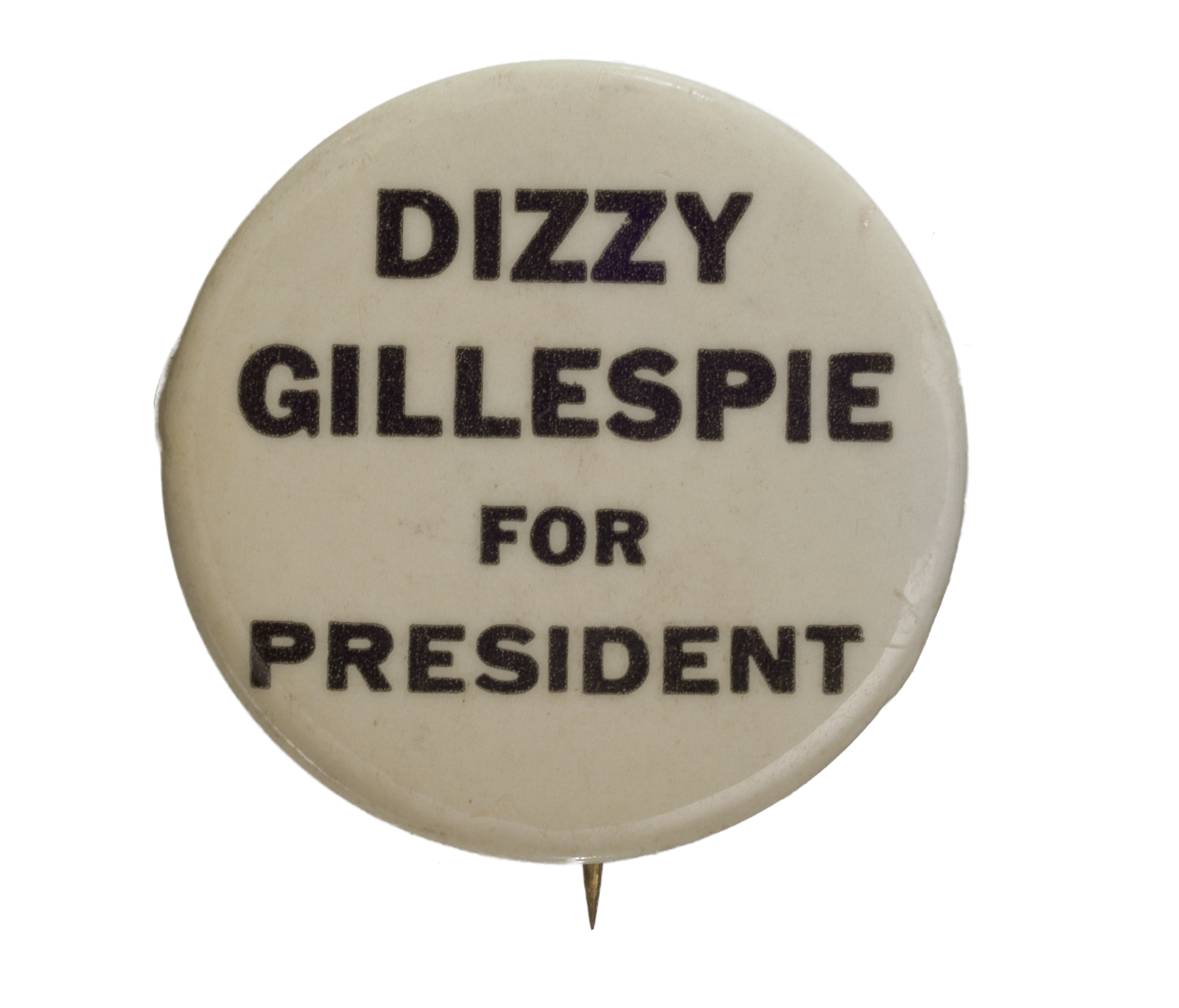
There was a clean candidate ready to go all the way, thought Gillespie. And his name was Dizzy Gillespie.
For years, ‘Dizzy Gillespie for President’ buttons had been popular amongst hipsters. He was beloved because he was an outspoken Black man whose popularity and talent meant he could speak freely, without fear of professional consequence. The buttons were ambiguous and universal, as few thought he was crazy enough to run — Gillespie included. That changed in the summer of 1963, when he saw a young woman sporting it, standing next to James Baldwin at the March on Washington. Suddenly the idea seemed appropriately out there.
Dizzy Gillespie was running for president, for real.
“It wasn’t just a publicity stunt,” Gillespie recalled. “I made campaign speeches and mobilized people.” Anything would be better than the iron-fisted warmonger Lyndon B. Johnson or the radically right-wing Barry Goldwater, he thought. “I was the only choice for a thinking man.”
He had lots of plans for his administration. In his cabinet there would be no secretaries, just ministers. Malcolm X would be Attorney General (“he’s one cat we want on our side”) and Louis Armstrong would be Minister of Agriculture (“he knows all about raising those crops”.)
Gillespie’s campaign planks were quips that sat with you. He wanted the House Un-American Activities Committee, made famous by Joseph McCarthy, to strike an investigation into “everything under white sheets.” (“We won’t take no ‘sheet’ off anybody!”) Sheets would be encouraged, instead, at job interviews: “So bosses won’t know what they are until after they’ve been hired.”
Under a Gillespie administration, NASA would be expected “to put up at least one black astronaut.” Gillespie vowed to get rid of the income tax, legalize numbers, and to change the name and/or color of the White House to the Blues House.
He had some more serious planks, too. Recognize China, enforce civil rights, better fund culture, and end the war against Vietnam. Jukeboxes would be taxed, with the money being distributed to the live musicians they displaced.
Plenty of Gillespie’s ideas became state policy. Johnson really did order the successor to the House Un-American Activities Committee to investigate the KKK just two years later; legislated civil rights and an end to the war would come soon; race-blind interviews came in vogue eventually; pot is finally being legalized, and so on.
Some of his big ideas haven’t come to pass yet. “We might even disenfranchise women,” Gillespie cheekily proposed, “and let them run the country. They’ll do it anyhow.”
Gillespie took his own campaign seriously enough. Profit from sales of buttons and banners went directly to the Congress of Racial Equality and Martin Luther King Jr. “You’re in for a fight if you call me a dark-horse candidate,” he joked during a show in Menlo, California.
Still, he became a punchline. The San Francisco Chronicle called him “the best comedian in San Francisco,” looking down at his presidential run as “a lot of fun.”
Not everyone took his candidacy as a joke. The Chronicle’s jazz columnist — who, he disclosed, was married to Gillespie’s campaign manager — endorsed Gillespie: “I am, as a voter and a citizen, tired of the lesser-of-two-evils choice system.”3 (He would later join as the campaign spokesman.)
Gillespie dropped out of the race. He ran again in 1972.
“The first time, I had a real reason for running,” he recalled. “I could threaten the Democrats with a loss of votes and swing them to a more reasonable position on civil rights.” The second time, however, “I have been deeply concerned with drawing attention to the dire necessity of bringing together the peoples of the world in unity so that all wars may cease.”
Gillespie dropped out again. “I was about to become a perennial candidate,” he wrote. The jazz artist hoped the real politicians could actually unify the country during tough times.
As Gillespie declared in 1964: “I’m running for president, because we need one.”
This week, on a very special Bug-eyed and Shameless: An exploration of the joke candidate. We are at unprecedented levels of cynicism and dysfunction: The far-right is ascendant, technocrats are (mostly) reviled, and the left looks moribund.
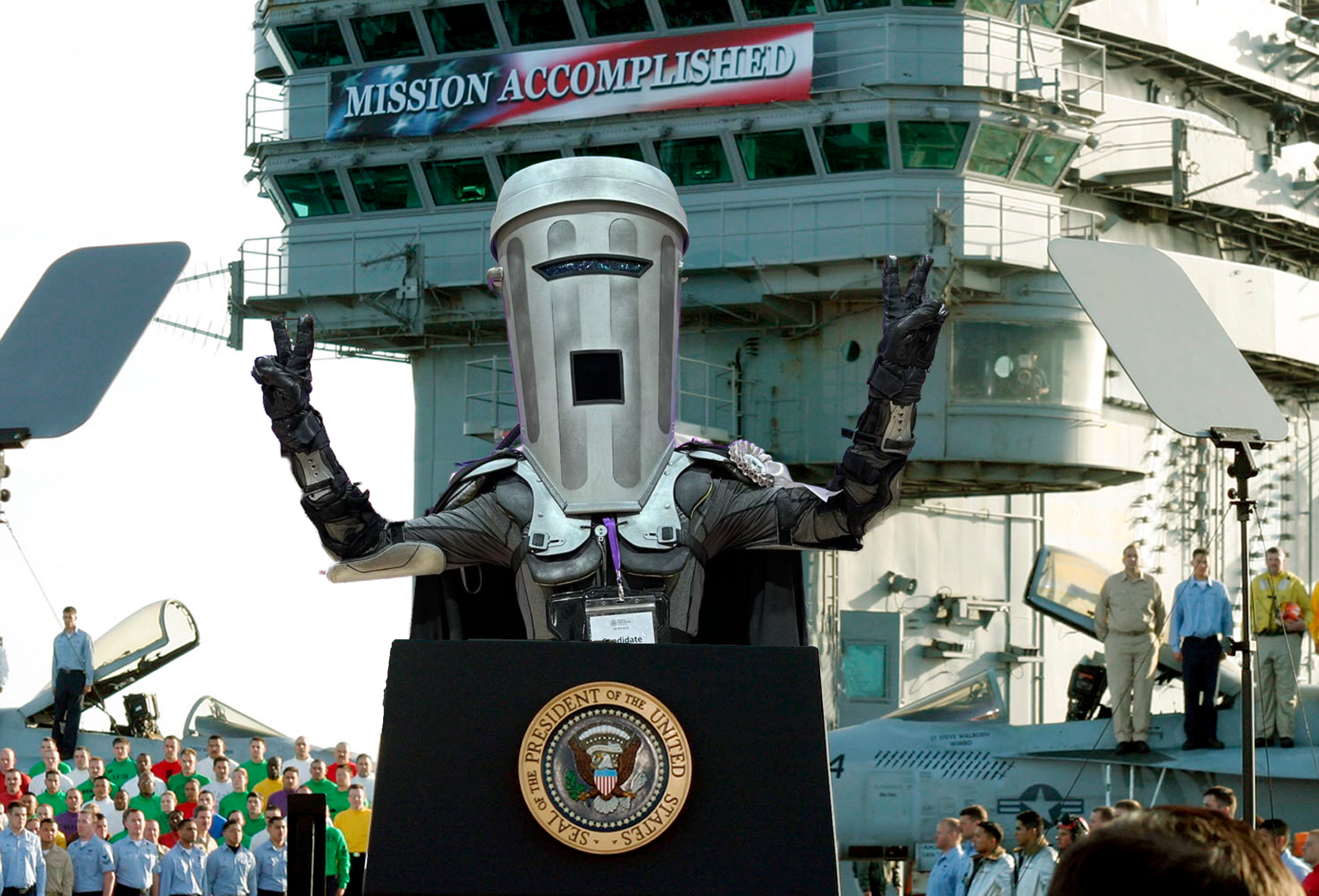
Perhaps, I argue, we need to stop worrying and love the buckethead.
The Ballad of Tarquin Fin-tim-lin-bin-whin-bim-lim-bus-stop-F’tang-F’tang-Olé-Biscuitbarrel
“Every British citizen who is more than 21 years old, does not qualify for the House of Lords, and is neither a bankrupt, nor a lunatic, nor a convicted felon, can go into any British constituency and become a candidate for election to the House of Commons,” a journalist explained to North American readers in 1963.4
He was trying, perhaps in vain, to explain why a by-election in sleepy Stratford-upon-Avon had attracted the candidacies of two weirdos.
One was Miles Blair, founder of the “violently anti-American” British and Commonwealth Party, ”whose policy seems to be a conviction that the United States should not have been allowed to exist.” (Sign me up.)
The other was leader of the Teenage Party, David Sutch, a shock-rock star who hung out with Led Zeppelin and referred to himself as “The Ghoul.” His candidacy may have been emblematic of just how easy it was to stand for office in the United Kingdom, but he was also running because he believed elections weren’t open enough. The 22-year-old wanted to open the franchise to teenagers.
Newspapers, which ran photos of Sutch wearing leopard print and massive buffalo horns, were scandalized that Sutch’s hair fell to his shoulders.
This byelection wasn’t supposed to attract any attention at all. Prime Minister Harold Macmillan had called the vote for the doldrums of summer in hopes it would gloss over the UK’s first big, modern sex scandal.
The riding’s outgoing MP, John Profumo, had been stepping out on his wife with a young woman. The papers knew of the affair, but observed the custom that they wouldn’t report on politicians’ personal lives — for fear of libel suit. But a Labour MP, citing national security, read details of Profumo’s affair into Hansard, the parliamentary record, where he enjoyed legal immunity. (The woman was also bedding a Soviet attaché.)
This byelection would change the country forever. It cracked the firewall around politicians’ personal lives — Rupert Murdoch would buy his first British tabloid a few years later, and supercharge that shift.
And while Sutch would never get credit, the UK did lower the voting age six years later — the first parliamentary democracy to expand the franchise from 21 years old to 18.
There was a bigger shift afoot. In the coming years, the public would start to realize just how silly their politics really were.
In 1978, a tiny UFO-obsessed publishing house printed The Full and True Text of a Notorious, Remarkable and Visionary Speech Made By John, Viscount Amberley, Earl Russell, on the 18th of July 1978 at 9.8pm in the House of Lords.
The best-selling pamphlet was, apart from some incredible Ralph Steadman illustrations, just an unedited speech to the House of Lords by John Russell, 4th Earl Russell (Son of Bertrand).5
In the speech, Lord Russell proclaimed “naked bathing on beaches or in rivers ought to be universal,” denounced Parliament as “spiritless papal bumboys” if they couldn’t withdraw from Northern Ireland, and proclaimed that “the Upper Classes are right and should be restored to vogue.”
My favourite: “Women’s Lib would be realised by girls being given a house of their own at the age of twelve.” The state should pay them enormous sums so “that marriage would be abolished and a girl could have as many husbands as she likes.” (Or just one, he adds.)
This was the duality of British politics: Deadly serious, steeped in a pompous history, and utterly absurd.
Monty Python’s Flying Circus sent up the absurdity of the system in their Election Night Special sketch. In it, the Silly Party is in a close race with the Sensible Party — as the Slightly Silly Party and the Very Silly Party play spoilers.
Sutch’s eccentric candidacy had merely been a bit early. In 1963 he had run as a teen — in 1983, he would try running as a lunatic.
In a 1981 byelection, a Tarquin Fin-tim-lin-bin-whin-bim-lim-bus-stop-F’tang-F’tang-Olé-Biscuitbarrel (named for one of the characters in the Monty Python sketch) appeared on the ballot as a Raving Loony candidate. A year later, Sutch founded the Official Monster Raving Loony Party. He had no trouble finding fellow eccentrics who wanted to take the piss of the whole politics thing.
Flying Officer Kite stood in the district of Bradford North — unusual, a paper noted, as “he prefers to be airborne.” The paper approved: “There are enough clowns in politics so a self-confessed Loony won’t make much difference.”6 Sutch himself ran against Thatcher, following her around with a giant novelty tin opener, vowing to “open up the Iron Lady.” The Loonies became a fixture of election night, with their absurdly-dressed candidates standing beside cabinet ministers and ashen-faced politicos. Others joined the fray: A Lord Buckethead ran against Thatcher in 1987. (Blackadder would parody the clowns by inventing the Standing at the Back Dressed Stupidly and Looking Stupid Party.)
Thatcher tried to have her revenge by raising the deposit required to run for office, to £500, but it didn’t dissuade a rising sea of raving loons.
The party never ran to win, only to hit the 5% threshhold required to win back their deposit. “If we do,” candidate Howling Laud Hope promised, “I will put it behind the bar and we will drink it.” (Hope was one of the few Monsters to hold office, having been elected to town council multiple times, uncontested, even serving as mayor of Ashburton.)
Their manifestos promised to create eight million jobs by turning Britain into Loonyland, to levy a tax on furry dice hanging from rearview mirrors, and to replace policemen with cardboard cut-outs — it would save money and thwart short-sighted villains. It had some real promises, too: A public access TV channel, more resources for the unemployed, an end to the poll tax killing local businesses. And then there were the ideas that defied characterizing: Free rent for the homeless, for example; or Sutch’s observation that it was absurd to have a single Monopolies Commission.
Like all parties, though, the Raving Loonys were prone to schisms. There was the offshoot Monster Raving Loony Morris Dancers’ Party, represented by Maurice Dancer; and the Monster Raving Loony Volleyball Party.
“It helps to think of me as a surrealist,” Sutch told the South Wales Evening Post in 1991. “I’m the guy in the outrageous outfit talking plain sense, as opposed to the guys in the plain suits making outrageous decisions.”
Long before Polymarket and Kalshi turned degenerate gambling into a viral phenom, Sutch put £5 on him becoming prime minister — London bookmakers put that outcome at 15 million-to-1.
Over the years, the Loonies would win thousands of votes, though they would never crack 5% in a competitive election. (Sutch got closest in 1994, winning 4.2% of the vote in a byelection.)
Sutch remained leader of the party until 1999, when he committed suicide at home. Beneath all the stunts and pomp, Sutch had a rough life: His father, a policeman, had been killed in the Blitz when he was a child. He had lived in poverty at various points, and suffered from depression and bipolar disorder. He was, beneath all the absurdity, quite real.
The tributes to Sutch after his death were plainly authentic. Papers called him “one of Britain’s greatest post-war eccentrics.”
Sutch had campaigned to lower the voting age, end the BBC’s stranglehold on commercial radio, to relax mandated hours for pubs, and for pet passports — all things later adopted by the serious politicians. But, more importantly, he given voice to the growing chorus of people who felt that politics in the UK had gotten just too silly.
As Sutch himself once said: “What loonies decided today, the other parties introduce tomorrow.”
The Absurdity of Perfection
Anti-system parties come in all shapes and sizes — populist, fascist, communist, separatist, protest — but they are all defined by a paradoxical relationship between imagination and perfection, argues Israeli political scientist Michael Keren.
These anti-system parties often predicate their politics on promising to destroy a system in order to make it work. They couch their politics in conjured enemies and idealized histories, while claiming to hold a unique understanding of the way in which things have been corrupted.
Much as Donald Trump vowed to wield his unrivaled deal-making ability and common-sense wisdom to Make America Great Again, these anti-system politicians have an incredible ability to both malign the status quo and promise to replace it with utopia. Their job is to lay waste to the sense of the impossible, Keren argues, adhering instead “to a standard of perfection.”7
“Social problems are expected to wither away just as they do in television commercials,” Keren writes, “political systems are expected to be cleaned up just as they do in management know-how books, and economic troubles are expected to be solved by instant remedies just as they do in internet chat-rooms.”
All politicians can be accused of promising too much. But the anti-system politician is guilty of taking this to the absurd.
Nigel Farage was living in this paradox when he stepped off a bright red bus emblazoned with: “We send the EU £350 million a week. Let’s fund our NHS instead. Vote Leave. Let’s take back control.”
Farage had held up Brexit as “the greatest opportunity for national renewal in our lifetime.” He framed his vision of a post-Europe UK as obsessively optimistic. The UK would cease unwanted immigration, stop deficit spending, and improve welfare and services. Free to make its own decisions and forge their economic relationships, Brexit would allow the UK to “earn our way to national prosperity,” he said in 2013. There was, in short, no problem that couldn’t be fixed by destroying the UK’s involvement in Europe.
A decade on from Brexit, the opposite has happened. Productivity is down, employment is down, exports are down, immigration is up, and GDP growth is down. The data are unequivocal: Brexit has been a disaster.
Today, Farage no longer says that Britain can fund its social services through repatriating cash from Brussels. Nor does he say that growth will return by signing new trade deals without say from Strasbourg. No, today he insists that the single most important act of salvation for the United Kingdom is electing Nigel Farage. It will be magical, he promises.
“Britain has not declined because of its people,” Reform UK declares proudly on its website. “It has declined because of weak leadership.” It is an incredible statement from a man once considered a joke.
The first time Farage ran for office, in a 1994 by-election, he earned just about 150 more votes than the next-closest candidate, Screaming Lord Sutch. He would, like Sutch, become something of a perennial candidate — losing in seven consecutive parliamentary elections.
Farage could afford to pursue such a quixotic campaign, ironically, because of the European Union. He was first elected to the EU Parliament in 1999, despite winning less than 10% of the vote. In 2017, the EU Parliament accused Farage and his fellow UKIP MEPs of diverting some £500,000 of EU money, meant to be used for official business, on domestic politicking in the UK: Farage personally had his salary docked £35,500 to recoup the misspent cash. As one political scientist told The Guardian in 2016: “It was the European parliament that gave UKIP the springboard to become a force in domestic politics.”
The hypocrisy only got more astounding when it was revealed that Farage had employed both his then-wife and his girlfriend — German and French citizens, respectively — using EU Parliamentary resources.
The BBC Three prank show “The Revolution Will Be Televised” did its best to make hay of this. (“Our world is full of hypocrisy, corruption and greed,” the show’s title card proclaimed. “Someone has to fight back. Shame it had to be us.”) In 2014, host Jolyon Rubinstein jumped Farage, asking for his help in getting the EU to pick up the tab for a £10 coffee expense he had incurred while visiting Brussels. In another, shortly before the Brexit vote, co-host Heydon Prowse presented Farage with a visa for his wife. “I wouldn’t want her to get caught short, now that we’re kicking all the migrants out,” he said to a silent Farage.
Listed as a writer on both episodes of this political prank show is comedian Jon Harvey. The year after Brexit, Harvey launched his own stunt: He became Lord Buckethead, Imperial Space Lord Commander of the Woopian Star Fleet.
Running against Prime Minister Theresa May, Harvey laid out his plan to rule the United Kingdom. He would endorse a new nuclear submarine program, then immediately promise to never build them: “They’re secret submarines, no one will ever know,” he said. “It’s a win-win.” He would nationalize Adele and legalize the hunting of fox hunters.
Like Screaming Lord Sutch before him, Harvey endorsed lowering the voting age to 16 (and capping it at 80, too.) He declared that MPs ought to “live in the seat they wish to represent for at least five years before election.” (Something neither he nor Farage were very good at respecting.)
Harvey promised that a Lord Buckethead government would mean “strong, not entirely stable, leadership.”
The Lord Buckethead character, however, belonged to someone else, and they wanted it back. So Harvey became Count Binface instead. And this is where he really began to shine.
Last year, the Oxford Student Union invited Count Binface to sit on the opposition benches to debate the following question: “This House would fake it ‘til you make it.”
Count Binface opened his speech with a single word: Brexit. While he needn’t go on, he did. “Fakery has completely screwed your generation,” Binface said. “Fakery by liars who knew they were lying, who put their lies on red buses — 350 million lies a week. And it was bought by a bunch of people who are now, statistically, dead.”
Politicians will no longer say the obvious, Binface observed. “They’re faking. But not me. I’m here to tell you as it is,” he told the students. “Yes, I do appreciate the irony,” he said. “It’s coming from an alien in a bin.”
And yet he was telling the truth. It is Count Binface who is earnest enough to say that Brexit was a disaster. One of his key promises — to build a single affordable home — sends up the infuriating gap between big promises and meagre results. It is Binface who says it plainly: Reform UK’s mass deportation plan is racist showmanship that will hurt plenty and accomplish little. He took aim at the establishment and the anti-system politicians: Both those who preserve and benefit from the status quo; and those who want to profit from burning it all down.
Binface was still just one loony amongst many. That is, until this spring, when The Guardian reported that Farage — now an MP, leader of Reform UK, and possible next prime minister of the UK — had accepted £5 million from a crypto billionaire in 2024.
The cash was, ostensibly, meant to cover Farage’s security costs as a private citizen. But just months after the massive payment, Farage announced he would run for office again, in Clacton — and it became the first contest for a seat in the House of Commons he actually won. Subsequent reporting revealed that Farage wanted the money to cover his lost earnings from exiting the speaking circuit. As multiple investigations were opened into the donation, Farage announced that he would resign and run in a byelection.
Quickly, the major parties announced that they would not validate Farage’s stunt. They called it “fake,” a “gimmick,” and a “circus.”
So then came Count Binface.
I don’t know if Count Binface can win Thursday’s by-election. The one poll conducted of the riding suggests he’s about 50 points behind Farage.
But I do know that he’s an infinitely better choice than corrupt, racist git Nigel Farage. While I’m not in the business of making political endorsements, nor do I think I have any readers in Clacton: Everyone would be better off if Count Binface beat Nigel Farage.
Because, like those of Dizzy Gillespie and Screaming Lord Sutch before him, Count Binface represents the politics of plain honesty. As a candidate with no power, he’s able to speak truthfully without ever having the opportunity to be corrupted. Implicit in his bit is the idea that things are broken and need fixing, that tagline policies and focus-grouped manifestos are deeply unserious, but also that racist populism is an inherently destructive force.
To that end, Count Binface has more power than the sneering media would have you believe. If he won, yes, he would deny the Reform UK leader a seat in Parliament: That would be grand. But he would also be a voice of honesty in a political space that seems increasingly detached from reality, one obsessed with faking it. Even his loss will be a win, as it will — as Sutch’s loss did in 1963 — draw a circle around the deep silliness of the supposedly-sensible party.
Comedians make better politicians than you’d think.
Servant of the People
“I’m fed up, fuck!” Vasyl Petrovych Holoborodko rants to his friend and colleague. His grade 10 history students have just been pulled out of class to assemble the voting booths for the upcoming elections.
“History is dog shit?” he exclaims, after learning that the math class wasn’t given similar chores. “We wonder why our politicians make the same mistakes when they enter the halls of power — because they’re great mathematicians. All they know is to divide and subtract!”
Unbeknownst to Holoborodko, one of his students is watching his expletive-laden tirade through an adjoining window, filming it on his cellphone.
“These fuckers vex me!” he continues. “Our choice begins in a wooden voting booth. And who is there to vote for? It’s always been the lesser of two assholes, and it’s been that way for 25 years.” And it won’t change because everyone — teachers, doctors, ordinary people — “we’ll once again vote for another shitstick!” Once elected, he gesticulates on, “they look and talk shit, talk more shit and swindle!”
He concludes: “If I could have just one week in office, if it at all possible, I would show them!” After the video goes mega-viral on YouTube, his students launch an online initiative to elect him as a write-in candidate. He wins a landslide victory (much to the dismay of the oligarchs).
This is the first episode of Слуга народу, or: Servant of the People. While the show isn’t what made Volodymyr Zelensky a star — he won the Ukrainian adaptation of Dancing With the Stars, voiced Paddington Bear, and went viral for his pianist skills — Servant of the People is what made him authentic.
To that point, Zelensky was not a terribly political figure. As biographer Simon Shuster writes in his biography of Zelensky (Dispatch #95), the comedian had spent the critical months of Ukraine’s Maidan revolution in Moscow. While his fellow comedians did sets for the tent city of protesters in central Kyiv, using laughter to mock the Russian stooge who wouldn’t leave office, Zelensky was producing a rom-com with a giant TV network notorious for espousing Kremlin propaganda.
Zelensky made fun of politicians, but he was careful not to offend either side of Ukraine’s wide political divide.
It’s not that Zelensky was unpatriotic or sympathetic to Russia. Rather, he had seen just how little past revolutions had changed. The Orange Revolution had given Ukraine more mathematicians, not more history teachers. “Zelensky had an instinctive mistrust for populists who claimed to speak on behalf of the people,” his biographer writes.
When things got violent, as President Viktor Yanukovych ordered the murder of the peaceful protesters — fleeing the country shortly thereafter — Zelensky got serious. Zelensky went on the evening TV news. “No jokes this time,” he said. He implored Yanukovych to stay gone. “Stop appearing at press conferences,” he implored the stooge. “It’s boring.”
He hectored the pro-Western revolutionaries to unify, not divide. “I have Jewish blood, I speak in Russian, and I’m a citizen of Ukraine,” Zelensky said. He implored Putin: Do not invade. “If you need it, I can beg you on my knees.”
Zelensky was still appearing on Russian TV, even as a political satirist. “I’m reporting here from the heart of Russia,” he said, in one of his final appearances, “if it has any heart left at all.” He cut his ties with Russia altogether after the invasion of Crimea, and formed a DIY USO show with his comedy troupe, performing for Ukrainian soldiers on the frontlines.
Talking to the men defending their country from a beligerent neighbour, Zelensky identified with their political cynicism. They would fight and die for their country, but felt perpetually let down by the corrupt politicians and oligarchs in Kyiv. It was then, touring the war-ravaged Donbas, that Zelensky began writing the script for Servant of the People.
The show is, as Shuster puts it, “cathartic.” Having watched the show a few years ago: I couldn’t agree more. The show (which is expertly translated) is both specific to Ukraine and strikingly universal. It speaks both to the frustrations of being left behind while watching the ruling class make off like bandits — and it explores how even working class people are inclined to nepotism and corruption when given a taste of money and power.
Where Zelensky’s early comedy had a toothless both-sides quality, Servant of the People reached the right level of mirthful derision. In its most iconic scene, President Holoborodko — in a daydream — pulls out two Uzis and murders the elected representatives of the Verkhovna Rada.
After the enormous success of the second season, Zelensky decided to make the unreal real: He would run for president. As he laid the groundwork, he filmed a third and final season of the show. In it, Holoborodko has been turfed from office and arrested. Ukraine collapses into a series of backwater and corrupt micro-states. But Holoborodko, with the help of the people, orchestrates his return and reunites the country. Season three of Servant of the People was released for free on YouTube just days before the first round of the 2019 presidential election.
Zelensky earned 75% of the vote. He ran under the party line Servant of the People.
The wartime president is inarguably the most consequential joke ever elected to office. It is the best example, though not the only one, of the Jón Gnarr effect.
Gnarr is an Icelandic comedian, punk, thinker, activist, musician, and — begrudgingly — politician. In 2010, as Iceland was plunged into a full financial crisis caused by decades of bad political decisions, Gnarr founded the Best Party and ran to be mayor of Reykjavik.
If elected, he promised, he would buy the city zoo a polar bear and plant palm trees on the waterfront. “We promise to stop corruption,” their platform said. “We’ll accomplish this by participating in it openly.”
The establishment called them “clowns,” which voters took as better than the alternative. The Best Party won a plurality of the vote and, through a coalition with a left-wing ally, Gnarr became mayor of Iceland’s biggest city.
The shock win led professor Ólafur Þ. Harðarson to coin the term “the Gnarr Effect.” While he never published a paper on the idea, he delved into the idea with the Reykjavik Grapevine.
The Best Party, he said, “presented itself as a party with little emphasis on ideology, and the party also had relatively nice, presentable candidates.” To vote Best would be “low risk.”
Low risk? the journalist asked. “Jón Gnarr’s platform was about bringing a polar bear to the zoo.”
“Ah, yes,” Harðarson replied, “but people didn’t take that very seriously. He was basically saying, we are nice guys, we have no extreme ideology and we are fed up with politics as it has been. When he was asked detailed questions on policy, he said we have an excellent public administration that will take care of the technicalities.”
The prediction was largely spot-on. Gnarr busied himself with actually being mayor — he showed up at the Pride parade in full drag, he got city finances under control, he fought the CIA’s use of Reykjavik’s airport to conduct rendition flights, and he approved the country’s first mosque.
Therein lies the crux. Parody candidates are, strange as it sounds, perfectly suited to governing. They emerge from segments of society dramatically under-represented in governance, and they arrive aware of their own ineptitude. They come armed with a popular anger about the failures of the state. And, perhaps most critically, they carry with them a belief that it is politicians — not the state itself — that need ousting.
Gnarr, Zelensky, Screaming Lord Sutch, Count Binface: Strange a group as they are, they are more attuned to the impact of state decisions on regular people than the populists who feed only on misplaced anger.
Nigel Farage’s entire political project involves turning a dial that says 'Racism' on it and constantly looking at his donors’ approval like a contestant on the Price is Right.
Comedians don’t succeed in politics forever, nor should they. Zelensky may have cemented his role as a world historical figure, but Ukrainian voters have begun to suspect that the nation is ill-served by his stubbornness.
The Best Party dissolved after one term in office. Its successor party served for a year as a junior coalition party in national government, before bringing down its own government and being wiped out in the subsequent election. Gnarr would go back into politics, albeit with a center-right establishment party.
The Jón Gnarr effect never caught on. But perhaps it should. If we are to throw the bums out, isn’t it better to do it laughing?
That’s it for this dispatch!
I tried, but ran out of room, to work in an aside about Canada’s beloved Rhino Party: For more on that, check out an interview I did with their outgoing leader in 2024.
Also in The Star recently, I have a pitch on how to revive the critically-important third place and a look at how Robert F. Kennedy Jr’s anti-science crusade is making people quite ill.
Until next time!
EDIT: I’m adding a second music track, because how could I not include some Dizzy?
To Be or Not to Bop: Memoirs of Dizzy Gillespie, Dizzy Gillespie, Al Fraser. (1979)
Gillespie uses the uncensored word in his book but I would rather not.
San Francisco Chronicle, September 20, 1964
The Record, Aug 13, 1963
which also meant he couldn’t vote — doubly so because he was a peer.
Telegraph & Argus, May 20, 1983
Political Perfectionism and the Anti-System Party, Michael Keren (Party Politics, 2000)
Thanks for digging up these nuggets of history. It was great fun reading about these truth-telling comedian-politicians. We sure could use more of them.
Justin, this is what I subscribed for: the way you circle around and bring so much into a story. This one is fabulous!