


The brownish ring around the woolly bear caterpillar, Lucy Clausen writes, is said to have some predictive traits: The wider the rust-colored belt on the otherwise-black insect, it is said, the milder the winter.
Such a folk legend, Clausen writes, might have some merit. Dr. C. Howard Curran spent four years measuring the larva of the pyrrharctia isabella and found that it tended to reliable. More research, she cautions, is needed to prove such a connection.
That was just one insightful piece of information inside Clausen’s book, Insect Fact and Folklore.
She offers up another extraordinary fact about the insect world: The male deer botfly is thought to be the fastest thing on the planet with wings. It can reach speeds, by some estimates, of several hundreds of miles per hour. Those claims, she confesses, may be exaggerated: But, even at its confirmed speed of 50 miles per hour, it’s still pretty damn fast.
The most famous claim in Clausen’s book, however, is no doubt this troubling statistic: The average human eats eight spiders per year. The arachnids, Clausen writes, crawl into humans’ mouths while they sleep.
It’s a claim that would still shock a half-century later. The Guardian printed that fact in 1999, ranking it 12 on their list of “50 top pieces of trivia,” right between “some lucky lions mate over 50 times a day” and “Marilyn Monroe had six toes on one foot.” The paper of record for the United Kingdom actually reported a more conservative version of the well-established idea: It’s eight spiders over one’s entire lifetime, not just a year.
The Guardian’s readers would later pitch themselves into a frenzy debating that fact. “The actual figure is probably much higher,” one wrote in. Another doubted the validity of the estimate: While the arachnid-eating is observed fact, they wrote, “you can't put numbers on it.” Another, a licensed medical examiner, offered some scientific validity: “A typical analysis of chemical stomach contents found in over 90% of cases shows a .018 % of insect DNA less than 90 days old.” The real number, they conclude, is much higher than eight over an entire lifetime.
One reader, however, was far more skeptical. “No, this is an urban legend. Created to show that people will believe anything — and then going on to be believed,” they wrote. The myth had actually been reintroduced by PC Professional columnist Lisa Birgit Holst in 1994, who was satirizing the bevy of myths circulating on the novel communication form of email. She had lifted the idea from Clausen’s book, which actually lists the spider-eating fact as a misconception, not a truth.
This Guardian reader was able to contribute this expert debunking thanks to Snopes, the bastion of online myth-busting. Snopes, citing Scientific American, underscored the lack of biological evidence for such stupid spider behavior. And they identify Holst and Clausen as the progenitors of the myth, complete with sources for their readers to check — the spider myth is on page 24 of Clausen’s book, and Holst’s repeat of it ran on January 7, 1993.
In the decades since, a litany of newspapers and websites have divided themselves into two camps — those which repeat the initial myth, and those which identify Holst as the original troll.
One newspaper columnist, earlier this year, divided the two groups: One side, after hearing this supposed fact, “would probably never sleep again which would definitely be bad for their brain” and the other would smell a lie right away, or at least “they’d do some research before they started taping their mouth shut every night.”
But, oh, actually, those two sides are closer than we may think. There are those who fell for the fact, and those who fell for the fact-check.
Page 24 of Insect Fact and Folklore is about moths, not spiders. In fact, spiders do not appear in Clausen’s book at all — spiders aren’t insects, after all. Clauson never made such a claim. Nor did Holst repeat it in a copy of PC Professional, because Holst doesn’t exist.
The whole thing was a very clever prank by the elves at Snopes, clearly keen to dunk on some of their smugest readers. They made it all up, references and all.
And so what?
Peer through the streets. Is there any difference between those who believe that .018% of their stomach contents is spider DNA; those who consider themselves big fans of a clever personal computing columnist who doesn’t exist; and the smug bastards who picked up on a Snopes practical joke?
No!
This week, on a very special Bug-eyed and Shameless, an appeal to give up trying to get everything right. A treatise against obsessive fact-checking. A screed against the church of debunking. A polemic against informational purity.
A call to sleep with your mouth wide open and let the spiders in.

In the saga of the night spider snacks, I feely that Lucy Clausen was unfairly victimized.
While Snopes’ prank tried to protect her reputation — insisting that Clausen’s introduced the idea as myth, but that it was copied without that context — few sources kept that key feature of the joke. Instead, Clausen was off-handedly slagged as a joke of a insect historian.
Which is, in my view, deeply unfair. Because Dr. Clausen is fucking awesome. She was the first woman admitted to the New York Entomological Society. She helped the military plan an entomological division. She developed children's programs with the state board of education in Delaware. She worked on film strips and museum exhibits. She conducted field research on tropical insects in Puerto Rico. She co-hosted a WNYC radio program: Science for the Seven Million.
Did she get everything right? No. But she was very good at making clear that she didn’t know what she didn’t know.
It turns out that Dr. C. Howard Curran’s optimistic belief about the woolly bear caterpillar did not pan out: The Isabella tiger moth larva cannot, alas, reliably predict the weather. And calculations of the true speed of the deer botfly shows that it is probably not much faster than an average insect — if it were truly able to fly the claimed 1,200km/h, its population would probably have destroyed the earth’s ecosystem to feed itself.
Science moves fast. It turns facts into fiction with lightening speed. All you can do is, as Clausen does, note where the uncertainty is.
There are those who propagated these tall tales long past their debunking — like the Guinness Book of World Records. The town of Banner Elk hosts the Official Woolly Worm Festival of North Carolina. Every year, I gather, a man in a lab coat inspects a caterpillar with a magnifying glass to determine the severity of the winter.
And nobody, I promise you, is reinforcing their windows to guard against speed demon botflies or trashing their winter coats because of a thick-ringed caterpillar — any more than they are spider-proofing their mouths shut at night. These lies, untruths, inaccuracies: They are innocent.
Which brings me to [screeching tires] Donald Trump.
During the tumultuous four years he was in power, the nascent field of misinformation reporting came into its own. I know: I was there!
And during that time, no instance of this new-ish (or, at least, new-ishly rebranded) field of journalism was more publicized than the Trump lie count.
The New York Times turned his early lies into a giant infographic. CNN’s Daniel Dale said Trump lied 5,276 times in the first year alone. The Washington Post said it was 30,573 lies over four years. The Wikipedia page has helpfully collated these data points into a bar graph.

For those dismayed by Trump, it was all a salve. A response to the call of “is someone else seeing this shit?” Raw numerical proof that something was amiss.
And, certainly, no one can ignore that Trump is a liar. He lies often, and he lies about any and everything.
But what does it mean to lie 30,573 times? And, what is a lie? Also, who decides? And who cares?
For plenty of people in America, the answers to those questions were, in turn: Nothing, an inconvenient fact for the elites, the elites, not me. And they had a question of their own:
Who watches the lie-catchers?
It’s a good question.
The Times, for example, took issue with Trump’s insistence that “we shouldn't have been in Iraq, but we shouldn't have gotten out the way we got out. It created a vacuum, ISIS was formed.” They point out that the Islamic State of Iraq and the Levant’s origins “date to” 2004. So they deem his statement a lie.
But that’s bullshit! While the origins of the Islamic State go back further, the group became one of the dominant jihadist groups in Iraq and Syria only after the end of Obama’s troop surge. Abu Bakr al-Baghdadi took power of the group in 2010, and proclaimed the caliphate in 2014. This wasn’t a lie. Trump’s assessment was devastatingly accurate.
CNN had a problem with the way that Trump boasted of the findings of the Mueller report: "No obstruction, no collusion. No nothing. It's a beautiful report.” Dale deems that a lie, as Mueller never said “no obstruction.” The special counsel, in fact, wrote that “we are unable to reach such a judgment” on the question.
Again, that’s not a lie! Trump is saying that Mueller did not accuse him of obstruction of justice. Which is factually true! I know that, because it says so right there in the fact-check.
And, finally, there’s the Post. Dozens of entries in their extensive database take issue with one sentiment that worked its way into Trump’s stump speech: “I am keeping radical Islamic terrorists the hell out of our country.” The Post chides that “Trump has offered no evidence to back up his claim.” But they go on that Trump’s noxious Muslim ban, which he is ostensibly referencing here, doesn’t cover Saudi citizens. Therefore, his claim doesn’t hold water, as a Saudi citizen carried out a mass shooting in 2019.
But, what the hell kind of logic is that? The internal logic in that fact-check is that the failure of the Muslim ban is that it didn’t ban enough Muslims. Is this a fact-check, or a John Birch Society newsletter?
I relitigate these past Trump ‘lies’ in service of a broader point: We have simultaneously lost sight of what the word means, and lost all perspective of why it matters.
Trump’s administration was relentlessly bombarded by fact-checks. Can we say with any degree of confidence that such fact-checking has created a healthier information environment, in 2023, than existed in 2016?
Corrupted facts are not individual monsters to be slayed. They are not weeds to be pulled out of a garden. In any age, half-truths and tall tales are a fact of life, and the bedrock of politics. If we, the media, continue trying to catch every insufficiently accurate utterance to emerge from every politicians’ mouth, it will cow politicians who speak freely, annoy readers who want actual news coverage, and embolden politicians who want to vilify the media.
And Trump is, I regret to tell you, right when he says he is being unfairly targeted. Nobody before, or since, has been fact-checked like Trump was fact-checked. If they were, we would have Daniel Dale lecturing the good people of Banner Elk about their scientifically implausible caterpillar-measuring festival.
Gullible America will spend this year some seventy-five millions of dollars in the purchase of patent medicines. In consideration of this sum it will swallow huge quantities of alcohol, an appalling amount of opiates and narcotics, a wide assortment of varied drugs ranging from powerful and dangerous heart depressants to insidious liver stimulants; and, far in excess of all other ingredients, undiluted fraud. For fraud, exploited by the skillfulest of advertising bunco men, is the basis of the trade. Should the newspapers, the magazines and the medical journals refuse their pages to this class of advertisements, the patent medicine business in five years would be as scandalously historic as the South Sea Bubble1, and the nation would be the richer not only in lives and money, but in drunkards and drug-fiends saved.
That incredible opening salvo, first published 1905 in Collier’s Weekly, comes from Samuel Hopkins Adams, an infamous investigative journalist and muckracker.
His devastating exposé on the state of patented medicine — which bears little resemblance to modern patented medicine but which is remarkably similar to modern anti-vaccine quack remedies — helped bring down an industry.
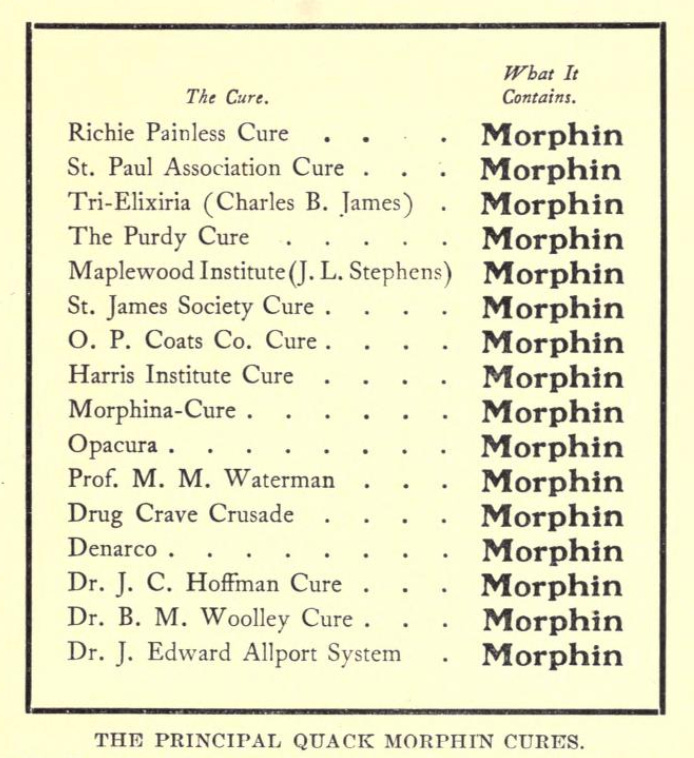
At the turn of the century, Americans were taking all manner of tonics and tinctures for what ailed them — and those bathtub remedies were some mixture of nonsense herbal cures, alcoholic bitters, and straight up narcotics. Even you remedy for opium dependancy was likely to contain opium. And Adams was here to bring it all down. The Pure Food and Drug Act was passed the year after his article ran. (It had been stalled in Congress for a quarter century.)
But what made Adams’ investigation so effective?
It would have been easy, for example, to just buy a bottle of Dr F. E. Grant’s miracle cure for "fits, epilepsy, or falling sickness” and show it to be of no greater help than a stiff drink.
Indeed, many had been doing exactly that, and for decades. But people, terrified by the high mortality rates at the local hospital, placed a deep trust in their local apothecary. And these patented medicines played to their belief that natural and medicinal cures were both effective and safe. (For more on this history, Kaz Rowe produced an incredibly interesting deep dive into this history.)
This had been a reality for decades.
What made Adams’ article so impactful was the exposure of the system that allowed these lies to fester, take hold, and withstand scrutiny. Because by the time his article had come out, the choice between swamp root and a hospital was no choice at all. So why did the industry survive?
“The strongholds of the fraud are dailies [daily newspapers], great and small, the cheap weeklies and the religious press,” he wrote. “Study the medicine advertising in your morning paper, and you will find yourself in a veritable goblin-realm of fakery, peopled with monstrous myths.” It was reported that the newspapers made more money from the ads for these lousy cures than the snake oil salesmen made selling them.
He wrote how testimonials from prominent doctors, businessmen, even senators graced bottles and advertisements for these useless remedies — endorsements sometimes bought, sometimes swindled. He exposed how these fake medicines were big business for certain unscrupulous marketing firms. He underscored how the broken government patent system allowed this fraud to prosper. He exposed how the industry kept both journalists and politicians onside, and quiet about their shady business.
In other words: He wasn’t out to tell people that their beliefs or experiences were invalid — that Coca Cola did not, despite its advertising, cure impotence — he wanted to show how the system enabled this wretched fraud.
And, yes, he called a significant portion of America gullible.
Adams’ investigation prompted change. But Congress did not strike a blow against the predatory industry by banning elixirs or shuttering the businesses that hawked them. No, it simply required that every patent medicine must list its ingredients, right there on the tin. It was the beginning of what would become the Food and Drug Administration. Armed with the right information, more and more people abandoned the quack cures and opted for safe, reliable alternatives. Transparency turned out to be a very effective cure.
Smart businesses quickly pivoted away from their booze-and-cocaine-filled slaves — and they have become the cola brands we love today. Many brands died. Some, however, are still around.
Vick's Magic Croup Salve, rebranded as Vick’s VapoRub, is probably no more effective today than it was in 1989. Lydia E. Pinkham's Vegetable Compound, marketed to help women deal with their regular hysteria (caused, of course, by a wandering uterus) is still sold today.
Many of them live on today in the exploitative quackery designed to trick the vaccine-skeptical. The Wellness Company’s Signature Series Spike Support Formula, a $76.99 bottle of pills full of good natural stuff “researched to block and dissolve spike proteins inside your body.” (We explore this grift in Dispatch #56)
Almost every ingredient on the back of the bottle has its roots somewhere in the patent medicine era. Irish sea moss? Step right up, try a taste of Kirk’s Irish Moss Cough Balsam and you’ll be yodelling from the alps in no time. Green tea extract? Lau Yit Cho’s Chinese Herb Company would mail you a personalized tea for just $10, sure to fix whatever your affliction — be it syphillis or cancer.2 Dandelion extract? Well Dr. Henley's Dandelion Tonic was sure good for rousing the torpid liver.

There will always be quack remedies and magical tonics. There will always be some hope that roots and leaves hold some restorative property we haven’t entirely understood yet, and that may not be entirely misplaced. (Do I guzzle green tea when sick? Yes.)
But what broke this predatory business’ hold on the public — relegating it to natural food stores, farmers markets, and Infowars’ online shop — was exposing this racket, and ensuring that people have access to the right information to make their own decisions.
I fell, spiralling, into this train of thought this week after getting into a discussion with some people on Bluesky about news that Facebook and Google are surrendering in the fight against disinformation. The Washington Post offers a prime example.
Earlier this month, the founder of a musical cruise company posted a screenshot on Facebook appearing to show Illinois Gov. J.B. Pritzker (D) signing a bill that would allow undocumented immigrants to become police officers and sheriff’s deputies. “In Illinois American citizens will be arrested by illegals,” reads the post, which has been shared more than 260 times.
Fact-checkers at USA Today, one of dozens of media organizations Meta pays to debunk viral conspiracies, deemed the post false, and the company labeled it on Facebook as “false information.” But Meta has quietly begun offering users new controls to opt out of the fact-checking program, allowing debunked posts such as the falsified one about Pritzker to spread in participants’ news-feeds with a warning label. Conservatives have long criticized Meta’s fact-checking system, arguing it is biased against them.
It’s easy to describe this change, as the Washington Post does, as a game of follow-the-leader with Elon Musk at the front.
But that’s not what’s happening. Facebook is abandoning the fact-check, and its broader effort against disinformation, because it is a fight they are losing, and were always destined to lose. While many may believe that this is a fight against misinformation, they know the truth: It became a war against the paranoid aspects of the political right. And now, assessing the battlefield, they want to stay neutral.
The proliferation of lies is an old problem, as the long reign of patented medicine shows. But the mass media era means the sheer volume of lies is impossible to quantify, much less control. Paranoid populism requires the weaponization of misinformation, and it turns those lies into a litmus test for political belonging.
When the media encountered Donald Trump’s political project, we thought the fact-check could be a pseudo-scientific apparatus. They hoped readers would see it as an instrument to objectively measure truth. You collect a statement from the wild, put it in amber, and stare at it through a microscope — measuring the furry rust-colored belt along its abdomen. You report your findings in a tiny text box that appears whenever someone shares a QAnon meme on Facebook.
Social media loved the fact-check. It was more content for their feed. A new way to provoke arguments between users. And it made their media partners happy — and more likely to forget about the fact that they had plundered the online advertising system, essentially bankrupting most of the news business.
So news outlets and social media banded together to hunt lies and protect true facts.
Neither told you the dirty truth at the heart of the fact-checking industry, however. For a fact-check to ‘work,’ it requires that people want their facts checked, to trust the fact-checker, and to be open to abandoning their facts. Too often, these things are not true. So what happens when you continue to bombard those people with the fact-checks anyway?
Well Trump’s exit from the White House prompted a lie so big it launched an insurrection, driven by self-styled patriots who consider belief in misinformation a badge of honor. That’s not a great sign, is it?
The data we have shows that the endless voice-of-god “well, actually-” articles did not disabuse believers of misinformation of their incorrect ideas, nor did it contribute to some broader improvement in news literacy. For some, it corroded the idea that newspapers were capable of independent fact verification. It created a victim complex. Trust in the news media plummeted.
Worse yet, so much of our work from recent years has been conducted with the lie-peddlers themselves: Social media. Meta, Google, Twitter convinced the news industry and they were an integral part of the news ecosystem. But they never had the best interest of news or democracy in mind. They wanted to maximize on-platform time, to increase their stranglehold over the advertising market, and to make themselves an integral part of the internet ecosystem.
And, for some reason, the news industry bought into all of it. We ran their fact-check divisions and took their money to combat misinformation. It did no measurable good, but it certainly drove a lot of engagement for the platforms.
The Republicans, seeing an easy target of sneering holier-than-thou elitism cooperating with powerful billionaires who control the means of free communication, opened fire. It was ruthlessly effective, as we can see from social media’s current retreat.
Today, unsurprisingly, the platforms are realizing that there is more revenue to be gained from letting people unplug from the fact-checked universe they helped create. So that’s exactly what they’ll do.
This was all a mistake.
Fact-checking is an integral part of journalism, not some elixir that dispel lies. There will always be a time and place for the standalone fact-check. Snopes and Politifact are useful niche websites to figure out if Marilyn Munroe really had six toes or whether the hurricane shark is real this time. But it’s time to retire the format as a daily bulletin for the professionally-approved truth.
Journalism can make an impact, through critical coverage like Samuel Hopkins Adams’ bombshell reporting. Tough scrutiny that goes beyond rating individual statements, and instead studies and exposes systems of power, is what changes minds. There is a lot of this work already being done, of course, but we wasted a lot of time, energy, publicity, and money on these stupid, splashy stunts.
The media needs to learn a lot more about why people believe in misinformation (Dispatch #58) and how bad actors weaponize information. The media needs to stop taking social media money to explore new ways that social media can solve the problem that social media created. (Dear Facebook: If you want to give me money to further explore this idea, I accept all major credit cards.)
And it is high time we start calling for some kind of a Pure Food and Drug Act for the internet: Not to mandate that the snake oil intermediaries moderate themselves better, but to force them to tell us what’s in their products. We need to regulate social media in such a way that doesn’t entrench their position as arbiters of truth or extensions of the news media, but which breaks their advertising monopoly and exposes their shady practises.
People are going to lie: About wayward spiders, about miracle elixirs, about stolen elections. We can’t stop that, or strong-arm every single person inclined to believe.
We can dismantle the systems that allow these lies to take hold.
That’s it for this week!
I moved in to a new office this week — one which, I hope, will double well as a mini podcast studio. Stay tuned for that.
Until next week.
The British South Sea Company was a notorious scam. The ponzi scheme was arguably the world’s first stock crash.
The company was actually run by Lou Wing, who was later reprimanded by the Postmaster General by committing fraud through the mail.
I continue to be amazed that the Wikipedia has found a way to moderate all dissension about their articles, remains at least basically-trusted. The fact that it is one of the few information sites that is not trying to make money should be noted.
Journalism may imagine it has "peer review" in that they all criticize each other, but they might consider going to academic peer-review standards: everybody contributes time to a pool of reviewers, assignments are random, reviews are anonymous.
Media organs participating get a seal of quality of some sort.
A fascinating and thoughtful analysis as always, Justin. You argue convincingly for the media's over-reliance on fact-checking in the Trump era and for your case that public trust in news media is eroding as a result. Let's not beat up on journalists too.much, though. They had not dealt with such a compulsive liar in such a high office before, and fact-checking jn real time seemed like the best response. What may be a better, though admittedly longer-term project, is to teach people from primary grades on how to spot disinformation and misinformation, to separate facts from conjecture and lies, to question the source of the falsehoods and the motivation behind them. To that end, I recommend the work of Dr. John Cook of the Centre for Behavioral Change at the University of Melbourne and his app, Cranky Uncle. See crankyuncle.com. and no, I didn't make this up! However, even if constant fact-checking isn't the way to go, we do need journalists to keep exposing public figures who constantly use cherry-picking and logical fallacies (*cough* Pierre Polievre *cough*) to fire up their base. Don't call it fact-checking, fine. But keep investigative journalism alive. We need it more than ever.