


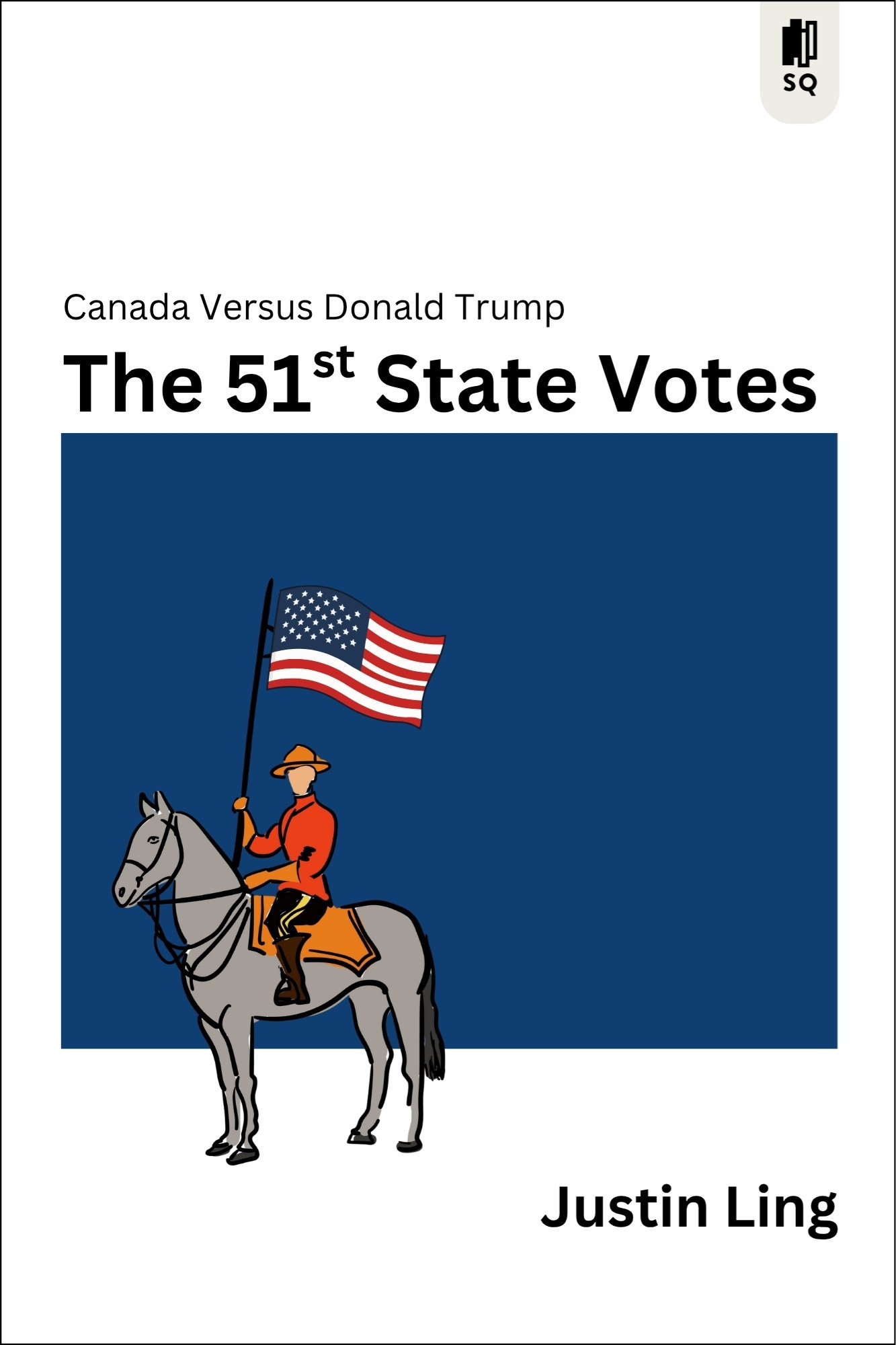
This is a special dispatch to hawk copies of my new book: The 51st State Votes.
The book is both a recapping of Canada’s most recent federal election, and a polemic about the Donald Trump-sized existential threat facing the country.
For my Canadian subscribers, I hope that the book serves as a useful reminder of the degree of the challenge we’re facing, and a cri de coeur about the need for us to get serious and confront it.
If any of my American subscribers want to get a copy, I hope the book serves as a useful window into the destructive impact of Trump’s delusional nationalism and beggar-thy-neighbour trade policies.
And for those Europeans, Australians, and Kiwis on the Bug-eyed and Shameless mailing list, I suspect this book will be a useful parallel to the exact kind of political fights happening in your country right now.
The book itself is a breezy 100-ish pages, and covers both the lead-up to the last federal election, the campaign itself, and comes right up to the G7 summit in Kanasaskis, Alberta this summer.
You can pick up a copy directly from Sutherland House Books, or you can find it at your local independent book store or library. (If they don’t have copies, ask them to order some!) For paying subscribers, I have a handy 25% off discount code at the bottom of this newsletter — beneath the paywall.
Below is a brief excerpt, so you can try before you buy.
By the time U.S. Brigadier General Winfield Scott crossed the Niagara River in the War of 1812, his side had mostly known humiliation and defeat at the hands of the British. Yet in July 1814, he invaded the Niagara Peninsula with enormous confidence, certain that his assault would be a turning of the tides.
Dressed in a heavy coat and high boots, sporting his sword and pistols, the ambitious Scott rushed to step from his boat to shore and charge the British. He misjudged his landing and fell into the river, his head sinking below the waterline, his high boots sucked deep into the muck and silt. His men reached in to pull their commander up, ensuring the only damage would be to his dignity. Nevertheless, it was an inauspicious start.
Scott would go on to lead his infantry to victory at the Battle of Chippawa and fight to a draw at Lundy’s Lane, a few kilometres from the majestic Niagara Falls. But like his landing in Canada, Scott’s reach would exceed his grasp. The Americans were unable to make real gains on the peninsula and ultimately retreated to New York. The two sides traded wins and losses. The biggest symbolic blow came later that summer when the British rowed all the way to Washington, D.C, and razed the White House. On Christmas Eve, 1814, a peace was signed.
It may have been an end to war, but it wasn’t kinship. Two decades later, a group of Canadian rebels calling themselves the “Patriots” began to organize an uprising against the British, with help from supporters in America. In 1837, they seized an island in the Niagara River and declared the Republic of Canada. The loyalist militias responded, seizing the rebel steamboat, Caroline, setting it on fire and letting it drift off the falls. In the internecine violence, one American was killed.
Winfield Scott, the hero of Niagara, was dispatched by President Martin Van Buren to quell the tensions that emerged in the border states, as the Americans called for revenge. “If you want war, I need only look on in silence,” Scott wrote to the president. “But if peace be your wish, I can give no assurance of success. The difficulties in the way will be formidable.”
The president chose peace, and that’s what he got. In each local conflict, Scott negotiated a reasonable outcome to avert war. He was so impressive in his ability to avert escalations that a British commander nominated Scott for a medal from the King, an honour that Scott had to refuse. But Scott’s ability to negotiate difficult peace came to define the cross-border relationship for a century and a half.
“For over 150 years, we’ve found a way — in true Canadian fashion — to disagree agreeably, to choose diplomacy over division,” said Mark Carney on April 18, 2025, as the wind whipped the pages in his hands and Niagara Falls crashed in the distance behind him.
“The depth of that kinship is symbolized here, where the border runs between Niagara Falls,” he went on. “The falls come from the same river—divided into two very different experiences—before reuniting to move forward. On each side, there is a town with the same name. Over centuries, the two Niagara Falls have demonstrated that collaboration, not conflict, is the path to great prosperity.”
It was heavy symbolism. But standing across the rooftop from the Liberal leader, it struck me as apt, given the weight of the Trump threat. “Unfortunately, that’s all changed,” Carney continued. “And it wasn’t us who did the changing.”
If you could criticize Carney for anything, it was not going far enough. In just the first three months of 2025, Trump had threatened Canada, and unilaterally announced, enacted, and suspended so many tariffs on us that it was difficult to keep track of what, exactly, was subject to the import duties. After his Liberation Day, Trump had insisted that his global tariffs were both a punishment for the rest of the world and a remedy — a means to get other countries at the table to negotiate new deals favourable to America. But when it came to Canada, Trump was blunt: The tariffs are a means to territorial expansion.
As April wore on and election day came into view, Trump sat for an interview with Time. The journalists suggested that when it came to gobbling up Greenland and Canada, perhaps Trump was trolling. “I’m really not trolling,” Trump interjected. Running through his usual grievances about the trade imbalance, Trump went on: “We’re taking care of their military. We’re taking care of every aspect of their lives, and we don’t need them to make cars for us. In fact, we don’t want them to make cars for us. We want to make our own cars. We don’t need their lumber. We don’t need their energy. We don’t need anything from Canada. And I say the only way this thing really works is for Canada to become a state.”
Time asked a shockingly direct question: “Do you want to grow the American empire?” Trump delivered a chillingly cavalier answer: “Wouldn’t mind.”
That day in Niagara Falls, Carney crystalized that pitch he had been making throughout the campaign: Trump was trying to reorder the global economy; he was threatening our workers, retirees, our culture, our language, our businesses, and our resources. This was not an aimless or confused exercise: It was an intentional campaign to seize the country. “President Trump is trying to break us, so America can own us.”
Carney, as I’ve said, offered a refreshingly blunt assessment of the threat. But as we entered the home stretch, it occurred to me that Carney’s tonic was more diluted than he let on. Reciprocal tariffs, the obvious move, had been drawn up by his predecessor. Carney wasn’t keen. His main campaign planks — removing interprovincial trade barriers, fast-tracking energy projects, doubling home construction, designating new national parks — might’ve felt ambitious in regular times but started to feel like a limp response the more we contemplated the scale of the threat.
The fact is, both Carney and Conservative leader Pierre Poilievre had a piece of the answer. The Liberals were right to sketch out Canada’s pivot to Europe, and the Conservatives were right about the need for strength at home. When it comes to recapitalizing the Canadian military, there’s no doubt that joining Europe’s defence industrial base would be a boon, but it will mean nothing if we can’t untangle our moribund procurement system and instill the Canadian Armed Forces with an actual purpose. Yes, we need to become productive again, but that can only be done by cajoling cities into reducing gridlock, building new homes, and ending the reign of NIMBY. Ottawa needs to scale up exports of its energy products, but it can’t do that if it is shackled by endless consultation and review. To do big things again, we need a civil service that works, and we need to recognize that, right now, it doesn’t.
Both men spoke of these problems, sometimes in bits and pieces. But Carney’s remedies fell too often into wishful thinking, whereas Poilievre put far too much faith in the idea that wielding a stick could solve all problems.
While no politician can strike the perfect balance between building muscle at home and showing flexibility abroad, the fact is that Canada needs a leader capable of wanting peace, knowing it’s difficult, and capable of conflict, if need be — someone who can fight a trade war, for sure, and also do battle with the status quo at home.
That’s it for this mini-dispatch — I’ll be back in just a few days with a full, proper newsletter.
