



The Hanseatic League were a shrewd bunch.
For a solid two centuries in the Middle Ages, the League — comprising some 200 towns and cities, including Danzig and Cologne, stretching from the modern-day Netherlands to Russia — dominated the most profitable trade routes in Europe.
The League wasn’t a military pact, per se, but it had powerful friends, in the Knights of the Teutonic Order. And it had a virtual monopoly on major trading ports, including London, Bruges, and Novgorod — moving wool and cloth from England east through the Danish Sound; then grain, copper, and furs from its members westward.
The League was very good at keeping this status quo in place. Its negotiators were always ready to set sail and set new terms, if need be. Where negotiations failed, it would simply suspend trade with any city which challenged its monopolies, moving the Hanse trading house to a rival city. Only when softer tactics failed would the League go to war.
England had a complicated relationship with the Hanse. The League had helped finance their Hundred Years War, but it was also an annoying rival for their own trade ambitions. Both sides maintained an awkward understanding — at least until the Merchant Adventurers of London blew things up.
The wealthy English traders had decided to set sail and challenge Hanse supremacy — often through privateering and piracy — in hopes of establishing their own trade monopoly. The League retaliated with blockades. Because of that, the League and the English found themselves in a trade war.
For fully a century, the Hanseatic League and England skirmished. The Hanseatic League blocked English trade, and prompted rounds of retaliation and counter-retaliation. English privateers seized Hanse ships, and the League seized English goods in response.
Edward IV signed a deal with the League to stop the feuding: The Treaty of Utrecht. The deal represented “the pinnacle of Hanse power over England,” writes professor John Conybeare in Trade Wars.1 The Treaty of Utrecht returned most of the Leagues’ old trading privileges “while obtaining virtually nothing for English traders in the Baltic.”
The outcome was a stalemate, of sorts, though the League certainly won on points. They remained the stronger alliance, and England was forced back into recognizing their trade monopoly.
Today, though, we know who really won. England went on to become the preeminent global economic powerhouse, while the Hanseatic League has become a historical footnote.
But the why of the Hanseatic collapse is what’s truly interesting.
“Both wished to tax each other’s trade so as to reap monopolistic profits on both the import and export trade,” Conybeare writes. Technically, both sides saw marginal gains thanks to their various aggressive actions and taxes, he observes, “and each preferred to retaliate rather than be exploited.” And yet the result was “mutually debilitating trade restrictions.”
The logical thing to do — what they should have done, Conybeare concludes — would have been to put aside the trade war and exchange goods freely. And therein lies the puzzle that would come to define all future trade wars. Two actors, at cross-purposes, are almost always better off collaborating than trying to take the other down, and yet things all too often slide into feuding. It’s the Prisoners’ Dilemma on a grand scale. That is: If both sides opt for compromise, they both obtain a marginal win. But both sides know that they would benefit more of they were to implement protectionist measures, so long as the other country doesn't reply in kind. But, we know, the other country usually replies in kind.
Indeed, the Hanseatic League and the English repeatedly came to relatively good terms. And yet they always fell into more trade wars. It bears studying, Conybeare writes, “why several hundred years of repeated plays of the game could produce no lasting cooperation.”
A core reason, Conybeare found, was disunity. While the English Crown was constantly trying to return to stasis, various lobbies and groups within the country were keen to restart the trade war. In the League, meanwhile, there was no single crown — and the various fiefdoms and city-states were constantly undermining each other and the embargo in order to trade with the English. This network of different power bases suffered from a “higher degree of internal paralysis.” And, in the long run, the internal schisms spelled the end for the Hanseatic League altogether while the even-more-shrewd ambition of the English propelled them to become the largest mercantile empire in the world.
If we are to boil down this trade war into its simplest terms: Neither side won on price, nor on quality of goods, nor efficiency of output. Neither the Hanseatic League nor England found the exact concoction of tariffs nor did they find the perfect end-run around the others’ embargo. Both sides continued fighting, in part, because of competing interests internally.
But England won the trade war, at least in the long term, because it was more united than its adversary.
This week, on a very special Bug-eyed and Shameless, we consider how to win a trade war. It is, I argue, not a matter of economics — but a function of information warfare.
In his exhaustive book on the trade war, Conybeare comes up with a rather frustrating assessment of why trade wars escalate into this mutually-destructive spiral. In some cases, he writes, both sides convey a commitment to compromise whilst secretly believing that the other will be first to fold — “a tactic that makes little sense in a Prisoners’ Dilemma game,” he writes.
In other cases, tariffs are deployed without appreciating that other nations will retaliate, as was the case when the U.S. Congress enacted the Smoot-Hawley tariff in 1930. But once nations fall into these fights, they become tit-for-tat, even when it causes pain. “Actors in economic games develop rational expectations,” he writes.
There’s good news, Conybeare concludes. “All trade wars are iterated, but some are more iterated than others.” That is to say: The more we do this, the more we learn. Trade wars are getting more targeted, less violent, and shorter — they now last a few years, not a full century.
To fight a trade war today is to believe that your effort to eke out an advantage must be so minute or well-justified that the aggrieved nations won’t bother responding, or that any spat can be a useful catalyst for a more mutually-beneficial deal.
Smoot-Hawley was a powerful lesson. America launched a trade war with the world — simultaneously prioritizing domestic industry while demanding better trade terms with the world — and it backfired. The tariffs prompted waves of retaliation and trade barriers, collapsing a fledgling global trade network and exacerbating the Great Depression.
Nobody has been, frankly, stupid enough to try it again since, at least not on that scale. (Until recently.) On the contrary, the World Trade Organization and other global bodies were established to become an alternative to trade wars, a way to remedy disputes without resorting to peashooting. They helped everyone solve the Prisoners’ Dilemma.
There is a possibility, Conybeare writes, that some large nation will opt to inflict a trade war on a smaller partner. But, he says, we don’t really know how that might go.
The basic logic of a hegemonic power imposing trade restrictions on a smaller country, Conybeare writes, is that the big power will have little incentive to stop and the little power will have every reason to concede.
The United States, in particular, could launch a series of bullying economic attacks on smaller nations, perhaps setting predatory tariff levels on strategic industries. It would be a divide-and-rule campaign to raise government revenue, destroy their export industries and/or force them into lopsided trade deals.
The money raised won’t be huge, he cautions. And really boosting domestic industry would be tough. And, he continues, things get shaky if “the small country is willing to inflict costs upon itself in an attempt to change the large country’s tactic to one of cooperation.”
But, he goes on, “if large countries are interested solely in maximizing their national incomes, they might go a long way toward this goal by raising trade taxes against smaller countries.”
Conybeare repeatedly cautions: This is not a good idea. But, hey, someone was bound to try it.
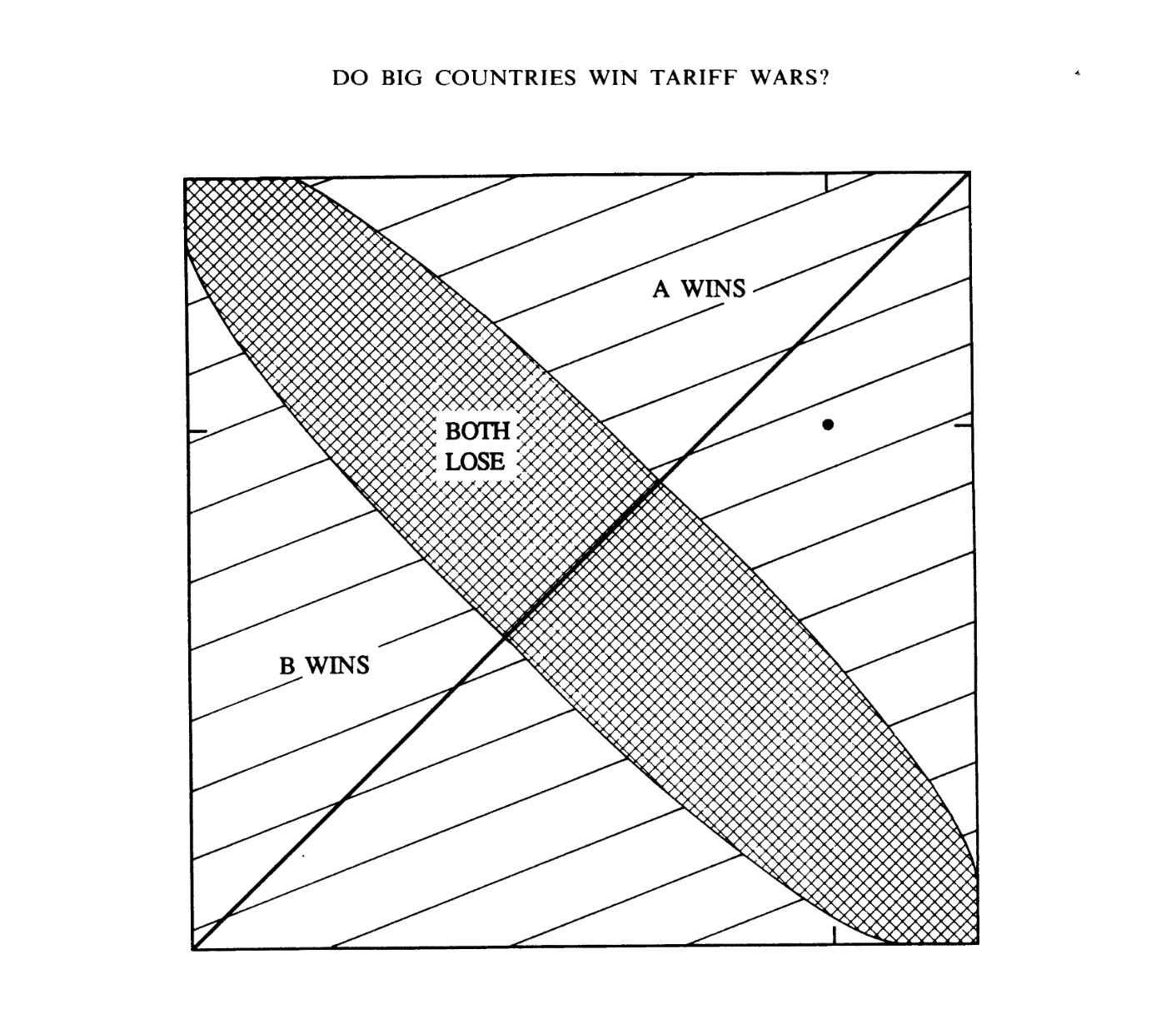
Here’s a tricky problem at the heart of trade economics: We don’t really know what ‘winning’ a trade war means.
While Conybeare’s seminal Trade Wars put a lot of the game theory on the table, the book still didn’t really answer the question: By what means does a country emerge from the trade tiff richer? And do tariffs really force the participating nations back to free trade, albeit under different terms?
In 2019, three Australian economists took the question head-on, asking: “Who Wins a Trade War?”2
They provide a blunt answer in the opening paragraph of their paper: “A country wins a trade war if it experiences higher welfare in a world of optimal protection than it would under global free trade.”
Well, duh.
But dig deeper, and the major factors of winning or losing become more clear.
The price elasticity of demand matters a lot. If tariffs force the cost of a good to double, to what extent do consumers opt not to buy it, buy much less of it, or buy a cheaper (and non-tariffed) alternative? If demand for the tariffed goods is quite elastic — that is, flexible — the damage will be blunted.
It matters, too, whether domestic production can jump in to replace the imported goods of the warring nation, even if this isn't an ideal outcome. If Country A can grow and process wheat for $1.45, but can buy it from Country B at $1, then it will likely import. If Country A places a 25% tariff on Country B, but can’t bring its own domestic costs down, wheat will simply cost 25% more. At 50% tariffs, though, that domestic wheels of production may start to turn.
The degree to which importers can internalize those price increases matters, too. If importers are capable of eating the duties without passing on the costs to consumers — or, if governments have the fiscal firepower to help subsidize the losses — the other country’s taxes won’t be so greatly felt by the public.
The number of participants in a trade war is also relevant. The Smoot-Hawley tariffs pitted the United States against the whole world, meaning America had no safe port in the storm of its own making.
And, of course, size matters. In 1988, two economists from the University of Iowa put together a theoretical framework and came to the conclusion that “if one country is substantially bigger than the other, then the big country can expect to gain by starting a tariff war.”3
All of this still brings us back to the central premise that prolonged trade wars are bad. Where tariffs restart domestic production, or where producers eat the cost of tariffs, the country is still worse off. It is less efficiently to produce fewer goods and force producers to accept less profit. And for what?
But back to the Australian economists. Because, despite us knowing these variables, there have been too few trade wars, each too complex and somewhat inconclusive in their own bizarre ways, to make firm conclusions.
Here, the Aussies tried to nail some general suppositions:
A country that is sufficiently large relative to its trading partner will win a trade war;
In a Heckscher-Ohlin model of trade [which holds that countries export goods from resources they have abundant, and import when they lack those inputs] the magnitude of a country’s welfare gain or loss from a trade war will shrink the more similar are its relative factor endowments to those of its trading partner
A country with a sufficiently large degree of substitutability in its preferences will win a trade war; and
Contrary to the existing literature, a small country can in some circumstances win a trade war against a larger rival
They ran a series of simulations to test those suppositions. Some findings were unsurprising: Yes, all else being equal, a large country will win a trade war. If a large country really effectively prosecutes said war, it can even tilt global trade to its benefit, becoming functionally addicted to its trade warfaring.
They did find, perhaps unsurprisingly, that countries whose domestic manufacturing is only slightly less efficient than their foreign competitors tend to do better.
But it’s those 3rd and 4th points which are far more interesting. They come down to a single variable, which they name σiC. That is: “The elasticity of substitution in consumption of the representative consumer in [a given] country.”
Put even more plainly: If consumers in Country A can switch their consumption habits more readily than consumers in Country B — to more expensive domestic goods, to equally competitive foreign goods, or to simply stop consuming those goods altogether — then Country A will probably win the trade war.
This conclusion suggests this factor could produce a David and Goliath scenario. The data “suggest that this may make the identification of trade war winners more difficult in practice than simply identifying countries with relatively high GDP.”
This conclusion is not iron-clad, because the data are still lacking. And it’s unclear just how much size difference this consumer power can overcome.
But nevertheless, it is a strong bit of evidence to suggest that agility can mean more than size.
In 1986, Bill Heine stuck a 25-foot fibreglass shark in his roof.
Heine’s neighbors in Headington, the posh suburb of Oxford, were unsurprisingly horrified. Installed to commemorate the anniversary of the nuclear bombing of Nagasaki, it was meant to convey the shocking horrors of war: Nobody asks for their home to be bombed, any more than they seek out a shark fired through their roof.
One future neighbor, a student at the university, appreciated it. His name was Mark Carney.
“Over the years, I have thought back to the shark because it isn’t just nuclear fallout that spreads across borders, but financial instability, cyber-crime and climate chaos,” Carney writes in his book Value(s).4 “To what extent can a country wall itself off from these sharks? And for those that try, what opportunities in trade and investment, ideas and creativity do their citizens forfeit?”
Carney is, it should be no great surprise, a big fan of free trade.
He spends a chapter of his book extolling the virtues of British economist David Ricardo, a successor of Adam Smith. Ricardo’s endorsement of free trade turned on the that protectionism, eventually, creates a spiral of economic inefficiency.
Ricardo first thought through this problem in a treatise against agricultural tariffs. If the United Kingdom blocked the import of corn, he argued in 1815, then they would need to find more domestic land to grow the corn and more machinery to make that land suitable. They will need more workers, even though employment was rather full. You will spend more to exploit less-fertile land and pay workers more to do it: All that raises prices for consumers while zapping corporate profits, which would otherwise go towards investment.
Why, Ricardo wondered, would you want that?
As Mark Carney observes, looking back on Ricardo’s essay: “It is better for the country to exchange on more advantageous terms with its trading partner than within its own economy with its own labour.”
The same ideas which prompted London to tariff cereal imports two centuries ago are back with a vengeance. Nationalists have pursued “a narrow, transaction-based sense of nationhood” in which trade wars become both an economic and cultural tool to exert independence. But trade for trade’s sake is no good, either, Carney writes. Offshoring your supply chains to countries of radically different values — dumping toxic chemicals, forced labor, so on — is no good.
Instead, economic cooperation with other like-minded countries can be both an economic boon and something the citizenry can be proud of.
What is needed, Carney writes, is the “opposite of such egotistical nationalism.” A model of global cooperation that is driven not by a quest for total, unapologetic efficiency. That middle ground, Carney argues, is patriotism.
You can’t put up a wall to stop the sharks from crashing into your roof, no. But you can form links with other countries who want to prevent the sharks from raining down in the first place. A positive globalism that promotes economic efficiency without outsourcing everything to poorer countries which allow slave labor and environmental destruction. If you do it right, people will be rather excited about the prospect — and you just might do better than the nutters who are building the flying shark walls.
Herein we arrive at my point: Economics tells us that protectionism is stupid. It breeds inefficiencies, often more to satisfy a self-defeating kind of emotional nationalism than in the name of actually supporting domestic workers. Weaponized protectionism — trade wars — is stupidity multiplied. Insofar as trade wars can produce a ‘winner,’ the gains are usually short-term and tend to leave everyone worse off than they were before.
But if you find yourself in a trade war against your wishes, economics tells us, you may as well fight it. And while economics can tell us the criteria that makes a trade war winner, it can’t actually tell us how to get there.
How does an economy promote high substitutability? How can we make demand for the goods of the trade aggressor more elastic? The literature hasn’t gotten there yet.
That’s because trade wars are not really a function of economics. They are information wars.
Today, nations find themselves fighting a trade war with the world’s largest economy. The United States and Donald Trump are imposing tariffs on the world, using a shifting set of justifications and laws to do so, trying both to reap the short-term and illusory benefits of protectionism whilst shaking down concessions from its trading partners. It is trying to prove the idea that big countries win trade wars and to prove David Ricardo wrong, all at the same time. The rest of the world knows how truly stupid this is, yet seems paralyzed in fear of what would happen if they fight back.
Canada, now led by that egghead Mark Carney, is fighting back.
And I think Canada can win.
Last year, I invoked the history of the Empire Marketing Board to argue that positive propaganda can help like-minded nations band together by inspiring citizens to think of trade at a local level. (Dispatch #129)
What I was describing was, to keep using this clunky economics word, substitutability promotion.
But back then, we were dealing with sectoral tariffs amid the prospect of real trade negotiations which, many hoped, would produce better deals — which had been the outcome of Trump’s last trade wars, fought in his first term.
Today, sensible nations should abandon the prospect of a real trade deal with America. Unless sovereign states are prepared to bake in American tariffs, to surrender some sovereignty in how they craft their own laws, and to offer up a raft of concessions — sacrificing part of their more-efficient industries to Trumpland, buying more American military hardware, or accepting planeloads of abductees — they should get ready to fight back.
But fighting back is not just a function of raising tariffs higher or targeting the exact right American goods. Fighting back means figuring out how to get your factories, processing plants, and consumers opting for non-American inputs — and reducing inefficiencies as much as possible. It also means convincing citizens to accept those inefficiencies, through less diversity of goods or higher prices, as a necessary cost of fighting. That isn’t something that can be done through act of legislation or by government edict. That needs to be a whole-of-society response, encouraged by propaganda but enacted by individuals making different choices.
Earlier this month, Le Journal de Montréal visited markets around Quebec to ask shoppers how they’re reacting to the trade war. What they heard was a collection of people who were finding new ways to make their demand for American goods far more elastic.
They met Paola de Vasconcelos at Jean-Talon market in Montreal’s Little Italy, who said she was absolutely motivated to seek out Canadian-grown produce instead of the (often cheaper) American-alternatives. “These last few times, I was a bit soft on that front,” she told the paper. “This time, I’m not going soft.” It was “liberating,” she said, to not bend over backwards to placate Trump. So now she was doing her part by ignoring American goods.
“If I want raisins, I’ll buy them from South Africa,” another shopper told the paper. Others said their community organizations were trying to opt for more Canadian-grown goods, even if it took some doing to make the math work.
One fruit vendor remarked since the start of the trade war, “about 50% of my clients put the goods back on the shelf if I tell them it’s American.” (That is backed up by survey data from early this year, which show more than half of Quebecers were actively boycotting American goods.)
It’s not the only part of the strategy, of course. Canada is also obsessively finding new trading partners the world over — something a pariah America can’t properly do. It is building big new things and finding new countries to build them with. It is trying to make domestic production more efficient, to stock the shelves and factory floors with goods made more efficiently than American imports.
That’s part of the story behind a new fleet of icebreakers Canada is building. “Right now, if you want an icebreaker, Davie is the first call you’ll make,” Marcel Poulin, vice president of public affairs for Davie Shipbuilding, told me.
Davie uses plenty of Canadian-made steel, but the plain fact is that America remains the go-to supplier for advanced steel — but, perhaps, not for long.
“If you need steel for icebreakers, you need EH36,” Poulin says, referring to a specific grade of shipbuilding steel. It’s this grade of steel that lets you cut through the heavy Arctic ice.
While Canada tends to rely on American steelmakers for that grade of steel, Poulin points out: “It’s basically the same steel that you use on bridge, but it does not have the same classification. But it’s very similar recipes. So we are working to say: Okay, can we use the same steel that they’re using on bridges on icebreakers?”
The answer to that question, which is being studied by the Université du Québec à Chicoutimi, has some pretty big implications. If the answer is “yes,” then it could mean that Algoma Steel — in Sault Ste. Marie, Ontario — is supplying those new icebreakers, not American producers.
For all this to work, you need both a popular, grassroots effort and a coordinated central response. And Canada, right now, has both.
You need no better proof that such a strategy is working than to hear the executives of the major banks brush off the prospect of a trade war and sing the praises of a glorious Canadian future.
We can thank Donald Trump for both this solidarity and the amount of fiscal firepower Canada has to back up its efforts. His constant Canada-bashing — exemplified by, amongst other things, his attempts to rename bodies of water — coupled with surging oil prices brought on by his flailing war in Iran has meant that Canadians are angry and richer because of him.
Americans themselves, meanwhile, are bewildered as to why Trump is fighting a trade war amidst a cost-of-living crisis. While there may be a high elasticity of demand for Canadian-made goods, Americans can’t exactly quit all imports cold turkey. Tariffs, per the Tax Foundation, now hit more than half of all goods imports to the United States.
Continued success for Canada — and whichever other nations opt to fight instead of surrender — is by no means a given. But we can and should count on disunity in the American ranks. Regular people, entrepreneurs, and big corporations alike are going to start openly wondering why they’ve become hoplites in this trade war.
And, just like the Hanseatic League six centuries ago, the United States may soon find itself facing that same kind of internal paralysis.
Greetings from Brussels, where I’m part-way through my extended vacation.
I had hoped to get this trade war piece finished before I left, but frankly I’m glad I didn’t — the past few days meandering through Europe has reinforced my belief that people are spoiling for a fight with the mad American king. What’s holding us back are leaders unwilling to stick up for themselves.
I’ll have plenty more to say about that in the weeks to come.
In The Star, I’ve got a screed denouncing American Big Tech (again), a deep dive into Canada’s new icebreakers, and a call-to-arms on the trade war itself.
Trade Wars: The Theory and Practice of International Commercial Rivalry, John Conybeare (1987)
Who Wins a Trade War?, Mark Melatos, Pascalis Raimondos and Matthew Gibson (2019)
Do Big Countries Win Tariff Wars?, John Kennan and Raymond Riezman (International Economic Review, Feb., 1988)
Value(s): Building a Better World for All, Mark Carney (2021)
A solid, well-researched and thoughtful read. History may not repeat, but it does rhyme!
Brilliant!
For your interest, an in depth discussion with Thomas Karat and John Perkins.
https://karat.substack.com/p/the-economic-hitman-is-back