


The Magna Carta was not quite, as many like to believe, a clipping of the wings of the English monarchy.
Yes, the landmark document “defined the interests and conduct, as well as the obligations, of the king and the barons,” professor Peter Jones argues. At a time when the central state was expanding out from London, the Magna Carta “prescribed the king’s power so that he could not use it as a political or financial weapon.”1 But that power had to go somewhere.
As Jones argues in Corrupt Britain, this new system of rights and obligations also created shady dealings and strange relations.
Guilds, barons, freeholders, and farmers could write in to the Chancery, demanding redress for some unfairness, or to demand advantages or patronage. This generated “an environment of a competition for favours: Subjects petitioned; officers in Chancery could assist a petitioner in his search for security and advantage.” In turn, a new industry sprung up: “A service sector of local lawyers, attorneys, and petty officials.”
The Magna Carta may have given the toiling masses new human dignity, but it also created the real bureaucracy of governance. With that, “the scope for intrigue and corruption was considerable.”
“Bribery and gifts were the lingua franca of the transactions between litigants and the state,” Jones writes. “Gifts reaffirmed social hierarchies between clients and patrons as they were regarded as legitimate.”
The Crown could not be voted out of office, sure, but the king could be deposed, which began to happen more frequently. When he was, he was often slain violently. Wise corrupt kings knew to curry the right amount of favor to stop that bloody outcome from occurring.
As the modern British state formed, and a proto-democracy emerged with it, this strange relationship of bribery and favor-peddling solidified. New rules and ethics were adopted forbidding outright quid-pro-quo payments, but that just generated creative new ways to trade goods for favor.
“The gift was the essential nexus of patron-client relations: patronage and clientage were held together because the relationships were both symbiotic and symbolic,” Jones writes. Payment for favors both solidified the state’s monopoly on power whilst also underlining that the persons of the state were reliant on private money.
As elections became more and more competitive, this system morphed again. This was no longer just a game of the Chancery answering petitions to earn coins and avert revolt, politicians now had to secure their candidacy and find people to come out and vote for them.
“Gentlemen,” wrote Member of Parliament Anthony Henley to a group of his constituents in 1734. “[I am] surprised by your insolence in troubling me.” Henley reminded them: “I bought you.” (His constituents, I’m sure, saw it the other way around.)
In national elections, many seats were simply not contested — the winner had already been decided. Others, however, were fiercely fought, with bribes flying every which way.
“Electors and candidates knew that elections were boisterous affairs with entertainments, free beer, feasting and money gifts which the local residents expected,” Jones writes. The machinery of local elections increasingly involved local agents — responsible for identifying local concerns and wants, and for doling out gifts. (They, too, expected payment.) “Some voters travelled considerable distances in order to vote with the expectation that they would receive overnight accommodation and breakfast.”
A half-century later, as a group of men gathered in Philadelphia to argue and bicker about the future of their radical idea for a nation, they had an obsessive goal: Avoid repeating the rank corruption of Britain.
Enlightened statesmen know better than to forgo impartiality in the name of graft, they wrote. But “enlightened statesmen will not always be at the helm.”
Today, the United States has an unenlightened statesman at the helm, presiding over rank corruption which rivals that of medieval Britain. And yet, President Donald Trump seems to have forgotten how the patron-client relationship works.
This week, on a very special Bug-eyed and Shameless: Why isn’t the president bribing his electors?
“We know exactly what a dollar is: a share of stock in USG [the U.S. government],” Curtis Yarvin wrote. “The dollar has never paid any dividends, though perhaps this will change.”
Yarvin, recall, is a fascist who wants the state to be more like a corporation: One where the CEO rules us mercilessly, informed by court jesters like Yarvin himself. (Dispatches #112, #131, #132)
“Fiat currency is sovereign equity,” Yarvin wrote three times (once in all-caps) to underline his point. That is to say: Holding a dollar in your grubby little hands is like owning a share in USA LLC. (Lest you be confused, the anti-democracy Yarvin does not believe this ownership implies power to the shareholders: “It is just one class of stock, of course, conveying no voting rights.”)
Decades of money-printing and debt spending have bankrupted America, Yarvin believed. It had become a Ponzi scheme, a bloated company that would be incapable of paying its debts if they were called. But perhaps, he believed, a corporate restructuring could save the nation. If the United States simply “converts its balance sheet back to gold,” those shares will be worth something again. That process will be enormously painful — for all except those with considerable gold holdings — but necessary. “America must experience bankruptcy as a whole,” he wrote.
Yarvin’s nuts-and-bolts plan for this is pure economic quackery. He would nationalize all financial assets, split the dollar, return to the gold standard, then sell off all the nationalized assets. His plan, in short, is a manic doodle of an economic system that does not exist, has never existed, and couldn’t exist.
One of the core mechanics of Yarvin’s absurd economic fantasy involves winding up America’s liabilities. All of the state’s funded obligations to its people — Social Security, Medicaid, food stamps — would be shut, their value returned to the public. “Essentially, we are cutting the strings of dependency that bind voters to Washington, not by eliminating their benefits but by cashing them out,” he wrote. “Once said voters understand this model, it strikes me as unlikely that they will oppose it. If there is some problem with this, just increase the allocations by 20 or 30 percent. The yelps will rapidly subside.”2
The ancien regime, — “the old management” as Yarvin calls them — “spent 75 years buying political power with [Washington]’s printing press, surely the new management-” his chosen tyrant “-cannot be excused for doing so on a one-time basis.”
We’ll dispense with the rest of Yarvin’s economic fever dream. What’s more relevant is who was reading it. He published this cartoonish fantasy in 2010, just as his neo-Nazi scribblings were finding purchase with billionaires like Marc Andreessen and Peter Thiel and their acolyte JD Vance.
It may not have happened quite like he described, but America now has a CEO-king who views every dollar in the U.S. treasury as his sovereign asset. And he had a real plan to cash out the American people, while he smashed the state.
In less than two years, Trump has tried to de-globalize the American economy wherever possible, he has forged incestuous relations between business and government, and he funneled money to the business of the sovereign wherever possible. He pretended to go on the maniacal cost-cutting exercise which Yarvin had called for, shutting down whole wings of the U.S. government on a whim, but he gave up pretty quickly. And so he’s kept inflating the debt: Adding another $3 trillion to it in just his first year.
What Trump hasn’t done, though, is pay dividends. And that’s surprising. Because Yarvin is right: It is the ideal way to subdue the yelping.
There have been some limited efforts to bribe Americans with their own money. Late last year, Washington announced the “Warrior Dividend” — a one-time $1,776 tax-free payment for 1.5 million service-members. And there are the “Trump Accounts,” tax-free investment vehicles where each child born between January 1, 2025 and December 31, 2028 gets $1,000 in free money for their retirement. (Parents, their employers, and random donors can help contribute more.)
But these initiatives are not what Trump promised, nor what Yarvin imagined. During the 2024 election, Trump floated the idea that slapping tariffs on all of America’s trading partners could generate enough revenue to abolish income taxes — once it became clear how absurd an idea that was, he pivoted and promised every person a $2,000 tariff rebate. In his first year back in office, Trump and henchman Elon Musk promised $5,000 for each American: The “DOGE Dividend.” He tried again in December, through his Great Healthcare Plan that would just send $1,500 to lower-income households to cover the costs of health insurance: The Senate GOP nixed that idea.
We should be extremely relieved that Trump has yet to cut these cheques, and extremely worried that he plans to do exactly that.
An uncomfortable truth about the economic theory of these modern kleptocrats is that, while it may be total quackery, it can be very popular. It was neoliberal leaders who re-learned the value of bribing people with their own money. Kleptocrats like Trump have understood that this could be taken to extreme ends.
Whatever form these payments take, if they ever arrive, we can say one thing for sure: They will be very popular.
“Even those who don’t vote for us,” Viktor Orbán declared earlier this year, “benefit from us.”
It was quite the wink. Orbán had spent more than 15 years bribing Hungarians, in ways both nakedly corrupt and legally sound. Voters had been enticed with cash and food to cast their ballots for Orbán’s Fidesz party — mayors had quotas on how many votes to deliver.
But Orbán also created broad and generous programs to reward his core constituencies: Young, traditional families; and retirees.
Couples who got hitched before the would-be bride’s 41st birthday were offered interest-free $33,000 loans — all of it would be forgiven if the couple had three kids. And that was just the beginning.
Mothers of four or more children would enjoy a lifetime tax vacation: A promise that came as a nasty “shock” to Hungarian economists. There is a childcare allowance, loans for families house-hunting, vehicle and gas subsidies for large vehicles of multi-children families, a one-time cheque for new mothers, and then an ongoing family allowance.
To put this into perspective, state spending on family benefits reached 4.6% of GDP. Not the state budget: Of GDP.3
Pensioners made off well, too. The so-called “13th-month pension” gave retirees an extra month of pension benefits in February, payments which were greatly sweetened if inflation stayed low and/or if GDP growth remained high.
All of this papered over Orbán’s certifiably insane economic policies. Upon entering office, the prime minister threw out Hungary’s progressive income tax, replacing it with flat personal and corporate taxes; a staggeringly high VAT; and sectoral business taxes.
Orbán had kept growth artificially high thanks to an oligarchic stranglehold on the economy and influx of EU payments (eventually frozen) but it led to systemic budget deficits and the highest public debt of its neighbors — nearly 80% of GDP.
Orbán understood well that — even in an economy of sluggish growth and stagnant wages — promising a free lunch works wonders. And he was not exactly opaque about his intentions with these promises: “We will extend, expand, and strengthen” cash payments to families, he promised ahead of the 2022 vote. “Of course, only if we win.” The promises totaled about $6 billion (about 3% of the Hungarian GDP.)
He won that 2022 vote handily. And he dove into the 2026 campaign with much the same plan — including a particularly brazen billion-dollar sales tax rebate for the elderly. The media called it a “tsunami of promises.”
And, finally, it failed.
But Orbán’s ousting from power came only after a series of dominating election victories, and it is far from impossible that he may stage a comeback in a few years.
“Modern Hungary is not just a model for conservative statecraft,” Heritage Foundation President Kevin Roberts told the Hungarian Conservative in 2022. “But the model.”
Gushing with praise for Orbán and his agenda, he vowed: “We will, as The Heritage Foundation-” author of Trump’s Project 2025 “-be a major advocate of it.”
Earlier this month, pollster American Research Group asked Americans a very interesting question: Do you expect, a year from now, that your household financial situation will get better, stay the same, or get worse?
When it asked that question last year, the answers were pretty dire. Fully 44% of respondents expected things to get worse, just 17% expected things to get better.
Asked this month, just 8% were optimistic that things would improve. A staggering 65% of Americans expect their financial situation to get worse.
Donald Trump is getting a great many things wrong. He has, despite his increasingly-desperate assertions, not fixed healthcare or drug prices. The housing shortage continues apace. His wars and adventurism remain deeply unpopular. His cultural crusading continues to alienate regular people.
None of those liabilities are, in my view, fatal for the president’s political future. Trump has shown an incredible ability to polarize the electorate into eking out Republican victory. His SAVE Act would federalize elections and allow for the mass disenfranchisement of predominately Democratic voters. Republican state houses have prosecuted a corrupt gerrymandering campaign to keep Republicans in power. He has repeatedly invoked invented tales of electoral subterfuge, laying the groundwork to send the National Guard to intimidate voters outside of polling places. All together, these things could stack the deck enough to preserve his power.
But he cannot overcome depressing stagflation.
As it stands, Democrats have an 85% chance of retaking the House of Representatives and a 54% chance of retaking the Senate, per The Economist’s modelings. Polls have consistently shown Trump’s popularity tanking, dovetailing with a huge explosion in motivation to oust the Republicans from control of Congress. It will take an enormous amount of corruption and vote-rigging to overcome an eight-point Democratic lead. This is all a direct effect of the rising cost of living.
But Trump cannot lose. If he does, he and his stooges know what is to come. Democrats will launch investigation after investigation into his self-enrichment and self-dealing. (Dispatch #143) They will expose the symbiosis between client and patron. They will introduce articles of impeachment — and they are likely to score a conviction. Even if Republicans maintain control of one house or the other, the few remaining moderates in the party may start to recognize that the emperor wears no clothes.
Put simply: If the Republicans lose the midterms, people could start going to jail.
Lessons have been learned from President Joe Biden’s refusal to seriously pursue Trump’s first-term corruption and his attempted coup. Democrats can’t make that mistake again.
Péter Magyar, in Hungary, is putting that lesson into practice. He is wasting no time at all cleaning up the state, exorcising Orbán’s ghouls and ensuring that he is able to govern without opposition from the kleptocrats who hope to regain power.
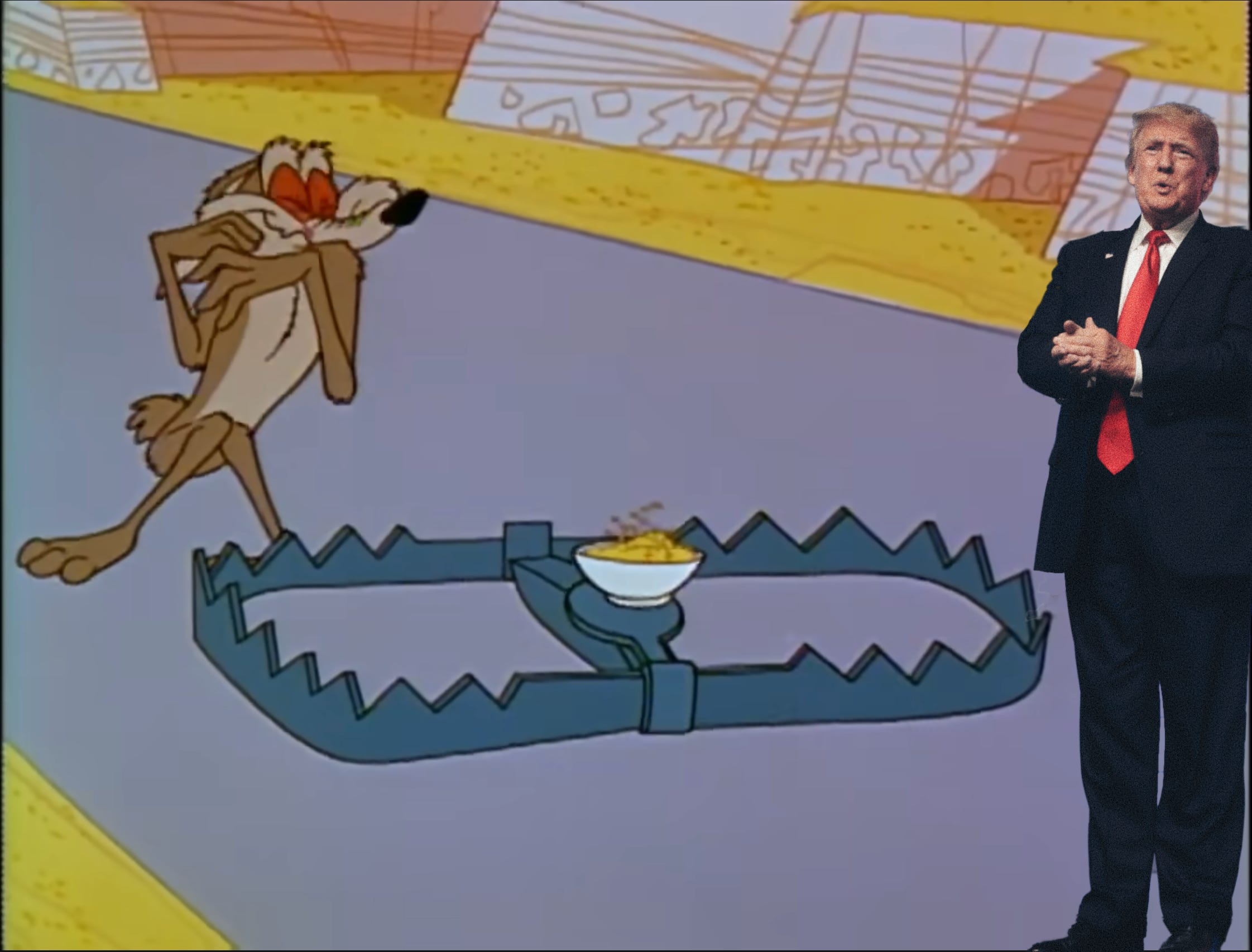
With all this in mind, there is really only one (legal, or mostly-legal) way out for Trump. And that’s to bribe his way to success.
So let’s think about how he might do that.
If Trump were to mail every working-class American $5,000 shortly before the midterm elections — dividends from a hot economy, Trump would declare — I would expect Republicans to keep both houses of Congress.
This is, of course, deeply speculative. But factoring in the pervasive economic anxiety, the psychological effect of paying out Trumpbucks, and the myriad ways in which Republicans have already tilted the playing field: I think it’s a reasonable guess.
The trouble is, Trump doesn’t have the money to do this and Congress doesn’t seem willing to give it to him.
Earlier this year, Trump sent his routine funding request to Congress: Asking for nearly $300 billion in additional funds (most of that for the Pentagon.) It was an outlandish request, stuffed with obscene military spending and draconian cuts to services and transfers.
And it landed on the Capitol like a lead balloon.
There have been competing spending bills introduced in both chambers, and it seems that protracted negotiations around reconciliation will be needed to actually fund the U.S. government for the coming year. At the center of this fight is a plain reality: Trump’s promise to slay spending was a lie, and the economy is not as hot as he likes to think it is.
Sure there have been performative cuts to agencies deemed woke and globalist, but the debt keeps piling up. The Republican Party deficit hawks have also, seemingly, woken up from their comas to notice that Trump is not the responsible economic manager he once claimed to be.
The mechanics of how the Republican majorities might yet get this spending passed remain murky and complicated. There is little space, in here, for the goodies. There is no money for a DOGE Dividend or fertility cheques.
There is a $1.8 billion slush fund — a settlement between Trump, the litigant; and Trump, the president — that was supposed to pay off the January 6 insurrectionists. The fund was so unpopular, even with Republicans, that Trump backed down. Trump is now reviving plans for the fund, but that fund is not nearly big enough to get much bribing done.
That aside, there is little evidence that Trump has the fiscal firepower necessary to do the kind of outlandish vote-buying he would need to do to keep his party in power. He has promised it time and time again, but it looks nearly impossible that he would be able to organize such a series of payments between now and November.
And so, why isn’t Trump vying for a big pot-de-vin to ensure his continued grip on power?
One explanation goes that Trump and his acolytes are merely delusional. They are so captured by their own manufactured media ecosystem, and so collectively convinced that the emperor is wearing the finest robes, that they are required to expect total victory come November.
Another explanation is that they don’t really care about these midterms, and that they are keeping their fiscal powder (relatively) dry ahead of the 2028 presidential vote.
A third, the darkest and most compelling, follows that the Trump administration has plans for a more robust election-rigging plot than we give him credit for. That, come November, the will of the electorate will not reflect the results in any way.
And the final explanation goes: Trump no longer cares. He has resigned himself to defeat, accepting that he is a disliked emperor with a term limit, wielding his power only insofar as it can pad his bank account and roil his enemies.
None of the four explanations quite fit. But perhaps this is a failure of imagination.
On Thursday, the Wall Street Journal published a fascinating investigation. It centered around Meredith O’Rourke, Trump’s bagwoman. “This is very important to the president,” O’Rourke tells Trump’s corporate backers, per the WSJ. “He’s asked me to call you and ask you for this donation.” Sometimes she’s more blunt: “The boss wants this money.”
Cheques have poured in to fund his new presidential ballroom, or to finance his legacy library. She has pulled in $800 million thus far in the president’s second term. Meta, OpenAI, Chevron, SoftBank: These companies, and the oligarchs associated with them, have given enormous amounts of wealth, and in return they have expected their petitions to be answered.
Much like Trump himself, these corporations will be ill-served if this patron-client relationship ends suddenly. Democrats can be bought, of course, but not like Trump can be bought. The fact that companies have continued funneling money into Trumpworld suggests they do not see a president of waning power.
If Trump can’t get Congress to bribe the masses, might his private benefactors take up the challenge?
In just two days, Trump posted on July 1, “the Freedom Fuel Network will be lowering gas prices at 25 ‘FREEDOM FUEL’ Stations across the Greater Philadelphia Area.” He included an AI-generated logo for this Freedom Fuel and an equally slop-y image of a gas station.
Trump’s critics (a class of people which grows every day, but never fast enough) mocked the announcement as a hallucination. The president, it seemed, had just conjured up plans for two-dozen Pennsylvania gas stations.
Not long after, a website sprung up. It featured a countdown clock and the same AI slop images. The official launch of Freedom Fuel was just hours away.
As promised and on time, 25 Freedom Fuel locations opened — offering gas for about 30¢ below the national average. A gallon would cost just $3.47, in honor of the 47th president. The White House posted a video of smiling Americans, thankful for the cheap gas.
“The administration is not involved in the company,” the White House told CNN. The company was founded just about a week before the stations opened and, at the $3.47 price point, would be losing money.
An AP investigation discovered that the stations were a venture between Shamikh and Syed Kazmi, brothers who have been accused of stealing hundreds of thousands of gallons of fuel; Baltimore Ravens coach Randy Brown, who has considered a run for Congress as a Republican; and Yoni Gontownik, an investor and GOP fundraiser.
Whether this is a one-off effort or the start of a broader campaign remains to be seen. But it is well-understood, from the dawn of the Magna Carta to the ramblings of Curtis Yarvin, that if you want to retain power in tough times, you need to quiet the yelps.
Trump’s takeover of American democracy is not complete. This November will be the ultimate test of whether his power expands or contracts. If he wants to ensure victory, he needs to find a way to extend his system of patronage and clientage to the voting masses.
That’s it for this week.
I am endeavoring to write as little about Trump in this newsletter for the month of August. We’ll see how that goes.
In the Toronto Star, I’ve got some thoughts on how Canada can counter Trump’s crusade against Cuba, on how Ottawa can better prosecute this ongoing trade war, and on how the new alliance of middle powers needs to start getting serious about a post-America world order.
Until next week!
Corrupt Britain: Public Ethics in Practice and Thought Since the Magna Carta, Peter Jones. (2023)
Get out your calculator and you will discover that liquidating the nearly $3 trillion Social Security Fund will net each American a fat one-time cash payment of $8,700, while the median worker would save about $5,000 in annual payroll taxes going forward. Even if we pad that 30%, that’s around $11,000. The average retired person gets somewhere in the ballpark of $25,000 in Social Security benefits per year. Don’t spend all your Yarvinbucks in one place!
Population Scenarios in Hungary in the Light of the Partial Results of the Family Support Program and the Change in Global Fertility, Éva Berde, Áron Drabancz (Köz-gazdaság, 2022)
Yah nobody who invokes Magna Carta in debate today has any clue what it meant then and how little it means now. When my bosses go to committee, I bet them a ten on which member will say it first.
We've been screwed financially ever since the Federal Reserve Banking Act of 2013 was inked and never repealed. If not now, when? Frankly,it's too late. The Jewish elite own all of us. The Iranians, Russians, Ukranians, and Chinese too. All these wars are just a cruel game they play to liquidate some young people and brankrupt older people. The defeat of Tom Massie in the primaries is an object lesson in what happens to true patriots. I hear talk that Tulsi's husband's health issues were induced by a microwave attack to sabotage her pending release of damning criminal evidence against many of the elites.