


Vadim Trincher lived on the 63rd floor of Trump Tower in New York City. Anatoly Golubchik just went there to do business.
It was from this ornate wood-paneled and gold-leafed unit that Golubchik and Trincher ran an international money laundering, sports gambling, and extortion ring.
It “must be,” a U.S. attorney would later remark, “the world’s largest sports books, catering primarily to millionaires and billionaires across the globe.” FBI wiretaps would catch Trincher threatening one man who owed them money. Torture and an unmarked grave awaited those who didn’t pay up.
The enterprise was impressively global: Starting in 2006, this clandestine gambling ring took in $100 million — mostly from oligarchs in the former Soviet Union — and laundered it through shell companies in Cyprus and the United States. A big chunk of the profits, however, flowed right back to Moscow.
The operation was directly managed by the highest level of Russian organized crime. The shots were called from Moscow, by Alimzhan Tokhtakhounov — also known as Taiwanchik, for his distinctly Asian features. The mob boss hadn’t been seen in the U.S. since he was indicted for trying to bribe Olympic judges in Salt Lake City in 2002.
But it had plenty of local helpers. One of the fellow leaders of this operation lived just 12 floors below, in an $18 million condo which spanned the entire floor. Helly Nahmad was the scion of a billionaire, a well-known art dealer, and a gambling addict in his own right. He helped bring some star power into the operation, given he palled around with the likes of Leonardo DiCaprio.
The ringleaders earned millions. While Trincher enjoyed his Trump Tower pad, Golubchik was in the market for some new digs. He found a stately building a few blocks away on the Upper East Side, a short walk from the Central Park Zoo. When the owners asked him for a reference, he turned to his friend Steve Witkoff. Golubchik wasn’t just a “friend,” Witkoff wrote, but “a person of strong reputation and integrity.”
The good times would eventually come to an end. Police raided both the 63rd and 51st floors of Trump tower (which must have irked the resident of floors 56, 57, and 58: Donald Trump) and booked the gang with racketeering, money laundering, extortion, and various gambling offenses.
Cops never got their hands on Tokhtakhounov, who remains at large in Russia. The rest, however, pled guilty in 2013. Golubchik and Trincher both got five-year sentences — Golubchik tried to contest it, to no avail; whilst Trincher got to serve part of his sentence in Trump Tower itself. (He sold his condo earlier this year.) Nahmad put his Trump Tower suite up as collateral for his bail, and eventually served a year for his role in the scheme (which he tried to get out of by teaching the homeless about art.)
This saga would fill plenty of tabloid pages, inspire the 2013 Aaron Sorkin flick Molly’s Game, and feed plenty of speculation about Trump’s own ties to Russia when he took office a few years later. And then it was largely forgotten.
But it’s a helpful reminder of a simple fact: Ever since the Berlin Wall fell, rubles have always been desperate to find their way to New York City. And the elites of the city, particularly those in real estate, have happy to have them.
And it’s a useful illustration of the small pools in which these tycoons swim. When Donald Trump prepared to finally vacate the White House in 2021, he fired off a list of bewildering executive orders. On the heap was a full pardon for Nahmad, who had already been out of prison for years.
It’s worth keeping all this scuzzy business in mind as the U.S. government — led, at the highest levels, by the a who’s-who of NYC oh-nos — prepares to sell out Ukraine to appease an increasingly-radical base of Putin fetishists and morally bankrupt corporate raiders.
This week, on a very special Bug-eyed and Shameless: How Trump and his emissary Steve Witkoff are planning to sell out Ukraine, what they want in return, and why Kyiv isn’t quite as screwed as you might think.
Guns Out For Marco Rubio
No matter how thoroughly Secretary of State Marco Rubio prostrates himself in front of Trump and his band of hard-right ideologues, he will always be “neocon” to Steve Bannon.
In the Kremlinology of Trumpworld, Bannon continues to be one of the major ideological and cultural poles. He was one of Trump’s earliest advisors and confidants, the guy who predicted the rise and lasting allure of MAGA, and the scaly-skinned cynic who continues dragging it closer to full-blown fascism. His sector of the Trump universe includes many moons and competing centers of gravity — RFK Jr, JD Vance, Kash Patel, Tulsi Gabbard, Tucker Carlson. His is the dominant wing of the party, and it wants America to be isolationist, sometimes; allied with like-minded autocracies, often; and willing to actively oppose the liberal order whenever it suits.
Rubio, meanwhile, represents the vestigial old guard of the party, the ones who don’t just worship an idol of Ronald Reagan but who actually reflect his politics. He believes in a muscular America which projects power, ends conflicts, and which generally tries to keep the world from devolving into war and rabid self-interest. It is an ideology that is often incoherent and hypocritical, and has historically supported ethnic cleansing and death squads where it suits, but it is roughly the one that America has operated under for the past century.
In joining a cabinet of whackjobs and sycophants styled after Bannon, Rubio really had only one option: Morph and contort all of his beliefs until they complement whatever insane position the president had taken that given day, and hope to exert a modicum of pressure on the administration’s agenda.
In the first administration, Rubio and his camp were he majority, and they succeeded in pushing out Bannon and his ilk. Now the roles are reversed, and many expected revenge.
The likelihood of internecine fighting is exactly why Trump consigliere-in-chief and chief-of-staff Susie Wiles supposedly put an edict against all cabinet-level firings. There would not be a Game of Thrones-esque series of internal power struggles, the thinking goes, so everyone would have to keep their guns holstered.
Coming up to the first year back in office, such a rule didn’t even seem necessary. Rubio was shaping the administration’s Ukraine and Venezuela policies without total catastrophe, and Bannon occasionally praised the pliant Secretary of State’s MAGA bona fides from the outside — “MAGA loves converts, Marco,” he wrote in 2023. There was even talk of a joint Vance-Rubio ticket, should Trump respect the Constitution and not run again. Impressive, since the men reportedly hate each other.
But the past few weeks, I think, have the hallmarks of a final rupture taking place. Let me lay out the timeline, here:
November 19: Axios and the Financial Times report that the Trump administration has been putting together a new peace plan for Ukraine. According to reports, a wide array of figures were involved in its drafting — from Zelensky advisor Rustem Umerov to Marco Rubio, the Qataris, Turks, and a whack of others — it is clear that the chief architects are ‘peace envoy’ Steve Witkoff and Kirill Dmitriev, the head of Russia’s sovereign wealth fund and a key Putin ally.
November 20: After 24 hours of Ukrainian, European, Canadian, and even American officials saying they have no idea what’s in the plan, Axios reports the full 28-point plan: It calls for Ukrainian surrender of Donetsk Oblast, a permanent ban on Kyiv’s membership in NATO, a modest reduction in the size of the Ukrainian military to 600,000, amnesty for Russian war crimes, flimsy security guarantees for post-war Ukraine, and the liquidation of Russian assets to finance the country’s reconstruction — to which America is entitled 50% of the profits. The plan aligns almost-perfectly with Russia’s negotiating position presented in Alaska. (Dispatch #139)
U.S. Secretary of the Army Dan Driscoll flies to Kyiv to present the plan to President Volodymyr Zelensky.
November 21: Even before any official text is released, Trump demands Ukraine accept the deal by Thursday, six days away, and intones that aid and intelligence-sharing could end if Kyiv refuses. Moscow signals indifference to the plan, despite it being everything they want.
November 22: At the Halifax International Security Forum, a bipartisan cohort of American lawmakers tell journalists that it had all been a misunderstanding. The 28-point plan is not America’s position at all, but Russia’s. In fact, the text seems to have been translated from Russian, they say. There is no American proposal, no deadline, and no threat. This comes straight from Rubio.
Marco Rubio takes to Twitter hours later to throw the senators under the bus: “The peace proposal was authored by the U.S. It is offered as a strong framework for ongoing negotiations.”
November 24: Rubio throws out the 28-point plan and replaces it with a 19-point plan that nixes the idea of handing over Donetsk. The plan has “little resemblance” to the earlier plan, FT reports.
November 28: Trump reverts back to the 28-point plan, demanding territorial concessions.
It’s hard not to view this back-and-forth as a powerplay to embarrass and undercut Rubio. If my interpretation of this affair is correct, I think Rubio and his fellow Ukraine defenders were frozen out of the actual drafting of this proposal; the right flank of the administration devised the plan in secret and coordinated its release; Rubio denounced the plan before learning he would be forced to accept it; leaving Rubio scrambling to try and force through an alternative. He failed.
There is only circumstantial evidence for this idea, but it is compelling. Driscoll, for example, is a surprising choice as envoy to Ukraine — particularly when Trump still has an envoy for Ukraine, Keith Kellogg — until you realize that he is a close ally of JD Vance. (Who Vance apparently wants leading the Pentagon whenever Pete Hegseth bombs out.)
Bannon has already resumed his attacks on Rubio after a long detente. He was posting just this week that Rubio is in a pitched battle with Ted Cruz to be “NeoCon in Chief.”
But here’s another bit of evidence that I think is useful.
I was in the room when that group of U.S. lawmakers relayed Rubio’s denunciation of the deal. And I asked them, Republican Senator Mike Rounds in particular, if they could help shed light on just who, exactly, calls the shots on these negotiations. Rounds, a consistent supporter of Ukraine, basically confirms that Rubio wasn’t just trashing the 28-point plan, but insisted that Washington would not be demanding territorial concessions.
Within days of this crystal-clear emergency announcement, which was designed to be public, Rubio fully backtracked and Washington clarified that it did want Ukraine to surrender territory.
It is a clear sign, I think, that Rubio has been totally marginalized.
Senator Mike Rounds: We were there when Secretary Rubio made the phone call. I did ask: Can we say that we’ve received the phone call from you? And he said: Yes.
Can we explain, basically, what had occurred? And he said: Yes.
So what we can share with you is is the administration was not responsible for the release of this information in its current form. But we can also tell you that, at this point, they want to be able to utilize it as a starting point for where Russia is making demands. And in doing so, the response was: We’re going to share it with Ukraine as an intermediary and we’re going to ask for them to respond back in a timely fashion. […] But the intent was to take what had now been publicly discussed in news reports and to allow the Ukrainians the opportunity to respond. But there and I can also share this with you: We are not aware of any discussion by the administration of limiting support.
“I Have the Deepest Respect for President Putin,” or “It Ain’t Called the Bloodlands for Nothing.”
This turf war isn’t new. Stretching back to even the first Trump administration, there has been a skepticism about Kyiv — ranging from a latent belief that Ukraine should be part of a broader Russia; that Kyiv is hopelessly corrupt and marginal where Moscow is grand and capitalistic; that Russia represents traditional and laudable values whereas Ukraine is the metastasization of toxic liberal values; that whatever the merits of Ukraine’s defense, it is doomed to fall; and that it is simply none of America’s business.
Bannon wraps all these narratives together often, and has recently started weaponizing them against Rubio. “For Marco to come out saying, ‘Our priority is to make sure you’re never at war again,’” Bannon said on his show earlier last month. “Dude, grab a history book and just read a couple of pages, man. They’ve been fighting for 5,000 years. It ain’t called the Bloodlands for nothing.” (This claim would no doubt make Timothy Snyder, author of Bloodlands, quite irate. Read to the end for more.)
Despite that, the Trump administration has fairly consistently opted to continue supplying and defending Ukraine. For whatever hiccups there have been, Trump has consistently sided with Ukraine and applied pressure to Russia, often going further than the Biden administration ever did.
But there has been growing desperation to make a deal in Moscow. Just today, Putin vowed to take Ukraine’s entire Donbas region “by military or other means.” Such a claim, however, makes clear that he’s really keen on other means.
As the Institute for the Study of War assesses today, Russia’s victory remains “not imminent or inevitable” and that these grandiose threats are continued “cognitive warfare efforts” meant to influence negotiations.
No doubt those efforts are feeding Bannon, Vance, and the whole crew with more ammunition to call for the abandonment of Ukraine.
But that alone can’t explain how the Trump administration has pivoted so hard and suddenly away from Kyiv. To date, Putin’s arrogance has consistently frustrated Russia’s ability to bring Trump onside. For all his many, many faults, Trump still thinks of himself as a dealmaker — and he has seen through Putin trying to gussy up the same insane proposals again and again.
So what’s changed? Why has Rubio lost this fight, after winning all previous rounds?
I think the answer lies with Anatoly Golubchik’s old friend: Steve Witkoff; and with a longtime Putin operator, Kirill Dimitriev. They have, together, finally made the pitch in such a way that sings for Trump. They have finally put together a package that reveals just how stinking rich everyone could get if the war were over.
We know, thanks to a devastating report from the Wall Street Journal and a transcript of a call leaked to Bloomberg, that Witkoff has been plotting this play for a while.
“Russia has so many vast resources, vast expanses of land,” Witkoff told Journal. “If we do all that, and everybody’s prospering and they’re all a part of it, and there’s upside for everybody.”
And everybody has been plotting those upsides, seemingly with the blessing of Witkoff and his buddy Jared Kushner, who has become an éminence grise for the petrostates of the Gulf. He has done so right as Russian oligarchs have sent missionaires to make contact with American business, and as a bevy of Trump donors have begun salivating at the prospect of joint ventures with Russia. One apparently wants to finance the reconstruction of the Nord Stream pipeline.
In a sign of where his interest lies, Witkoff has not traveled to Ukraine once this year. He has gone to Russia six times. On his travels, Witkoff has forged close ties to a certain Russian: Kirill Dmitriev.
Dmitriev is no stranger to winning friends and influencing people in the Trump orbit. According to the Senate intelligence committee’s investigation into Russia’s efforts to elect Trump and court his administration, Dmitriev “used multiple business contacts to try to make inroads with [Trump’s team.]” That included leveraging the UAE as a friendly middleman and setting a secret meeting in the Seychelles with Blackwater mercenary boss Erik Prince, who turned around and reported the entreaty to then-advisor Steve Bannon.
Dmitriev was responsible for pitching a “reconciliation plan.” He shared it with an American interlocutor who was supposed to sell it to Bannon, Kushner, and ultimately Trump. Here’s a draft:
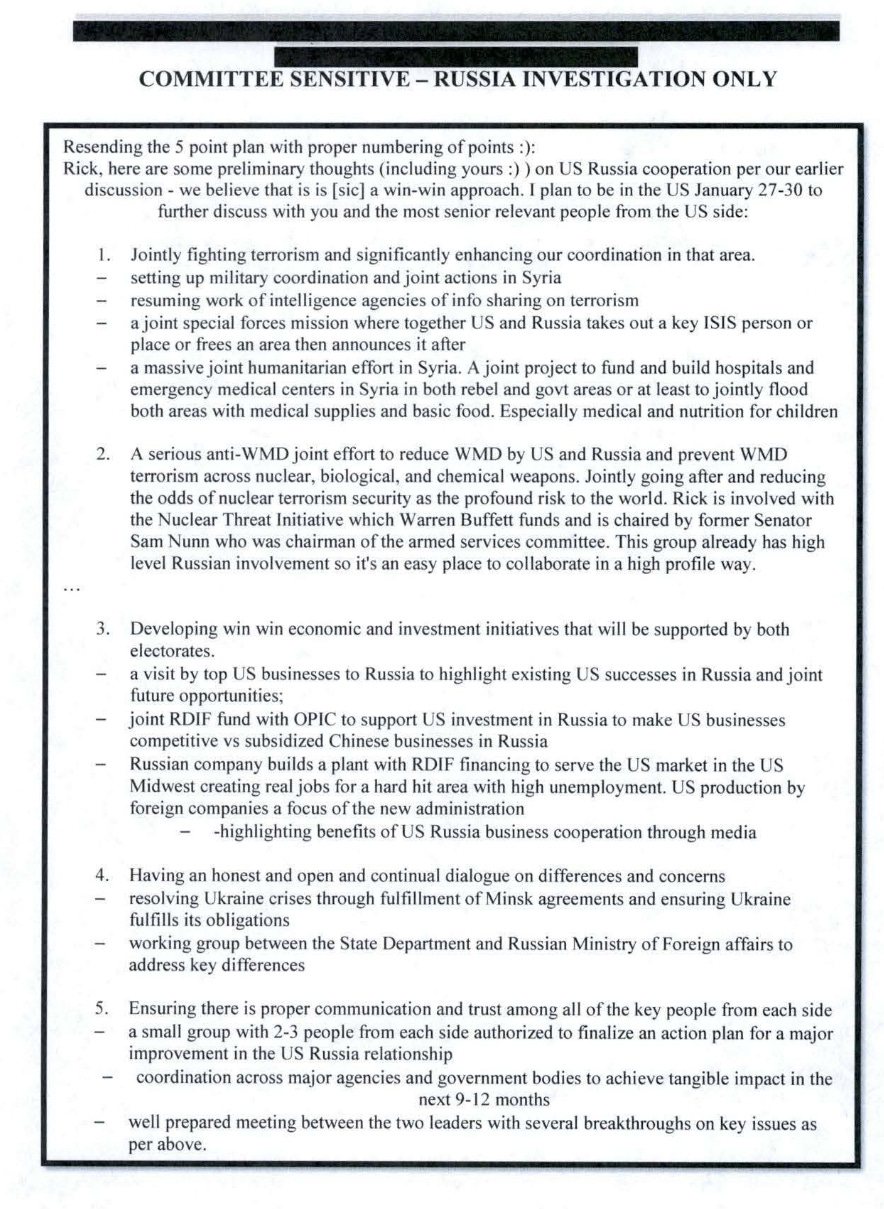
That was 2016. Dmitriev ultimately failed in these efforts, and was sanctioned and barred from the United States under the Biden administration.
With Trump back in the White House, Dmitriev was again tapped by Moscow to sell the Trump team on this rapprochement. Witkoff even pulled some strings to ensure that the Russian banker could visit the White House to present a list of lucrative deals to the president. Still, he failed.
But, at that point, neither Witkoff nor Dmitriev were involved in the Ukraine talks. That was left to Rubio, Kellogg, and Russian Foreign Minister Sergei Lavrov — who reportedly froze out Dmitriev and lambasted him in the halls of the Kremlin.
That changed just a few months ago. Kellogg was getting set to leave the administration, and Witkoff’s star had risen after securing a ceasefire deal in Gaza. He had helped secure the Putin-Trump meet in August, but the deal had fallen apart under scrutiny by the Europeans, who Witkoff had snubbed. Now he was getting serious, and he chose Dmitriev as his opposite, who suddenly hopped in the front seat. We know he made another request to get Dmitriev stateside, organizing a secretive Miami meeting, alongside Kushner, in October.
On October 14, Witkoff got on a call with Yuri Ushakov, Putin’s foreign policy advisor.
Witkoff: Listen to what I’m saying. I just want you to say, maybe just to say this to President Putin, because you know I have the deepest respect for President Putin.
Ushakov: Yes, Yes.
Witkoff: Maybe he says to President Trump: You know, Steve and Yuri discussed a very similar 20-point plan to peace and that could be something that we think might move the needle a little bit, we’re open to those sorts of things — to explore what it’s going to take to get a peace deal done. Now, me to you, I know what it’s going to take to get a peace deal done: Donetsk and maybe a land swap somewhere. But I’m saying instead of talking like that, let’s talk more hopefully because I think we’re going to get to a deal here. And I think Yuri, the president will give me a lot of space and discretion to get to the deal.
Let me translate: If we gloss over our plan to sell out Ukraine — a plan that would hand over hundreds of thousands of Ukrainian civilians to Russian concentration camps, to pave the way for the next invasion, which would excuse war crimes — we can get some real business done.
It’s easy to weave a grand conspiracy theory from all these linkages and shady meetings. But you needn’t, because there is a very simple narrative to sum all this up: Putin thinks he can trade sweetheart resource deals to the U.S. for a chunk of Ukraine, and he thinks having interlocutors trusted by Trump pitching the idea will make it more likely to succeed. More than that, he thinks that marrying this overt corruption to the very ideologues who want to abandon Ukraine for being corrupt will be a one-two punch that will solidify both Russia’s presence with the White House and Trump’s popularity with his base.
And he’s right. Witkoff wants that too. It worked.
“This Isn’t 2023.”
So, to my mind, it’s done. Trump held out for Ukraine longer than anyone expected him to, but the administration is going to succumb to the pressure and temptation, and he will opt for rubles instead of principles.
In chatting with some Ukrainian contacts, however, there’s a clear message coming from Kyiv: It’s not the end of the world.
As one well-connected Ukrainian put it, “this isn’t 2023.”
Even two years ago, Ukraine was utterly reliant on American shipments of 155m shells, anti-air missiles, drones, intelligence, cash, and so on. But Kyiv always knew it couldn’t win a war on donations alone.
Since then, Ukraine (with American investment) has built up its own defense industrial base. By the end of 2024, Kyiv reported that fully 30% of its weaponry was made locally. In September of this year, Zelensky reported that number had jumped to 60%. With respect to drones — which have come to replace Ukrainian artillery amid a global shell shortage — 96% of those used on the battlefield were made in Ukraine.
Europe, meanwhile, has accelerated donations in a huge way, donating more in the first three quarters of this year than the Biden administration gave all last year.
There are American donations that will be tough to replace. Its anti-air missiles are critical in stopping incoming Russian drones and missiles. But Ukraine is getting better and better at deploying more sustainable made-at-home solutions: Disrupting ballistic missiles with Ukrainian music that spoofs the missile’s location as Lima, Peru; and developing cheap-to-make interceptor drones.
Satellite imaging and intelligence is incredibly important in anticipating Russia’s next move and coordinating strikes. America has, bar none, the widest high-resolution satellite coverage in the world. But both Canada and Europe have satellites of their own. In a roundtable with journalists last month in Halifax, EU Defence Commissioner Andrius Kubilius intoned that help is on the way.
Kubilius: The European Union has the satellite systems in some areas — even better than America. There are some systems where we are a little bit behind, and where we’re developing them, for example on secure communication or Starlink. Ukraine, if they want to decide that they want to continue their defense, they will continue. We need to take into account, really, their strategies and their wishes. […] In some cases, we do have very good space capabilities. For navigation, we have Galileo. For observation, we have a very good systems. Some member states have advanced systems of their own. We’re now looking, quite rapidly in some cases, to integrate those systems into European ones.
Europe has a habit for moving slow. But there is ample indication it is learning agility, and it is readying to position itself to stopgap the assets that Ukraine may soon lack. That is very good.
So things are bad, no doubt. Ukraine cannot accept the deal that Trump now insists on. It is the difficult choice for Ukraine, Zelensky said last month, between “losing its dignity or the risk of losing a key partner.” It seems that it will have to lose its ally.
But in so doing, America and Russia may have turned Europe into a real partner.
Mr. Commissioner, Build Up This Drone Wall
America finally giving it to the bombardment of Russian flattery has a perverse upside. It will allow the world to stop pretending as though Washington remains relevant.
Earlier this year, Ukraine’s non-American allies set up a structure to manage exactly this: The Coalition of the Willing. It is the vehicle through which the rest of the world can continue defending against this imperial aggression, regardless of what the wannabe imperialist in the White House does.
Throughout this Potemkin peace process, Europe and Canada have had to continue pretending that America is reliable. Soon, perhaps, the charade can end.
In coming off the rails of American military might, the participating nations still need to confront the ways in which they are insufficient.
Consider the Russian drones which strayed into European airspace earlier this year, or the harassing drone attacks which have plagued European airports. Insofar as Europe has been able to respond, it relied heavily on American fighter jets stationed on European soil. It, like Ukraine, relies on American satellite imagery and intelligence, too. Even as it seeks to buy kit for Ukraine, it often does so through American suppliers.
So this Coalition of the Willing has also become a means of introspection. Of figuring out how to create defenses and capabilities that do not balance themselves on American infrastructure. Europe — plus Canada and the UK — have raced ahead on ReArm Europe, a trillion-dollar effort to build out this self-defense equipment sooner rather than later. The money is set to start flowing soon.
For this to address the current crisis, however, everything must be plugged in to what Ukraine knows and needs. While applying jimmy-rigged battlefield solutions to a long-term multi-nation military plan isn’t quite as simple as it may sound, there are huge technological innovations that Kyiv has figured out that Europe should acquire and produce at scale. That, in turn, should feed right back into Ukraine’s self-defense. By creating symbiosis, instead of an exchange from two silos, both sides are going to move faster, build cheaper, and be more effective at defending against a cheap and corrupt military which only knows how to put bodies in front of cannon fire.
There’s good signs that this is exactly how Europe is thinking. I’ll leave you with an exchange I had with Kubilius about the prospect of a European ‘drone wall’ — a network of drones and electronic warfare sensors capable of disrupting Russian incursions.
BE&S: You’ve spoken about the prospect of building a wall of drones through Europe. I wonder if you can give us a bit of an update.
Kubilis: Now, officially we call it, “Drone Defense Initiative.”
BE&S: “Wall of Drones” sounds better.
Kubilis: Things are really moving now. As you know, this drone initiative — together with our Eastern Flank Watch — they are written down into our defense readiness roadmap as flagships, meaning we shall pay bigger attention to them. On the Eastern Flank [the Baltic state and Poland] they’re looking for two major elements: One is the ground wall, and one is the drone wall. Ground wall means ‘control mobility measures’ — which would not allow tanks or artillery or so on and to enter the territory. Again, we’re learning from Ukraine. It seems that the fortifications and things they built were very, very effective. We need to build the same here, on the Eastern flank.
On drones: Again, we can see very big differences in capabilities with what the Ukrainians have. Go to Ukraine and you will see. With the provocations — 20 drones flying into Poland, for example — it appears that we do not have the capability to detect drones, or they are very limited. So we need to build those capabilities. Either new types of radar, or through acoustic sensors. The Ukrainian DELTA system is a very inspiring example. We need drone interceptors and electronic warfare. Maybe lasers — but that will take time. So those are things which we want to develop. And we really need to build that structure together with Ukraine.
BE&S: Talking about building structures together with Ukraine, especially in a world where America is trying to unplug itself from these systems — you’re bringing on a new partners in your defense industry in Canada (and, I suppose, Ukraine as well.) How, in a real sense, do you build shared supply chains for your defense industry, and do you think there’s enough willingness of member states to really do that? Has there been an understanding of the actual business-to-business linkages necessary to bring on Canada and Ukraine into Europe’s shared defense industry?
Kubilis: Well it is developing. We see a lot of interest among European companies, even without any of our initiatives. But different industries from the EU are very active in Ukraine. They’re creating joint ventures — establishing them somewhere in Europe, learning from Ukraine, producing weapons for Ukraine needs, and so on. And so there’s more ahead. There is the so-called Danish model — meaning that European Union member states are coming with their money and they are procuring weapons from the Ukrainian defense industry for Ukrainian needs.
What is much more difficult is to copy-and-paste the ecosystem from Ukraine to Europe. In Kyiv, you can see in, here, drone producers, in the next room, drone operators, in the next room, they’re analyzing data from the front line. They have the information to react if drones are starting not to work. Russians are finding ways to disable drones. Ukrainians are doing the same as Russian drones. So you need that ecosystem to ask: Where are they now?
And, on Canada: We’re looking very much into issue of security and supply of rare earth materials. That’s very important. Since Canada has quite substantial possibilities to supply.1
That’s it for this week!
If you’re keen to read more of my thoughts from Halifax, my two Star columns this week are all about the particulars of America’s fuckyou to the international community and about how Canada can rebuild its defense industry to facilitate its divorce. (These are gift links that will work for the next few days.) I’ve also got a longer piece on why Canada needs to buy the F-35 already, as unpleasant as it may be.
Episode 2 of Soft Power has also dropped. I’ll be sending out a standalone dispatch about that next week.
I should expand a bit about the future of Bug-eyed and Shameless: Like I said in my previous dispatch, this thing isn’t going anywhere. I’ll continue writing this newsletter so long as people enjoy reading it and I enjoy writing it.
Before taking on my new role, I had considered raising the price of a subscription and putting more things behind a paywall. My mindset went that more revenue would justify more of my week spent working on it.
Now that I’ve got a full-time job, my desire to think through big ideas here on Substack has actually grown, even if it has been shunted to after-hours and weekends.
So I’ve got more ideas to break down and less time to do it. That may mean that my (already tenuous) promise of publishing once-a-week is fully broken. I could paper over that fact with more short-form content designed to gin engagement, but your email inboxes are already full.
Instead, I’m just going to knock down my subscription price a bit and promise that virtually nothing will be behind a paywall. If you want to subscribe: Thank you so much. It is paying for my time to writing these dispatches, and it is also funding Soft Power, some ambitious and off-the-books reporting missions I want to do next year, and — if things continue on — even hiring some outside writers to contribute to this newsletter.
But I don’t expect people to pay for a newsletter that comes less frequently than promised. So I won’t insist on charging for it. And I will also, as I’ve always done, hand out a free subscription to anyone who asks, no questions — just ask.
So, anyway, it is now $50CAD for a year and $100 if you want to become a ‘founding member.’ (What does a founding member get? My eternal gratitude. My looking at your name and thinking this person is fantastic. My automatic, enthusiastic, endlessly appreciative response to any email you send me.)
That’s enough navel-gazing. I’ll leave you with a song and a passage from Bloodlands. Until next week.
Timothy Synder: Hitler and Stalin rose to power in Berlin and Moscow, but their visions of transformation concerned above all the lands between. Their utopias of control overlapped in Ukraine. Hitler remembered the ephemeral German eastern colony of 1918 as German access to the Ukrainian breadbasket. Stalin, who had served his revolution in Ukraine shortly thereafter, regarded the land in much the same way. Its farmland, and its peasants, were to be exploited in the making of a modern industrial state. Hitler looked upon collectivization as a disastrous failure, and presented it as proof of the failure of Soviet communism as such. But he had no doubt that Germans could make of Ukraine a land of milk and honey.
For both Hitler and Stalin, Ukraine was more than a source of food. It was the place that would enable them to break the rules of traditional economics,rescue their countries from poverty and isolation, and remake the continent in their own image. Their programs and their power all depended upon their control of Ukraine’s fertile soil and its millions of agricultural laborers. In 1933, Ukrainians would die in the millions, in the greatest artificial famine in the history of world. This was the beginning of the special history of Ukraine, but not the end. In 1941 Hitler would seize Ukraine from Stalin, and attempt to realize his own colonial vision beginning with the shooting of Jews and the starvation of Soviet prisoners of war. The Stalinists colonized their own country, and the Nazis colonized occupied Soviet Ukraine: and the inhabitants of Ukraine suffered and suffered. During the years that both Stalin and Hitler were in power,more people were killed in Ukraine than anywhere else in the bloodlands, or in Europe, or in the world.
This interview was heavily edited for length and clarity.
Thank you again for this exceptional journalism post. I always appreciate whatever you post whenever you can.
Thank you