


In April 2014, a bus pulled up to the Kramatorsk police station and out spilled a gang of masked men with assault rifles.
The eastern Ukrainian city, which sits along the edge of the industrial and coal-rich Donbas basin, was hardly a high-value target. Like much of Eastern Ukraine during the Second World War, it had been captured by Nazi Germany, then by the Soviets, then Germany, then the USSR once more. Under the Soviets, it had been part of the industrious East, and a regional rail hub; while in an independent Ukraine, it fit into the complicated ethnic and linguistic politics of the country: Its 200,000 working-class residents were overwhelmingly Ukrainian, though they spoke mostly Russian.
But on that spring day in 2014, Kramatorsk was about to be occupied, ostensibly, by itself.
The masked assailants fired into the building, and the police inside fired back. The invaders made their way inside as a crowd of locals congregated outside. The irate public demanded to know who had just shot up their police department.
“We are not Ukrainian troops,” the invaders told the restless crowd outside. “We are a people’s militia.” They tore down insignia of Ukraine and raised the rebel flag of the recently-proclaimed ‘Donetsk People’s Republic.’ They demanded that the city surrender itself to this breakaway state.
The crowd began booing and told them to get lost.
Over the next three months, Kramatorsk — like many other cities in Eastern Ukraine — would find itself suddenly split in two. A provisional government in nearby Donetsk, clearly and obviously supported by Moscow, had laid claim to Kramatorsk. The Ukrainian military, still finding its bearings after the sudden resignation of the government in Kyiv, scrambled to reassert control over its own territory.
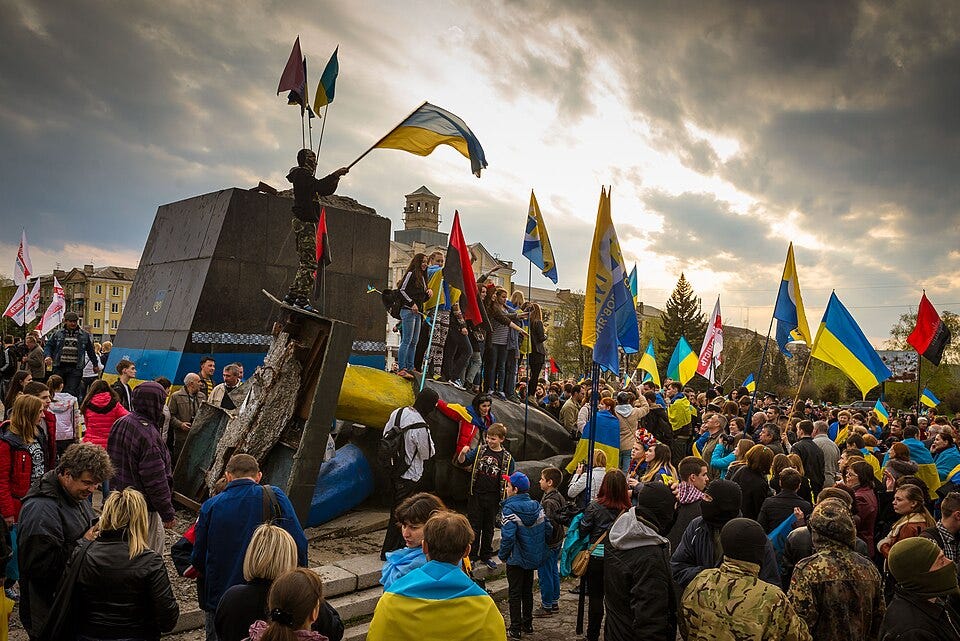
After a series of successful military operations that summer, the remaining members of the militia fled. The borders of this Russian client state rolled back, and life in Kramatorsk went back to some semblance of normal. The next year, residents waved Ukrainian flags as they toppled a statue of Vladimir Lenin in the city square.
Kyiv began building defences just east of Kramatorsk, convinced that if its sovereignty were to come under threat again, it would run through Donetsk. This city would become a linchpin for the nation’s collective defense.
Sure enough, when Russia launched its full-scale invasion of the country, in 2022, its forces rushed towards Kramatorsk — but did not even get close, before Ukrainian defenders pushed them back.
Today, Kramatorsk is still in Ukrainian hands. Its streets are neatly kept, its roses well-watered and pruned, and its Palace of Culture remains impressive, albeit boarded-up. But the war is inching closer. Parts of the city lie in ruin, having faced constant bombardment from Russian airstrikes and drones. More than half the population has fled. In recent weeks, the city has come within firing distance of Russian artillery.
But the city is far from lost. In fact, Kramatorsk is the backbone of Ukraine’s defenses. Russia has been heading towards a confrontation here, and it will be in for one hell of a fight when it arrives.
In Alaska earlier this week, Russian President Vladimir Putin made a cynical suggestion: What if Ukraine simply surrendered the city — and the whole region — in exchange for peace?
In Kramatorsk this week, journalist Julius Strauss asked a young woman her thoughts on the proposal.
“Everyone would leave,” she said. “We can’t live under the Russians after what they have done to us.”
This week, on a very special Bug-eyed and Shameless, I want to break down what happened this week in Trump’s stumbling, staggering amble towards a fake peace and consider how Europe, Canada, and Ukraine ought to respond.
The Negotiating Positions
If we, the media, are guilty of one sin in covering this current stage of the Ukraine-Russia conflict, it’s that we are utterly failing to remind the public of the actual positions of both parties. A casual reader could be forgiven for thinking that a peace deal is tantalizingly close, if only both sides could get in the same room.
But if you actually compare what Russia is asking for with what Ukraine is able to give up, you’ll realize just how impossible this peace deal is. To that end, I’ve put together this handy chart:1
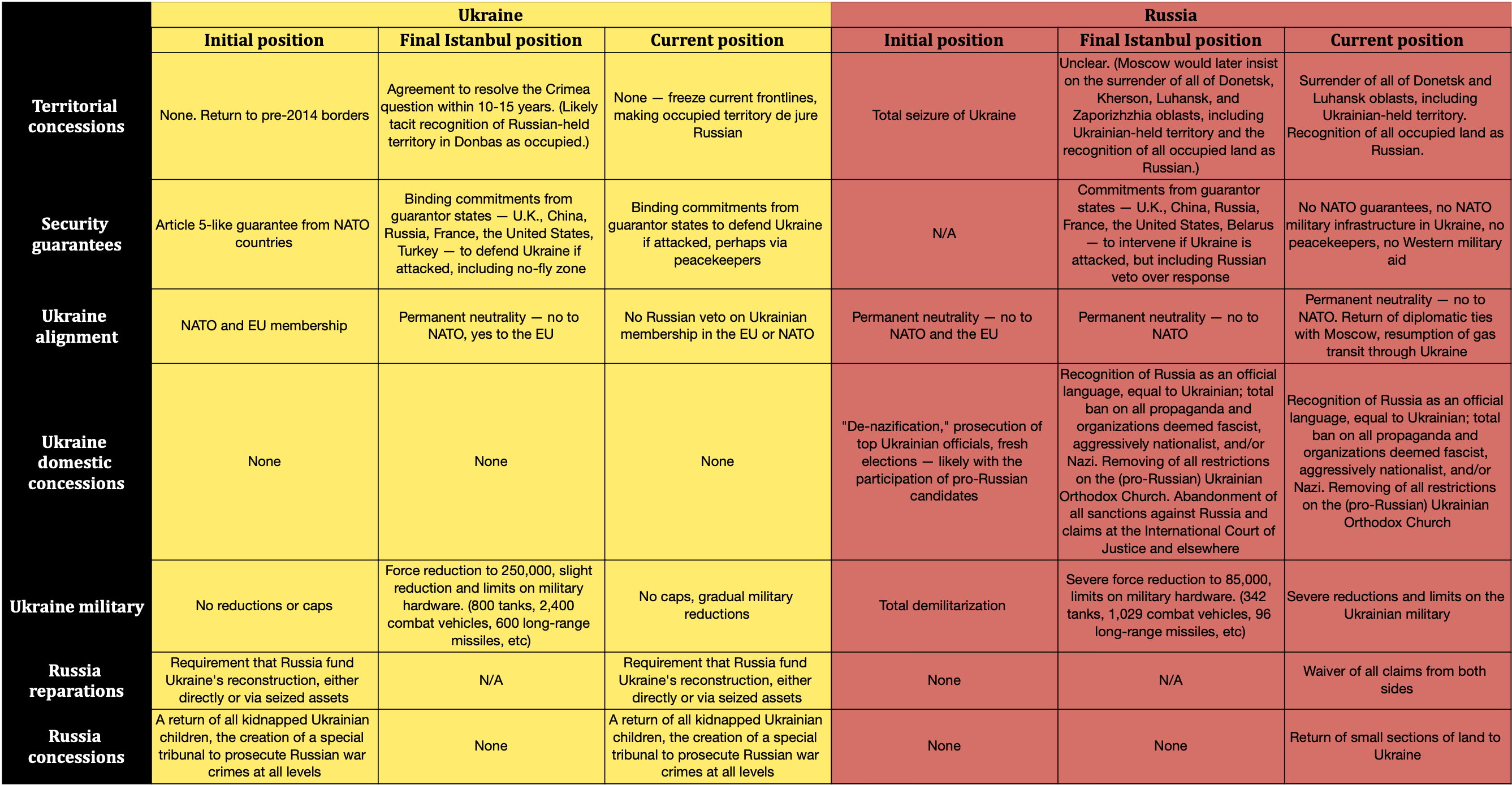
As you can see, there remains some big outstanding issues.
Thus far, the flurry of activity out of the White House — meeting Putin in Alaska and hosting Europe’s leaders at the White House — has succeeded in downgrading Russia’s territorial demands from insane to slightly-less insane and upgrading the promise of security guarantees to Ukraine, albeit only in tone.
In effect, yes, that moves both sides closer to a deal: But it closes the mile-long gap by mere inches.
The last time Russia and Ukraine seriously talked peace, it was in Istanbul in 2022. At those talks, negotiators managed to find compromise positions on some items and get close-ish on others, but they never settled the question of borders and territory — that was left for a leader-to-leader summit which, they thought, would come next. It never happened.
In fact, shortly after a draft text was agreed upon, albeit with some unresolved items, the Kremlin began contradicting the proposal its own negotiators had signed. For Kyiv, it was proof that the whole negotiation was a ruse, designed to dissuade Ukrainian counter-offensives and discourage Western military aid. (Dispatch #128)
Indeed, the compromises that Moscow’s negotiators put to paper in Istanbul were quickly forgotten, and it actually hardened its negotiating positions in some respects. About six months after those talks concluded, Russia staged an illegal and fraudulent set of referenda in its occupied territories, declaring that the people of those Ukrainian provinces had voted to join Russia. Since then, it has demanded that Ukraine give up this territory to attain peace. It has further demanded all sorts of domestic concessions that would try and bend the country to becoming a pro-Russian client state. (Looming over these talks is a pervasive belief that, if Ukraine agreed to the sweeping terms, Russia would find a way to rig any post-war elections.)
Even putting aside the still-unresolved question of borders, there has been absolutely zero indication that the White House has managed to bridge the divide on any of these outstanding issues — demilitarization, ‘de-Nazification,’ returning kidnapped Ukrainian children, and so on.
But Trump and his inept advisors have been spun into the belief that they are making progress, and have therefore forgotten about their threats and plans to derail the Russian economy. That’s a huge win for Moscow.
Putin Karaoke
When I took a shot at gaming out the Alaska summit, last week, I figured the biggest factor in those talks would be Trump’s attention span. I suspected that Trump’s desire to notch up another quick win would eclipse any affinity he has for the Russian president. (Dispatch #138) I wasn’t quite right, there.
It became clear pretty quickly that, while neither man got what they wanted, Putin exited those talks feeling good and Trump left with a head full of Russian propaganda.
Consider what Trump told Fox & Friends, his preferred platform to discuss geopolitics.
It is foolish to try and parse Trump’s words for any coherent strategy or understanding of the world, but it’s worth considering exactly what Putin has duped him into believing.
Putin’s position has always been that countries and blocs must maintain spheres of influence which are both geographic and ideological. America controls, more or less, the Western Hemisphere and it is Putin’s view that he should control the East. In his telling, America is to blame for constantly expanding NATO’s presence into eastern Europe, essentially contravening this division of the planet. He has pointedly said that the invasion of Ukraine was done in order to disrupt, oppose, and ultimately rollback America’s supposed expansionism. (Dispatch #89)
To put a fine point on it: Putin says he invaded Ukraine to constrain America.
The truth is, of course, more complicated than Putin would have you believe and also fairly simple: NATO is a defensive alliance, not an offensive one; membership is voluntary, and Moscow repeatedly acquiesced to its expansion; and Putin’s clear objectives in Ukraine are territorial expansion, resource acquisition, and domestic propaganda.
Nevertheless, to hear Trump parrot the same lies about NATO is staggering. He is, in effect, conceding that America posed a threat to Russia’s sovereignty, tacitly recognizing Russia’s invasion of Ukraine as a move of self-defense.
Not only is that ludicrous, the sign of a deeply gullible man, it undermines Trump’s own efforts to beef up NATO — something he actually deserves credit for. It also runs completely contrary to Trump’s supposed axiom of “peace through strength.” And it weakens his stated goal of wanting to counter an aggressive China, Moscow’s ally, in the east.
Worst of all, accepting this position seemed to lead Trump towards supporting Putin’s most untenable demand: That Ukraine surrender the Donbas.
According to the New York Times, Trump left the Alaska summit believing that the best way to get a quick peace deal would be for Ukraine to surrender all Donetsk and Luhansk oblasts — including territory it currently holds and has been able to defend. That includes Kramatorsk and the surrounding area.
And he left with an invitation from Putin to hold the next rounds of negotiations in Moscow.
As I wrote last week: You can’t be a realist if you’re an idiot.
While the core of my analysis from last week, I think, holds — Trump is unlikely to continue supporting Russia’s maximalist negotiating position, and is more likely to either give up on peace talks or to eventually punish Moscow for its intransigence — acceding to Russia’s “root causes” of the conflict and endorsing his land grab does change the equation somewhat. And not in Ukraine’s favor.
The European Traveling Circus
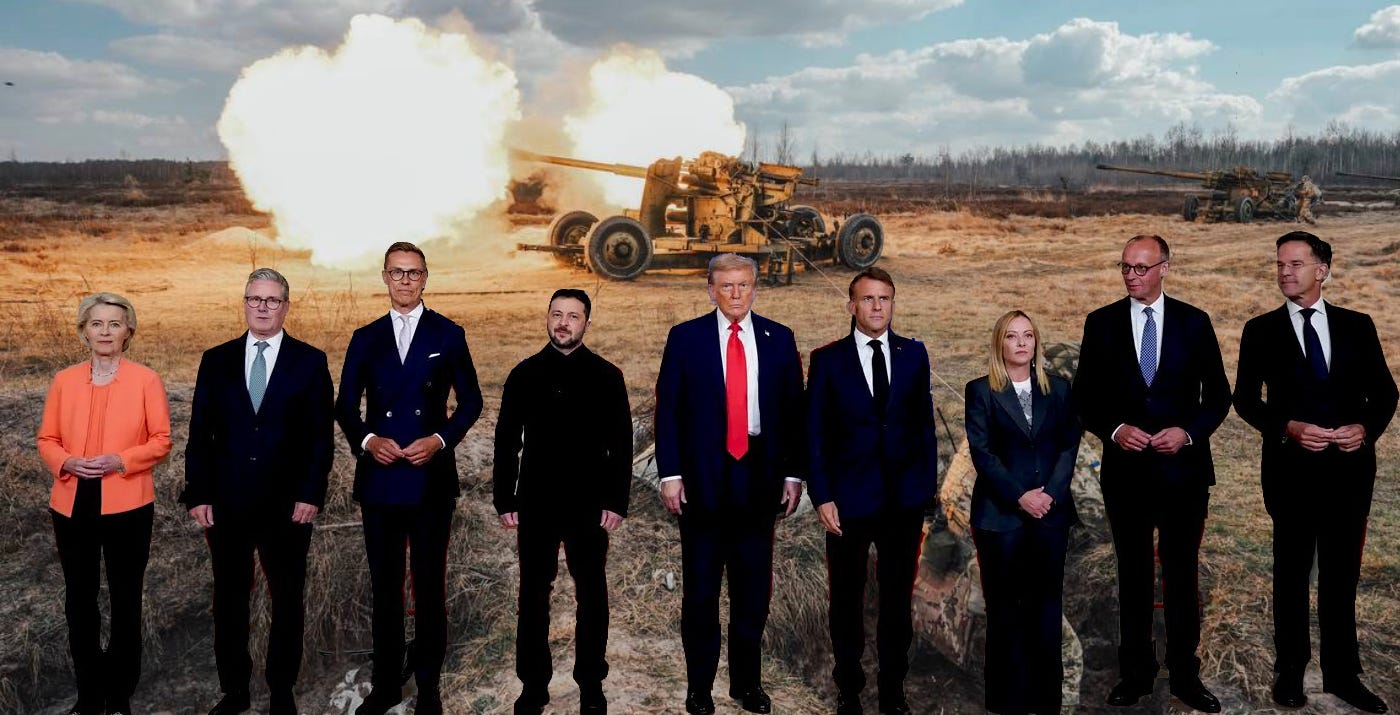
In the hours after Trump’s cozy sojourn with Putin, Europe’s leaders scrambled to D.C. to try and shake that nonsense out of his head. Flanking Volodymyr Zelensky, it was their job to dislodge Trump from the Russian negotiating positions which Putin had effortlessly led him onto.
As they trotted into the White House, the gang of European leaders lumbered up to perform their very best contortionist routines.
German Chancellor Friedrich Merz likened Russia’s plan to seize the Donbas “to a proposal for the United States to have to give up Florida.” French President Emmanuel Macron insisted that if Putin refuses to sign an equitable deal, then the West ought to quickly impose not sanctions — but tariffs. All of them, one-by-one, praised Trump for getting both sides closer to peace than anyone ever had before.
This is all strategic flattery, a recognition that the only way to drag Trump onto your position is by relentlessly soothing his volatile ego.
It worked, at least to some degree. Zelensky got Trump thinking about the plight of the abducted Ukrainian children (with an assist from Melania) and the EU gang got some real, albeit vague, commitment to long-term security guarantees.
Over the course of days, Trump promised “we’re going to help [Europe] and we’re going to make [Ukraine] very secure,” floated the prospect of Article 5-like protections, and raised the possibility of sending American fighter jets to patrol Ukraine’s skies. He then ruled out sending American troops and insisted “it can’t be NATO.”
I think it’s clear that Trump signaled support for strong security guarantees because he doesn’t fully understand what he’s signing up for.
Still, by getting Trump onto a key Ukrainian position, it put the White House in conflict with Kremlin. While Moscow has always pretended to support security guarantees for Ukraine, it has always shot down any actual proposal for what they should look like. Indeed, the proposal Russia put forward in Istanbul is that, in the event that Ukraine is attacked again, Moscow should have a veto over any defensive response. In other words: Russia wants to be able to tell Europe and America to stand down if/when it invades Ukraine again.
If Europe can’t convince Trump to be pro-Ukraine, getting him offside Putin is the next-best thing.
The Best Option Remains Victory
Here’s a plain fact about Russia’s current position in this war: It will not be able to take the land it wants unless Ukraine surrenders it.
Putin has long fantasized about seizing the eastern half of Ukraine — what the Russian tsars once called Novorossiya. Putin has spent years telling his citizens that this part of Ukraine is culturally, ethnically, historically, linguistically, politically, spiritually Russian. That isnt true. He actually wants that land because it is rich in minerals and coal, and because it connects to territory he has already seized. He wants it because he needs something more to show for the million dead men he fed into the meat grinder — and needs to acquire new citizens to replace the dead ones. But, more than anything, he wants it because it will rob Ukraine of its most critical defensive line and become an incredibly useful launching-off point for his next invasion.
This swath of territory isn’t just burned-out outposts and trenches. People live there. While these cities have been bombed and terrorized, they are still standing. And Ukraine has worked incredibly hard to make sure that no marauding army can take this land.
This area is all part of Ukraine’s “fortress belt” — a 50 kilometer stretch with Kramatorsk in the dead middle of it. Russia has made some measurable progress in that direction recently, mostly because it is rushing small groups of fighters through ahead, largely through undefended open fields. (Analysts agree this is both a propaganda effort to claim big advances ahead of these pathetic peace talks and a new strategy to set up beachheads from which they can mount a more serious push. The results of this strategy have, thus far, been mixed.)
This progress will, very soon, collide with Ukraine’s fortress belt. As the team at The Counteroffensive with Tim Mak put it recently, this belt consists of ”a vast expanse of wire, concrete, trenches, and gravel snaking across the entire Ukrainian front line, serving as one of the country’s most vital defenses against a full-blown Russian takeover.”
Ukraine has spent a decade building these fortifications, knowing full well that Russia would one day try and seize Ukraine through this axis. The idea that Ukraine should surrender this territory isn’t a concession, it would be suicide.
As the Institute for the Study of War wrote recently:
ISW: Ceding Ukrainian-held parts of Donetsk Oblast would place Russian forces on the borders of Donetsk Oblast, a position that is significantly less defensible than the current line. […] [Those] border areas would provide a much more advantageous launching point for a future Russian offensive into nearby areas of Kharkiv or Dnipropetrovsk oblasts than the current lines.
Forcing Ukraine to concede the remainder of western Donetsk Oblast to Russia would bring Russian forces 82 kilometers further west in Ukraine
This fact underlines the single most important thing about these negotiations: Vladimir Putin cannot be trusted.
There is overwhelming evidence — from his territorial demands to his opposition to real security guarantees and his demands for Ukrainian demilitarization — that, if a ceasefire or peace deal is signed, Russia intends to restart this war at the first opportunity. A deal on these terms would offer no peace, only more war.
These facts should steel Europe and Canada, if not America, to the same conclusion that Ukraine reached years ago: The only option is victory.
Victory is possible, but it will require Ukraine’s allies to drop their hesitancy and obsessive reliance on American action.
It will require outright economic warfare against Russia and its proxies, new weapons donations to Kyiv, the promise of serious and binding security guarantees for when a ceasefire is achieved, and the weight of NATO’s research and industrial machine running at full-speed behind the Ukrainian Armed Forces.
It will require us to take on Putin in Moscow, much as he has taken on the liberal American establishment in Washington.
Currently, the only thing stopping us is Trump. That’s by Putin’s design.
Anyway, here’s a video of a Russian armored personnel carrier flying both its tricolor and the American flag getting hit by a Ukrainian drone.
Below, for paying subscribers, a look at how Trump’s sycophantic media is already trying to sabotage any real peace deal for Ukraine.
