


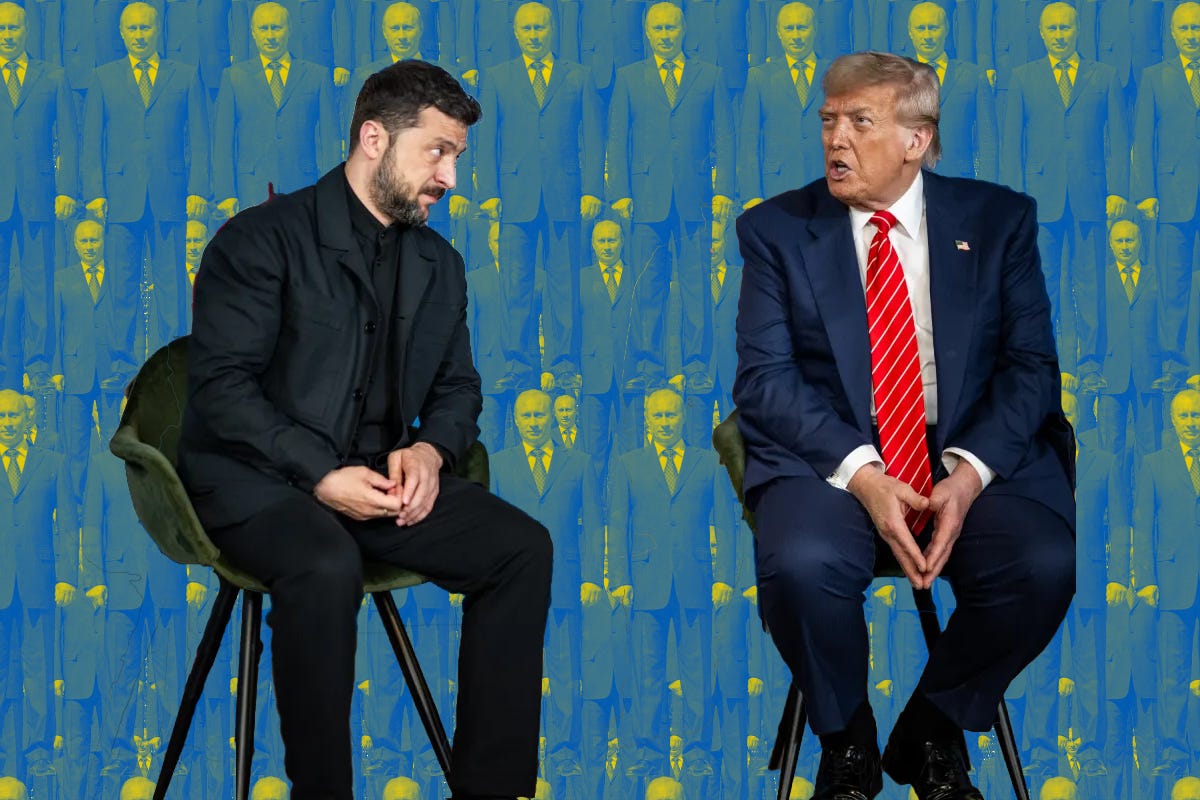
“When I first heard someone use the term ‘Donetsk People’s Republic,’” recalled Stanislav Aseyev. “I remember how a feeling of perplexity washed over me rather than the urge to smile, and I thought, ‘What the heck are they talking about? What republic? What kind of nonsense is this?’”1
A few months later, Aseyev watched his family trudge to a makeshift polling location. On the hastily-printed ballots, it read: “Do you support the act of state independence of the Donetsk People's Republic?” His family marked a tick next to the affirmative: “да.” Aseyev estimated that 80% of his male friends had signed up for the militias fighting against the Ukrainian government. He, himself, had been sympathetic to Russia, but all this chaos gave him pause.
“How did this happen?” Aseyev wrote in early 2015.
There is a technical answer to that question, of course. Moscow had, for years, been pumping propaganda into Eastern Ukraine: Claiming that the Russian language was being marginalized and crushed by the Ukrainian-speakers in Kyiv; that Ukraine was not a real country; that the Russian Orthodox faith was under attack; that NATO was inching the world closer to war; that moral degeneracy was corroding the foundations of the Western world; and so on. At the time, the central government in Kyiv, led by a man enriching himself with Moscow’s help, was orchestrating a pivot away from Europe and towards Russia.
When Ukrainians erected a massive tent encampment in the center of the capital, forcing the resignation of that kleptocrat, most rejoiced. But those in the east — in the coal-rich, working-class, poorer regions of the Donbas which had once fed the Soviet industrial empire — were worried. And Moscow kept telling them to be worried.
It is exceedingly difficult to say what would have happened if the people of Donetsk and Luhansk oblasts had merely waited to see how things would have played out in Kyiv — in the years since, Ukrainians have elected both a native Ukrainian speaker who hails from the west and a Russophone who comes from the middle of the country. But Moscow, having already lost its puppet in the capital, did not want to wait and see. So they pushed.
The Kremlin sent seven Spetsnaz GRU brigades into the Donbas, around the same time that it sent a huge amount of conventional forces to seize Crimea. Those soldiers, highly-trained special operators, delivered weapons and cash, surveyed Ukrainian military positions, and participated in the takeover of Ukrainian government institutions.
Certainly, a huge number of regular Ukrainian citizens in those eastern states opted to revolt when invited, but there was ample evidence they weren’t that serious. When a group took over a town hall in Donetsk, the Ukrainian government managed to bribe them into leaving. After meeting with those Spetsnaz fighters — dubbed the ‘little green men,’ because they arrived in unmarked uniforms — the locals turned around and re-occupied the town hall.2 Plenty of others only joined the Russian-funded militia because, with the coal mines and factories closed due to the fighting, it was the only way to earn money.
Aseyev had to witness the consequences of those actions. “Since the first days and minutes of the separatist protests, those who now proudly wear mud-colored balaclavas and DPR patches never have explained why they've transformed our land into a smoking ruin,” he writes. Figuring out the “us” from the “them” was notoriously difficult in those days. The whole area had been engulfed in the kind of sectarian violence that Ukrainians didn’t believe themselves capable of.
A year later, the fighting had turned life in much of the Donbas into hell. Ukraine and Europe were pushing for peace, but finding that the “people’s republics” were unable or unwilling to make a deal on their own — that decision rested with Moscow. And the Kremlin was constantly changing what it wanted.
In April 2014, Foreign Minister Sergei Lavrov announced that the militias would only lay down their arms if the Maidan tent encampment in central Kyiv were dismantled. Those encampments were mostly cleared by police in August and gone by the time legislative elections were held in October. The militias continued fighting. Demands flew in the ensuing months: A constitutional referendum to decentralize power from Ukraine’s central government, more rights for Russian speakers, a retreat of NATO from Europe. It became clear that they had only one real demand, however: Give the Donbas to Russia.
Kyiv was, nevertheless, negotiating in good faith. It negotiated a first ceasefire in 2014: Russian-backed forces quickly violated the deal and it collapsed entirely months later. A second ceasefire, Minsk II, remained on paper for years but was never fully implemented by either side. The fighting continued anyway. While Ukraine has been blamed for violating some aspects of the deal, observers agree that Russia repeatedly, consistently, and intentionally violated these agreements from the very moment they were signed.
"This war is a long-term, well-devised metaphysical project,” Aseyev wrote in 2016. It is not about economic growth or the size of seniors’ pensions. He described the actual work of this potemkin republic:
Aseyev: Reinforcing the rigid chain of command of a military dictatorship, engaging in active propaganda, expanding local media, establishing an “Academy of Interior Affairs” that trains those who just yesterday were Ukrainian students, proselytizing in schools and DPR-owned enterprises, and deepening economic relations with Russia […] As the key and only actor in this war, the Kremlin will, once again, determine the course of history, while, once again, all we will be able to do is adjust, however awkwardly, to Moscow’s initiatives.
Worse than that depressing realization, Aseyev was forced to face another grim reality.
“If we try to imagine the impossible — that the Ukrainian government simply returned to the occupied Donbas right now — we would find ourselves in a greater mess than under the occupation itself,” he wrote a year later. “No one, not the government, not those who live in free Ukraine, or the locals who are pro-Russian, is prepared for such a coming together.”
Aseyev wrote that last dispatch from prison. He had been kidnapped by the Russian-backed militias in 2017. He remained captive until he was released in a prison swap in 2019. When Russia’s full-scale invasion began in 2022, with tanks rolling through the city where he grew up, he volunteered to defend Ukraine.
Three years after Russia failed to topple Kyiv — 11 years after it failed to capture all of the Donbas — President Donald Trump and President Vladimir Putin are set to meet on American soil to negotiate the war’s supposed end.
The Americans already foresee a “West Bank-style occupation of Ukraine.” It’s a useful metaphor. We might also call this proposed deal Minsk III. Whatever you name it, we’re heading to the same place that the deeply unserious charlatans in the White House have been bringing us to since January. It is, in many ways, where Ukraine’s allies have been dragging it to for the past decade: Surrender.
This week, on a foreign policy realist Bug-eyed and Shameless: A briefing on the state of play ahead of tomorrow’s tête-à-tête; a study in delusion; and why Ukraine is not in as bad a spot as it seems.
The Joint Base Elmendorf–Richardson regularly finds itself responsible for intercepting Russian fighter jets which intrude into American airspace. It plays host to the Alaskan arm of NORAD, the joint U.S-Canada continental defence system designed, in part, to guard against Soviet missiles. While it’s not nearly as active as it used to be, the base still hosts a squadron of stealth fighter jets.
And on Friday, it will welcome Vladimir Putin.
During his first term, Trump had a flurry of meetings with the Russian president, most recently in 2018. Trump loves to brag that his relations were so special and wonderful that, under his tenure, there was no war. “Under President Obama, they [Russia] took a lot of territory,” Trump said on Monday. “Under Biden, they essentially took the whole thing.”
In fact, Trump’s first four years in office were all marked by war in Ukraine. Russia may not have expanded its territorial holdings over those years, but it certainly solidified the gains it made in the preceding years. By 2020, it was increasingly clear that Moscow was plotting a larger war — Trump was largely indifferent.
The pair haven’t met since. Which makes Friday a particularly auspicious occasion.
Ahead of that summit, I want to quickly go through three things: The good, Trump’s mounting skepticism of Putin; the bad, his entourage’s increasingly hard line against Ukraine; and the ugly, everyone else’s pitiful indifference.
“It takes two to tango, right?”
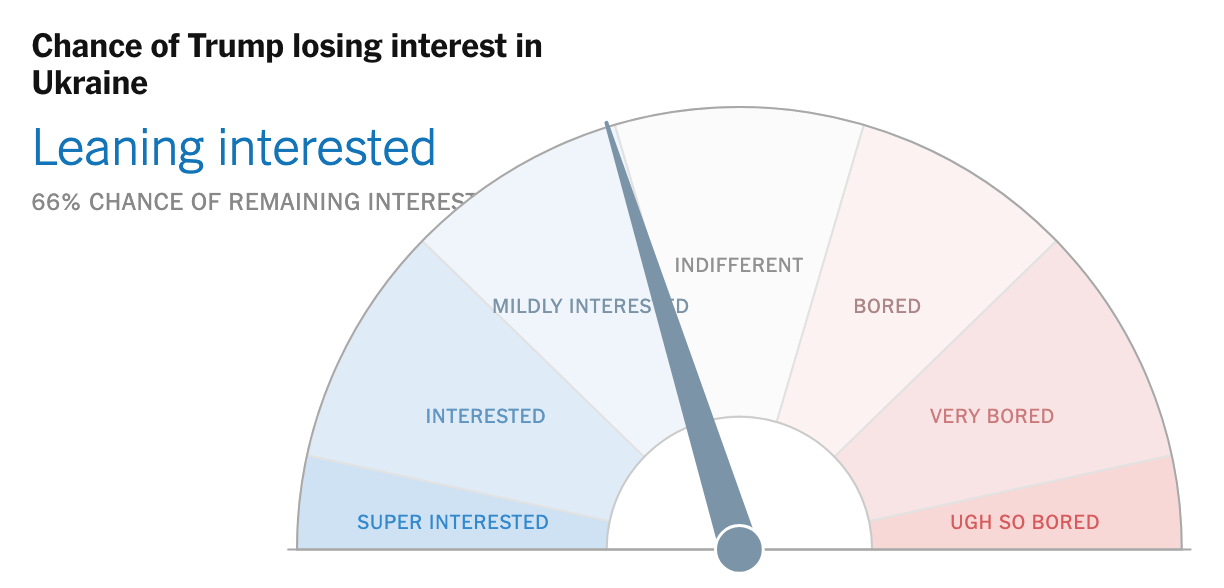
It has become clear that Donald Trump wildly over-estimated his ability to make a deal to end the war in Ukraine, and he’s feeling self-conscious about it.
His most snivelling sycophants have tried to lead him towards moving on, as I’ll talk about in a second, but Trump is too stubborn to let go. He swore that Russia wouldn’t be stupid enough to seize more territory on his watch, he played up his legendary status as deal-maker, and he presented himself as the only man smart enough to strike peace.
Russia has seized more territory, he hasn’t been able to make a deal, and he’s been too stupid and indifferent to even learn the nuances of the conflict let alone resolve them. As we all knew would happen.
But Putin misplayed his hand, here. Rather than frustrate Trump into accepting a bad deal, or no deal at all, he rankled the president into anger. Trump has kept up weapon sales to Ukraine and has even threatened Russia’s oil clients with sanctions for keeping Moscow afloat — both things he boasts about frequently.
Speaking Monday, Trump made some good noises, albeit in his usual scuzzy fashion.
“Russia's occupied a big portion of Ukraine. They've occupied some very prime territory,” Trump rambled. “We're going to try and get some of that territory back for Ukraine.” (He went on to decry that Russia has seized Ukraine’s “oceanfront property.” As he noted: “That's always the most valuable property.”)
Beyond the constant real estate allusions, Trump vowing to regain Ukrainian territory is a positive sign. Better yet, he’s talking-up the kind of punitive measures that could make that a real possibility.
“They're not doing well,” Trump said of Russia. “Their economy is not doing well right now because it's been very well disturbed by this. It doesn't help when the president of the United States tells their largest — or second largest — oil buyer that we're putting a 50 percent tariff on you if you buy oil from Russia. And I haven't stopped there. I mean, look, I was all set to do things far bigger than that.”
While we should be both skeptical about the diplomatic impact Trump’s tariffs can really have, and consider that Trump always chickens out, these are modest indications that Trump knows he’s being jerked around. That, alone, is worth a lot.
Trump has also been blunt that he has no idea why this summit is even taking place.
“I'm going to see what they want to meet about,” Trump mused, adding “I'd like to see a ceasefire. I'd like to see the best deal that could be made for both parties. You know, it takes two to tango, right?”
Failing that, “I may leave and say good luck, and that'll be the end.”
“Good Luck”
When J.D. Vance insisted he condemns “the invasion that happened,” he prefaced it with “of course.”
But, let’s be clear, that’s not a given. Vance has showed a total lack of interest in Ukraine, except as it relates to his metatheory about deep state warmongers provoking conflicts to expand their power.
One of Vance’s chief advisors in this regard is financiers David Sacks. Speaking to the hard-right American Moment PAC (Dispatch #105), Sacks insisted that a “blob” of pro-war politicians instigated the war in Ukraine, that Kyiv was going to be destroyed, and that the realist approach would be to cut a deal whatever the cost and seek “detente with Russia.”
He continues. (Notes and fact-checks in brackets)
Sacks: We did deliberately pass up the opportunity for peace — but they've tried to say that the terms weren't good enough. In fact, the terms were favorable and certainly more favorable than anything Ukraine's going to get now, and it would have avoided all of the destruction of this war. [Those familiar with negotiations say both sides were nowhere near peace.]
Even if you believe that the United States did nothing to provoke this war, even if you believe that it was okay for us to back a coup in Kyiv in 2014 [Russian propaganda], even if you believe that the Russians should have been just fine with the CIA setting up a dozen secret bases on their border inside Ukraine [true, but those bases helped detect and thwart aggressive Russian covert action], having a network of biolabs [joint Russian/QAnon propaganda] and with the United States pushing relentlessly to try and bring Ukraine into NATO [America was openly saying that it was unlikely Ukraine would join NATO in the near term], even if you think that all of those things weren't a provocation — I still think that once Biden sabotaged the peace deal that was available there he became a co-owner of this war. So, like I say, it takes two to tango.
This man, who wholeheartedly believes that utterly deranged ‘biolabs’ conspiracy theory (Dispatch #127), has an enormous influence on Vance. And the vice president dutifully parrots Sacks’ talking points: “We’re done with the funding of the Ukraine war business,” Vance declared this week.
Inherent in this position, however, is learning — or, at least, acknowledging — as little as possible about the conflict itself. These men couch their positions in the language of realism, but are really just staking out domestic political positions and molding the facts of the conflict to fit.
Take a speech that Vance gave to the Trump-aligned Quincy Institute last year. In it, he decries politicians using “the same old slogans” to justify wars. “In the Ukraine context: This is a war of democracy against tyranny. Well that's, like, a very simplistic way, of course, to think about it. I don't think anybody, even the people who say these things, actually believe them. Ukraine is hardly a perfect democracy.” That is an indefensibly stupid position that can be countered easily: Ukraine has free and fair elections, Russia does not.
Vance went on to repeat his view that America should withdraw all support for Ukraine — even as he insists it should ramp up support for Israel’s war against Gaza — because it is simply not in America’s interest.
In polite company, however, Vance insists that peace is possible. “We don’t like that this is where things are, but you have got to make peace here,” Vance said this week. “And the only way to make peace is to sit down and talk.”
You can pick up on the incoherence, right? Vance believes that America is responsible for starting the war, that Russia was provoked, that Ukraine is undeserving of support, that America can’t afford it — but also that there’s an easy deal to be done, if only the realists were in charge.
Vance spends painfully little time explaining how, exactly, a deal should be done. But luckily we have a bit of direction from his preferred foreign policy thinktank, the Quincy Institute. Earlier this year, they unveiled “A U.S. Peace Plan for Ukraine,” a MAGA-friendly roadmap to a deal. The outline of their proposal looks like this:
Ukraine will swear off NATO membership, but will join the EU after undergoing elections and some political reform.
Ukraine will be allowed to operate a “a Western–armed, trained, and maintained Ukrainian military force capable of deterring and defending against any new invasion.”
The United Nations operates a Ukrainian reconstruction fund using frozen Russian assets.
Kyiv and Moscow accept a ceasefire freezing the current contact lines, “establishing a de facto border in the four provinces of eastern Ukraine that will not be further changed by force or subversion,” to be managed by peacekeepers.
You may be surprised to learn that this is, more or less, Ukraine’s position. It has been Ukraine’s position for about three years.
In fact, when Ukrainian and Russian negotiators met in Istanbul in 2022, Ukraine was actually engaging with even worse terms than the Quincy Institute lays out there.
A major barrier to settling this dispute came on the topic of security guarantees. Ukraine wanted, as the Quincy Institute correctly summarizes, “the right mixture of incentives and deterrents to make a resumption of the war by either side as unlikely as possible.” But that topic was fraught from the beginning: Russia wanted to act as one of those ‘guarantors,’ as a way to weaken the guarantee itself; and America refused to commit to any kind of obligated defence of Ukraine. (Dispatch #128)
The other is the topic of the contact lines. While we can’t say for sure what Kyiv is willing to accept in these talks, it seems Zelensky has recognized that any ceasefire deal will, at best, mean keeping the current frontlines where they are. Of the both sides, it’s Moscow that is the holdout, here. Putin’s demand has consistently been that the frontlines should move deeper into Ukraine, giving Russia control over the four oblasts it illegally tried to annex in 2022. Put simply: Russia wants to use a peace deal to seize more Ukrainian land and kidnap hundreds of thousands of Ukrainian citizens.
Russia, just this week, reiterated that its demands have not changed one iota.
But Vance et al know this. They know what a reasonable deal would look like, because the Quincy Institute laid it out. They know that America would be hopelessly embarrassedand discredited if it forced Ukraine to surrender more land or demilitarize, and that it would risk a more devastating war in the medium-term.
And yet this B-team continues to pretend as though it has some magic solution to end this conflict tomorrow.
Steve Witkoff, Trump’s envoy to both the Middle East and Ukraine who is hopelessly tied to Russian oligarchs, came back from Russia parroting exactly Putin’s expansionist plan, regurgitating it as though it was a clever solution. More recently, it seems Witkoff endorsed the grotesque idea for a “West Bank-style” partition of Ukraine. It’s not clear what Witkoff even has in mind when he, apparently, signed on to that grotesque metaphor, but it again shows that these guys have no actual ideas.
While Trump may be, rightly, skeptical of Putin’s actual goals in negotiations, he is supported by an absolute clown car of cosplaying ‘realists’ who get their news from Twitter, implicitly trust Vladimir Putin, and couldn’t negotiate their way out of a paper bag.
“You are pathetic and weak”
I do not have a lot of love for Viktor Orbán, president of Hungary.
The man is a corrupt wannabe despot who is ruining his country’s democracy, corroding the EU from within, and wrecking consensus on defending Ukraine.
But this week, Orbán stepped in front of the cameras and delivered a surprisingly on-point summary of the situation.
Now, I think Orbán is actually arguing that Europe ought to abandon Ukraine and side with Russia, which is obviously bad. But here’s a good occasion to take some quotes out of context. Because Europe does look weak, and it doesn’t have to.
I won’t go through the nitty gritty of the argument — for that, you can read Thomas Wright at Brookings or Agnia Grigas at the Atlantic Council — but suffice it to say that the EU, along with its other NATO partners including Canada, have allowed America to take the lead on Ukraine for far too long. Other countries can and should do more to step up. (This is, credit to Vance, something he repeats often.)
The fact is, other NATO countries trusted America to lead the way on Ukraine for a variety of reasons: It had a longstanding mano-a-mano relationship with Moscow; it had more weapons and cash; and it could speak with a single voice, where Europe is always bickering.
Today, however, we have good reason to question America’s commitment to countering a rogue Russia; Washington is threatening to turn off the taps; and Europe has become significantly more unified than even the White House.
I’ve spoken to NATO officials from several NATO countries over the past year, all of whom insist that they are this close to giving up on America and pursuing a standalone Ukraine policy. But they haven’t fully committed.
Last week, the so-called Coalition of the Willing met virtually. The group includes EU and NATO members, but technically excludes America. The Coalition was organized to pledge support for Ukraine in the event of a peace deal, and could be the vehicle through which peacekeepers are deployed to monitor a possible ceasefire. This group was struck explicitly in response to Trump’s re-election, as a way for France and the United Kingdom to organize support outside of Washington.
When they met on Wednesday, who attended? J.D. Vance. In a readout released by Ottawa, the leaders “welcomed the leadership and initiative of President Trump and the United States and discussed ongoing efforts toward securing peace in Ukraine.”
I’m not sure I fully fault this Coalition of the Willing for walking in lock-step behind the United States to date. Like I opined in the opening section, Trump could — by force of sheer pig-headedness — stumble into a good deal or lead the charge in bankrupting Moscow. But given his own meagre attention span, his personal affinity for Putin, and the strong magnetic pull coming from his own administration, we can’t keep waiting around and hoping for a different result.
The fact is that things are bad right now in Ukraine, but not as bad as Russia would have you believe.
Headlines have blared that Russia has advanced rapidly in Ukraine’s east, advancing roughly 10km into Ukrainian territory. But, according to the Institute for the Study of War, these gains have not yet been consolidated: Meaning it is quite likely that Russia rushed these gains in order to score a propaganda win.
What is certainly real are the increasingly-brutal tactics Russia is deploying on the frontlines. It is bombarding population areas even more than before, hoping to soften the ground for its eventual advances on multiple fronts. But even then, Russia still lacks the resources necessary to advance quickly or far.
Meanwhile, Russia’s defence production is showing signs of overheating. While it is absolutely producing a significant number of increasingly-sophisticated drones, there are signs that its production in other areas is faltering.
Even senior Russian officials are acknowledging that the economy is heading towards recession. Economists who look past Moscow’s ginned-up statistics see evidence of a double-whammy of de-growth and price inflation. Although this likely won’t slow down the war machine — it might speed it up — it does make Russia particularly vulnerable to any additional pressure that can be put on it.
Europe and Canada should wait and see how Friday plays out. If this is yet another round of chicanery, however, it is high time that the Coalition of the Willing stops waiting on its unwilling partner.
What Happens Tomorrow?
Who knows.
The prevailing factors are notoriously hard to predict. Will Trump, as he says, know “in the first two minutes…exactly whether or not a deal can be made”? Will Vance, Witkoff, and Sacks weasel their way into the president’s decision-making process and convince him to cozy up to the Kremlin? Will Europe, Canada, and Ukraine figure out a burden-sharing deal that could allow Trump to claim victory, while increasing pressure on Russia?
One variable I’ve not mentioned yet is arguably the hardest to gauge: What does Putin do?
Despite his repute as a master strategist and expert manipulator, the Russian president has consistently misjudged Trump. He counted, it seems, on the many prevailing anti-Ukraine forces — which Russia has actively supported — to pull Trump out of the fight. As such, Putin has refused to move off his unreasonable negotiating positions. This has backfired, leaving Trump with the impression that he’s been cheated. Trump hates feeling cheated.
So if you’re looking for an intelligence assessment of what happens tomorrow, here’s my armchair take: I’d say, with moderate confidence, that Trump walks away from Friday’s summit flattered but reverts back to form by next week after the meeting fails to produce clear deliverables, and continues threatening Putin — without taking firm action. I could guess, with low confidence, that it is plausible Trump is immediately offended by Putin’s intransigence and blows up the meeting on the spot, or otherwise decides to punish Moscow for refusing to negotiate in good faith. Alternatively, it is also possible that Putin shifts his position in some clever way to win Trump’s favor, and that the president pressures Ukraine to sign a bad deal.
The overwhelmingly likely outcome is that these negotiations produce no real breakthrough, because Russia refuses to abandon its maximalist demands.
As such, the world can’t keep doing the same thing and expecting different results. Someone has to change the dynamic of this war, and it doesn’t seem like it will be Putin or Trump.
That’s it for this spot analysis on a crazy week.
In case you haven’t already, my new book is available for pre-order!
If you missed them, my recent columns in The Star argue that Canada should tell Trump “no deal” and that Ottawa can and should participate in the International Court of Justice case against Israel.
Until next week.
In Isolation: Dispatches from Occupied Donbas, Stanislav Aseyev, Translated by Lidia Wolanskyj. (2022)
Russian Special Operations Forces in Crimea and Donbas, Tor Bukkvoll. (The US Army War College Quarterly: Parameters, Summer 2016)
Well, that was a very thorough overview of the Ukrainian state of play with Russia & the US. Very informative.
I’m really up on the war in Ukraine and your analysis is spot on