


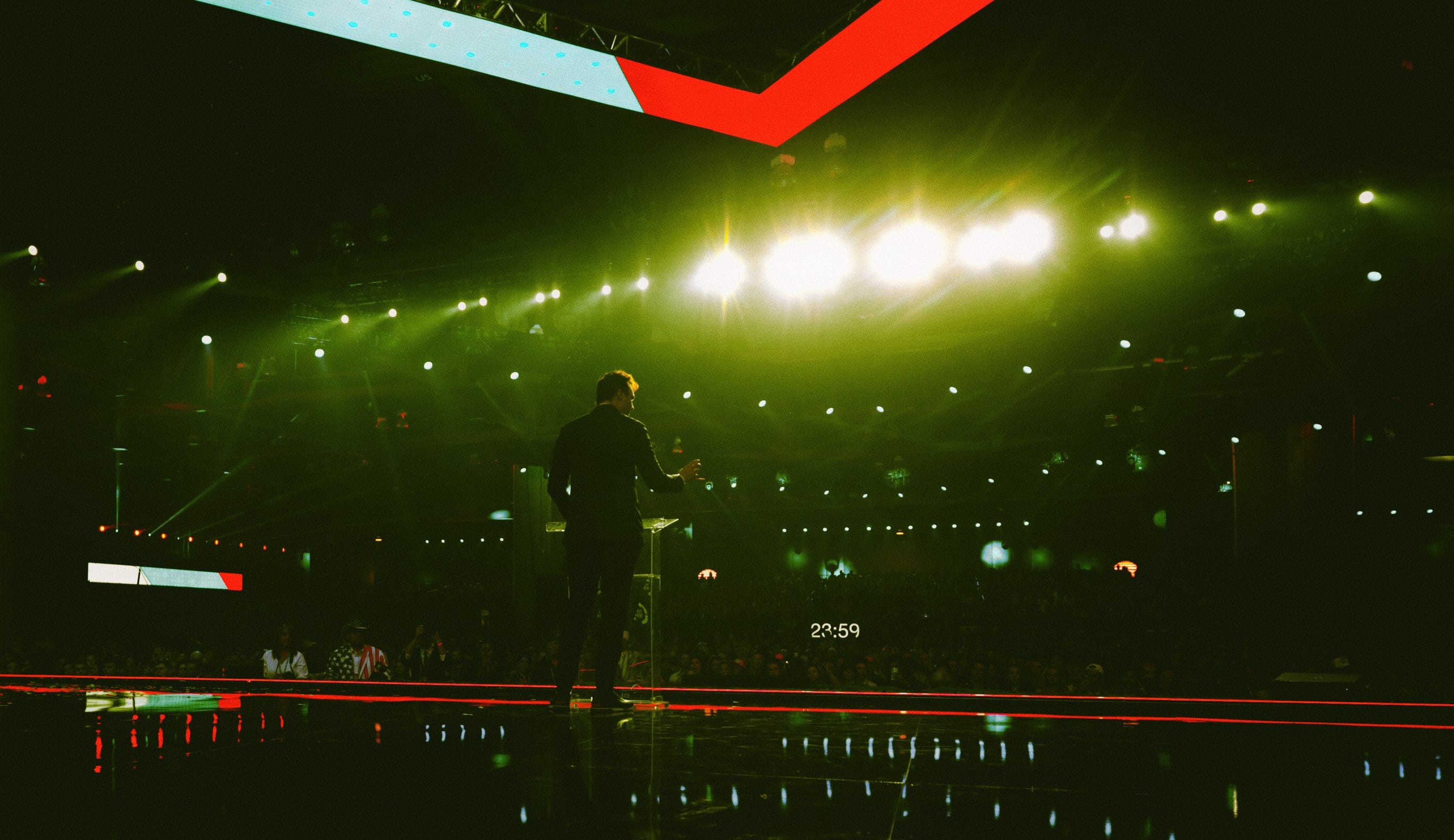
“My question is, again, directed to Mr. Kirk,” the man in the jean jacket said.
The man was standing in the back of a college auditorium, and it was his turn at the microphone, held aloft by a campus volunteer.
“As the guy before said, you've advocated for homosexuality, said that there's a place for the gay agenda within the conservative movement,” the man began, waving his arms around to reveal patches on his jean jacket: One, the flag of the Roman empire; the other, a skull impaled by a combat knife.
“Is there any point where conservatives should take a moral stance on Christian morality, or should we abandon it altogether?” He asked, rhetorically. He wanted to know: “What is your brand of conservatism doing to actually conserve Christian morality?” Because, he said, “if we’re ceding to the left on transgenderism, gay rights, gay marriage, we don’t want that in conservatism.” A swell of applause rose as he rattled off his list.
Charlie Kirk, standing in front of a banner that proclaimed CULTURE WARS, looked unusually annoyed. “So you don’t want him in the conservative movement?” He said, pointing to his guest onstage, Rob Smith — a Black, gay, Iraq War veteran, and conservative influencer.
“No!” “No we don’t!” “Not if it waters down the movement!” came the cries from the audience.
Kirk and Smith tried to mount a defense, but the jeers continued. Kirk steered the conversation towards more questions from the audience. Shortly after, a baby-faced student with a MAKE AMERICA GREAT AGAIN hat stepped to the microphone with an even more charged question: “Can you prove that our white European ideals can be maintained if the country's majority is no longer made up of white European descendants?”
Kirk got more and more testy as this went on. He waved around his anti-immigration bona fides before rejecting the “racist question,” and decrying the idea that “America should become a white ethnostate.” A wave of disgruntled murmuring rose from the audience. And it was just the beginning. Over the course of the evening in Ohio, and at nearly every stop on Kirk’s cross-country campus tour, a veritable army of trolls walked to the microphone to needle the face of the young MAGA movement. Kirk, they believed, wasn’t radical enough — not yet. They wanted to make him squirm.
If you’re familiar at all with Charlie Kirk and his organization, Turning Point USA, you likely know him as the college firebrand, the fresh-faced activist who loves to debate young leftists — and DESTROY, DECIMATE, DEMOLISH them. You may have seen the ample coverage of the progressive protests outside his events, evidence of the supposedly censorial nature of liberalism in the face of an intellectually ambitious ascendant right-wing movement. Even if you’ve never heard of him before, you’ve no doubt followed, with some degree of horror, the fallout from his assassination.
This week, on Bug-eyed and Shameless, I want to dispense with the myth-making and instead talk about who Charlie Kirk was, look at the organization he built, and break down how it fits into Donald Trump’s reactionary movement.
There’s no hot takes, just a deep dive on where Charlie Kirk fit in our current moment: And the vacuum that has been created now that he’s gone.
31-year-old Charlie Kirk was killed by an assassin’s bullet at a campus event in Utah on Wednesday. Police have apprehended a suspect, but the exact motivation of the killing is still unclear.
To that end, speculating about the why, how, and what’s-next of the killing strikes me as particularly useless.
But to get some basic ideas on the table: Kirk’s murder is a tragedy, and an unfortunate continuation of both America’s assassination culture and its gun obsession. Kirk was a father of two, and he was a human being. Trying to meter out sympathy to murder victims and their families based on their political beliefs is an exhausting and pointless endeavor. He didn’t deserve to die. People who trip over themselves to insist that this murder deserves a special, lower level, of sympathy are really just peacocking their own kind of edgy politics, and I find that pretty uninteresting.
Nor could such an assassination ever be defensible. Responding to speech with murder is both fundamentally illiberal, antithetical to how we’ve built our society, and practically fucking stupid. There is no speech that should be met with a bullet through the neck and no way to stop that speech with a gunshot. Martyrs make great spokespeople, and vice versa.
There is also a reasonable anxiety that his death will make things quite a bit worse. Kirk straddled fringe movements and national power, and we don’t know how either side is going to react. There are already some genuinely terrifying rhetoric coming from both government officials and outright extremists, and we don’t know how that talk will be put into action.
Trying to debate the morality of his killing is pointless and forecasting the consequences is madness-inducing. These basic truths do not mean we must trip over ourselves to whitewash or rehabilitate Kirk’s beliefs. In the same way that his beliefs do not justify his murder, his murder can’t justify his beliefs either. Sweeping proclamations like “Charlie Kirk was practicing politics the right way” are inane efforts to over-eulogize the man.
So this dispatch has one clear take, and it has very little to do with his assassination. It is this: Charlie Kirk was one of the most successful and radical right-wing voices in America, and he was poised to do some very big things.
Understanding how Charlie Kirk got to where he did is a pretty useful way of understanding Trump’s movement and the state of American democracy right now.
Turning Point USA did not begin as a grassroots organization, but it became one.
Charlie Kirk set up the group in 2012 as a vehicle to castigate the Democratic administration for their debt spending ways: Seemingly before the 18-year-old Kirk even had an organization to speak of, he was booked as a guest on Fox News. A charismatic speaker, he quickly found an audience of conservatives who wanted to hear about how public schools and private colleges were foisting liberal economic propaganda onto youth. He showed up to speaking gigs and rallies armed with a copy of an economics textbook written by liberal Paul Krugman: One that denied the economic benefits of Ronald Reagan’s tax cuts.
“What we're trying to do is we're going into the high schools and the colleges to challenge these textbooks that publish flat out falsehoods and fallacies,” Kirk told supporters early in his crusade.
One of the conservatives in the audience for Kirk’s talk was a retired businessman named Bill Montgomery. Thanks largely to his patronage, Kirk had about $500,000 in the bank by 2013. Kirk and Montgomery co-founded Turning Point USA, the scaffolding for a new kind of campus conservatism.
TPUSA quickly began putting together campus chapters to act as the foundation of his movement, but first it needed to make a name for itself. Kirk experimented with YouTube as a channel to reach young people: He posted videos of him conducting streeters in his native Chicago and cellphone footage of encounters with campus police. He was an early adopter in the art of political meme-making, helping to flood Facebook with all kinds of conservative copypasta.
At this point in America, broad-appeal young conservative activism was basically unheard of. Here was Kirk with a high-quality proof-of-concept.
In 2013 he raised $2 million, a figure he would double the next year, then double again the year after. With his millions, flowing from conservative activists looking to influence the next generation, Kirk set to work on nationalizing the petty squabbles of his former classmates. (Kirk dropped out of school to focus on activism.)
TPUSA built out a database of ideologically unaligned academics: A “Professor Watchlist” of those guilty of spreading “leftist propaganda” on campus. He began peddling in the kind of culture war jargon that was still somewhat foreign to older activists: Decrying cancel culture, trigger words, and safe spaces. Fox News branded Kirk as “one of our favorite millennials — if not the favorite” because he translated the ideological warfare happening on campuses for a broader audience Did it matter that the fights were contrived and exaggerated for political effect? Not really.
Kirk and his crew were pro-gun, anti-feminist, climate-skeptical, in favor of small government, anti-immigration and, most importantly, pro-Trump. They used their pariah status to great effect.
Despite professing to be studiously non-partisan and despite TPUSA being an educational not-for-profit, Kirk threw himself into Donald Trump’s 2016 campaign. Solidly in the camp of a political movement that was entirely and radically offside the youth of America, Kirk and TPUSA evolved into a new kind of activism. He would no longer just whine about the deplatforming and censorship, he was going to pivot TPUSA onto the front foot.
Kirk’s content took on the hue of vociferous debate: There he is destroying democratic socialism, there he goes crushing identity politics, that’s him roasting Congress. Sometimes this was actually debate, but more often it was one person with a microphone shouting down someone without one.
Ben Shapiro, who was a friend of Kirk’s and a frequent guest at TPUSA events, popularized this format to enormous effect: But Kirk was the one laying the groundwork for this kind of gladiatorial argumentation that hadn’t been part of the conservative movement for quite some time.
While Fox News pundits and Trump campaign apparatchiks were ensconced in their Manhattan high-rises, Kirk began relentlessly touring university campuses. His events became both a coming-out for a new generation of young conservatives and also a flashpoint for cultural tensions: Left-wing students began protesting and demanding that Kirk be forbidden from their campus, for his offside views on feminism and LGBTQ rights. It all made for great content. TPUSA began pumping out videos of “ANTIFA” coming to silence his peers and denouncing “snowflakes” who couldn’t take a joke.
This was all contrived, but it met a growing population of young Americans — and Canadians, Europeans, and Australians — who started to get sick of the stifling orthodoxy of progressive liberalism. Gay marriage, post-modernism, gender theory, transgender acceptance: Ideas that felt rebellious just a few decades ago had become bog standard, and an orthodoxy that felt imposed. Teens love to rage against the machine, and TPUSA events became an edgy and transgressive to do so. You would wade through a sea of purple-haired pride-flag-waving protesters to enter a room of forbidden truths.
At the annual Student Action Summit, TPUSA’s big confab, the who’s-who of the emerging nü-right came out to strut their stuff. Donald Trump Jr. was the draw for their 2017 summit, Jordan B. Peterson would grace the event stage shortly after his massive 12 Rules for Life was published in 2018, Supreme Court Justice Brett Kavanaugh showed up in 2019. Donald Trump himself began gracing the TPUSA stage.
By 2019, TPUSA was reporting nearly $30 million in annual donations. It registered political action committees which also pulled in millions, pouring cash towards electing particularly-MAGA candidates. It managed a database of tens of thousands of young, ideologically simpatico true believers from across the country.
Kirk’s own star rose with TPUSA. He became a totem for the young flank of the movement — a wing that was considerably more radical than their elders. He wrote a book, Campus Battlefield: How Conservatives Can Win the Battle on Campus and Why It Matters — with foreword by Donald Trump Jr. — an inane book of platitudes and empty rhetoric, but it laid out the enormous impact TPUSA was having.
Kirk: We have organized more than five thousand events, trained more than five thousand conservative Millennials, and conducted more than five hundred thousand face-to-face conversations—the most effective method of engagement. We have launched more than 350 TPUSA chapters and provided over 750 like-minded student groups with resources such as activism supplies, leadership training, and field staff support.
For all its success, Trump’s MAGA movement was horrific at grassroots organizing. They dominated the airwaves and monopolized people’s attention, but they utterly failed at identifying their supporters and activating them into the cause. Kirk wasn’t just mobilizing people, he was actively recruiting them. That was an enormously unique and valuable thing.
Kirk was a well-tolerated spokesperson for the movement, but TPUSA itself was a hodgepodge of radicals and moderates, racists and social climbers, ideologues and opportunists. It boasted senior figures like Candice Owens, a gullible conspiracy theorist; Benny Johnson, a paid stooge of Russia; and Ashley St. Clair, who was photographed pallin’ around with white nationalists. (And who would go on to have Elon Musk’s baby.)
This was all possible because TPUSA was one of the few pieces of MAGA that was both organized and open. It had members, events, mailing lists, secretaries and vice presidents — but it was also, increasingly, part of Trump’s political apparatus.
And that made Kirk a very important bridge between two worlds.
Nick Fuentes is a neo-Nazi.
Journalists have equivocated over this fact for some time, particularly after he dined with Donald Trump at Mar-a-Lago, but it is a simple fact. He praises Hitler, denies the Holocaust, peddles antisemitic conspiracy theories, and supports what can only be described as phrenology.
He is the boss of a hard-right movement of terminally-online losers who call themselves the Groypers. They are young, they are radical, and they believe they have a unique opportunity to turn America into a fascist all-white utopia.
Over Trump’s first term in office, particularly after the race riot in Charlottesville, scrutiny of figures like Fuentes increased and their brand became more and more toxic. It emerged, much to Kirk’s embarrassment, that TPUSA had become a useful forum for the Groypers and that some of his key organizers were chummy with Fuentes. With his privileged position at risk, Kirk ordered these white nationalists banned from TPUSA events. The “Groyper army” would not be welcome.
But it wouldn’t be that easy. TPUSA may have started as an astroturf organization, funded with millions from wealthy Republican benefactors hoping to groom youth into their brand of politics, but it had become a quasi-organic movement of many regional chapters and local organizers. Trying to root out the Groypers was easier said than done.
Fuentes knew that.
“We can do a lot [of] damage at TPUSA,” Fuentes wrote that year. “I think they are the best foil.” He and his fellow Groypers began to target specific Kirk campus tours and rallied their extremist supporters to show up. They strategized on what to wear, what to ask, and how best to take over the TPUSA machinery and megaphone.
The very nature of Kirk’s events lent themselves well to this kind of entryism. Sending 100 white nationalists to a Trump rally was pointless: They would, like everybody else, show up, sit down, listen patiently, cheer at the right moments, then go home.
But at TPUSA events, participation was the whole point. The audience was full of kindred spirits who were encouraged to go to the microphone and ask the right questions: How do we push back against leftism on campus? What books should I recommend to my classmates? Can I date a progressive? Every once in awhile, some determined leftist might saunter to the microphone with a gotcha question to pose, but these events were meant to be both participatory and comforting.
Fuentes’ army was showing up to pierce that safe space. They arrived with cutting questions about Kirk’s support for Israel, hammering him with esoteric conspiracy theories about Israel’s supposed foreknowledge of the 9/11 attacks; they demanded to know why he tolerated immoral homosexual activity; they castigated him for his supposed tolerance for immigration.
This was “the Groyper war.” And it’s undeniable that Fuentes won it.
In city after city, TPUSA events became some of the most high-profile and high-production white nationalist summits you could find, to Kirk’s chagrin. When Kirk was slated to appear at UCLA with Donald Trump Jr, Fuentes urged his supporters to show up and ask tactical questions to embarrass the TPUSA founder: “The name of the game tomorrow is to expose Kirk in front of Don Jr.” When TPUSA held its annual leadership summit in West Palm Beach, Fuentes tried to hold a rival event down the street. Fuentes claimed, with some credible evidence, to have inserted his Groypers at all levels of TPUSA’s organization.
It was all adversarial, but it was symbiotic. Fuentes needed the oxygen of TPUSA’s openness, and TPUSA needed the controversy and attention of the Groypers.
And on January 6, everything crashed together.
Ali Alexander was a very successful sloganeer. He joins the pantheon of great political one-liners with his creation: “Stop the steal.”
Donald Trump was always going to claim that the 2020 election was stolen from him. But it was Alexander who pushed the three-word phrase that became synonymous with rambling bug-eyed diatribes about abnormalities in DeKalb county and vague allusions to “Chinese bamboo paper.”1 Alexander was part of a digital mob that helped piece together the meta-therapy of this election-rigging, and he was positioning himself as a young leader in the movement.
As it became clear to Trump that he had lost the 2020 election, his team began to adopt these half-baked ideas as proof. And activists like Alexander raised the idea of holding some kind of event to coincide with the counting of the Electoral College votes. In mid-December, Trump agreed: "Big protest in D.C. on January 6th. Be there, will be wild!" There was no plan to hold a protest in D.C. on January 6 because this tweet was the plan.
So Alexander, an ally of Nick Fuentes, went and began organizing “Wild Protest.” But Alexander had no actual organization or skill, so he outsourced: He pulled in donors, politicians, and eventually the president himself made plans to hold a rally on the Capitol that day. But to get people to actually show up, Alexander turned to Charlie Kirk.
“You did so much work behind the scenes that you weren't given credit for,” Alexander said of Kirk in 2022. “And, you know, don't be ashamed of the buses.”
Kirk had bragged about bringing “80+ buses full of patriots” to the Capitol for the Stop the Steal rally, a claim he deleted after the President’s supporters smashed into the seat of American democracy. Alexander would later tell a Congressional committee the actual mobilization of attendees “was ran through Turning Point USA.” Multiple insurrectionists who were convicted for their role in the attack testified that they were bussed there — and had their hotel rooms paid for — by TPUSA.
TPUSA’s involvement went further than that. Tyler Bowyer, the group’s chief operating officer was part of a scheme to arrive at the Capitol as a fake elector for the state of Arizona. A committeeman with the RNC, Bowyer’s job was to arrive at the Capitol and insist that Arizona had actually voted for Trump, and that he ought to be the delegate to the electoral college. Prosecutors say this amounted to fraud, an attempt to change the democratic results of the U.S. election. (A criminal case against Bowyer is ongoing but is likely to be dismissed.)
After Trump was removed from power and his movement shrank, those left loyal to him grew more radical. Kirk adopted the so-called ‘great replacement theory’ — insisting that Democrats were enacting a plan to use immigration to “diminish and decrease white demographics in America.” He leaned harder into Christian nationalism, musing on his show that the right response to “the growing threat of Islam” may be to ban the religion entirely.
In 2022, Kirk held a live event with Christian extremist Sean Feucht, where a member of the audience asked if America was heading towards civil war. Kirk answered:
Kirk: We need a political extinction event of the woke left. We need to make it unacceptable to believe, for example, that we should judge people based on the color of their skin, that men can become pregnant, that we should have segregated classrooms. Like in Colorado, they have playtime at playgrounds only for black families, and white families are not allowed like this. This garbage has got to stop. And I believe most Americans are looking for an outlet or a vehicle to repudiate that, and want a return to team reality. The civil war thing, here's what I do believe: Most Americans don't want a civil war. I don't think we will get to a civil war unless, for whatever reason, the other side tries to provoke people.
On his show in 2023, he offered this take:
Kirk: Joe Biden is a bumbling dementia-filled Alzheimer's corrupt tyrant who should honestly be put in prison and/or given the death penalty for his crimes against America.
Kirk began talking more explicitly about how immigration could see “America becoming more Third World” and adopting outright white supremacist lingo, tweeting: “Whiteness is great. Be proud of who you are.”
When Trump mounted a fresh bid for the White House, TPUSA stepped up and became a core piece of his ground game. Because the Republicans had basically given up on direct voter outreach, that work was outsourced to PACs and third-party groups, like Kirk’s. Marshaling tens of millions of dollars, between its non-profit and its PAC, the group homed in on Wisconsin and Arizona as their target states: And they succeeded, with both states flipping from Democrat to Republican. (The effort was led by Bowyer, the same guy who had tried to overturn the results of the 2020 vote.)
To say that Kirk was in a pole position in 2025 is a wild understatement. As a podcaster, radio host, TV personality, and writer, his audience was well into the tens of millions. As a political operative, he controlled a core piece of the Republican political infrastructure. As an influencer, he was the hinge between Trump’s geriatric leadership and his growing legion of young hoplites — including a movement of hard-right radicals.
The Kremlinology of Trump’s harum‑scarum administration is normally not important for the public to understand. But Kirk’s senior position in the movement and his relationship — bad as it was — with Fuentes and this hardcore group of white supremacists and neo-Nazis is important to understand. Fuentes, consummate troll, spent years trying to both destroy and convert Kirk. He succeeded, to some degree, at both.
“Charlie Kirk declaring that there is a war on White People yesterday is just a testament to how thoroughly Groypers have taken over the conversation at the national level,” Fuentes posted in 2022. In 2024 he celebrated how “Charlie Kirk became a Christian Nationalist.” This summer, he wrote: “Charlie Kirk has effectively adopted Groyperism 100%”
Other times, Fuentes was more dour. He railed at Kirk’s attempts to discredit his extremist movement. “Charlie Kirk and Shapiro want us branded Alt Right so they can deplatform and blacklist us,” Fuentes wrote in 2019. “That is the difference between ‘us’ and ‘them.’” As he seized on the anti-Israel settlement following the war on Gaza, Fuentes went hard on Kirk’s support for Israel — accusing Kirk of “working for the Jewish interest.” He went on:
Fuentes: We settle for breadcrumbs. Breadcrumbs fall off of the table at Fox News or at The Blaze or at The Daily Wire. And…there are a lot of Catholics, or America Firsters, or white separatists, white nationalist types who are going to scurry under the table and eat up the crumbs gratefully. Meanwhile, the Jews are at the table having a feast...And Charlie Kirk is serving up a feast.
Of all the targets of Fuentes’ ire, of which there are many, Charlie Kirk stands apart. The neo-Nazi influencer dispatched hundreds of his fans to harass and embarrass Kirk, and found that it was great for his own brand. It was a microcosm for the war playing out inside the Republican Party now, the tension dragging the party in power further towards its dark fringes.
In a livestream Thursday night, Fuentes reacted to the “nightmare” of Kirk’s death.
Fuentes: It is our responsibility — mine and all of ours — to step up and to get serious. To the extent that politics was fun or we took it lightly. I think we now realize it just got very real. It's been real. People talk about a civil war. They say a war is coming. Some say we're already in one. We have an obligation now, the leaders, the spokesman, the men, the young men, the elderly men, we have an obligation to lead.
Perhaps out of an anxiety that one of his supporters may have fired the bullet that killed Kirk — who, as Fuentes pointed out, was “part of the political establishment in many ways…part of the problem” — Fuentes delivered a speech disavowing “this nihilistic, malevolent violence.”
Instead, Fuentes said, his movement — one that tried to use Kirk’s establishment position to infect the U.S. government with their neo-Nazi ideology — needs to show some leadership. “We need people to fill in to that role.”
I’m not sure you can over-state how much Kirk influenced our current moment. He was uniquely responsible for nationalizing the culture war battles percolating on campus, setting up the widespread belief that leftism in all its forms — progressivism, wokeism, liberalism — was a threat to the liberty of every American. In Kirk’s world, any and everything is a function of partisan and ideological belief, which meant that any and everything was part of the culture war.
You can clearly see Kirk’s influence in the waves of book bans in schools across America, in the Trump administration’s assault on post-secondary institutions, in the reactionary anti-transgender panic, in MAGA’s terminally online ethos, and in the far-right’s attempts to insert themselves into the machinery of power.
The fact that even his assassination itself became a culture war flashpoint should be no surprise. There has been a deluge of hagiography about who he was, pithy tweets about how he was asking for it, morally hollow grandstanding insisting that he doesn’t deserve empathy, finger-pointing to those who apparently encouraged or celebrated his murder, and total guesswork about what Kirk’s fans will do in response to his death.
It is, as Bo Burnham sardonically sang, “the backlash to the backlash to the thing that's just begun.” The high-velocity rage machine began firing at a rate we’ve probably never truly seen before.
As I was finishing this newsletter, news broke that Kirk’s killer is 22-year-old Tyler Robinson. We still don’t know his motivations, and there’s a good likelihood the why will never become entirely clear. He could be a rabid Marxist, or a Nick Fuentes fanboy, something in between, or just a deranged nihilist. All we seem to know thus far is that he was well-versed in online meme-speak.
Whatever the tortured logic, this is going to have an impact. As someone who gleefully lived in the center of America’s increasingly toxic and violent culture wars, Kirk’s death was uniquely guaranteed to catalyze waves of outrage. All of this is so dangerous. Societies which find themselves fighting over political violence are rarely living in healthy times.
Back in 2022, with a Democrat in the White House, Kirk offered this bit of advice to his allies:
Kirk: People on the right aren't disciplined enough to realize that they [the left] are trying to tempt you into something fake to justify a security response. I've said this openly before: Don't take the bait. Satan would love nothing more than for you to get into a conversation or a political dialogue that would then [allow them to] all of a sudden say: Hey, we have to get more power at the FBI or DOJ to take care of these people that want to tear the country apart. We must be explicit unifiers. We must be always trying to bring people together on things that are agreeable and that are a part of the American Trinity.
I don’t think Kirk practiced his own advice. But I sincerely hope the American right follows that wisdom now.
That’s it for this dispatch.
Obviously it wasn’t the one I was planning on publishing this week. I’m just back from a two-week vacation, so I’ll be getting back in the saddle more regularly by next week. Until then.
Actually, the term was first used by Rodger Stone, but for the 2016 campaign.
An excellent fact-filled piece. Exactly what I had been hoping to see. Thank you for your excellent journalism.
"In the same way that his beliefs do not justify his murder, his murder can’t justify his beliefs either." Excellent comment.