


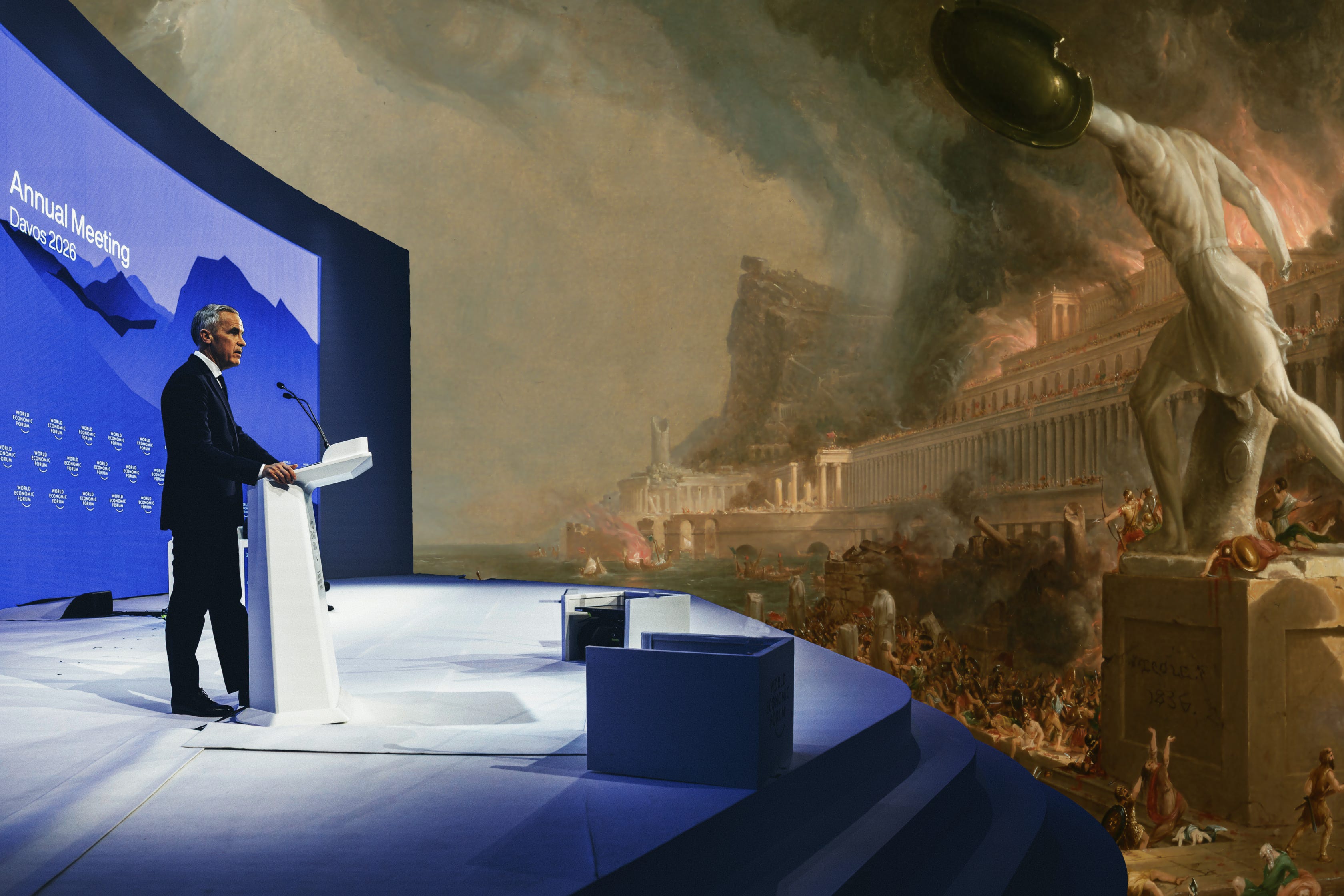
Melos was, stuck firmly between two empires, an island of quiet stability.
The Persian empire had been booted out of the territory around the Aegean Sea, which left just the Athenian Empire and Sparta cohabitating along the archipelago and island chains. While both powers were rivals, each commanding loyalty from a network of city-states, they maintained a parity and cooperation that kept the peace.
Melos had fought with the Greeks against the invading Persians, but as a longstanding ally of Sparta it declined to join the new Greek empire. So Melos remained neutral, delicately balancing itself between two powers.
Then, towards the end of the 5th century BCE, the tiny state had to make a decision. Competition between Athens and Sparta broke into open war, and the city states were forced to pick sides or face invasion and ruin. Athens raided part of Melos and demanded tribute. Faced with an existential threat, Melos abandoned its neutrality — and provided aid to Sparta.
This was a tense moment. Melos was the easternmost Spartan ally, and thus one of the easiest for Athens to reach. Knowing they had a massive advantage, Athens sent an emissary to deliver an ultimatum.
“We have come against you now because of the injuries you have done us,” the Athenians told the Melians. 1
There were merely two options, they said: Surrender or destruction. There was no use wasting time looking for a third way. “If we were on friendly terms with you, our subjects would regard that as a sign of weakness in us,” the Athenians said. “Whereas your hatred is evidence of our power.” The only way to satisfy the empire would be to destroy or enslave Melos. “We recommend that you should try to get what it is possible for you to get.”
According to a dialogue recorded by Athenian historian Thucydides, the Melians tried to reason just the same. “In our view it is useful that you should not destroy a principle that is to the general good of all men,” they pleaded. States under military threat should enjoy “fair play and just dealing,” they said.
But, the Athenians said, there was a “law of nature” at play, “to rule wherever one can.” This wasn’t a new rule, but an old one. “We are merely acting in accordance with it, and we know that you, or anybody else with the same power as ours, would be acting in precisely the same way.”
The emissary explained: “A standard of justice depends on the equality of power to compel and that, in fact, the strong do what they have the power to do, and the weak accept what they have to accept.”
The Melians kept arguing. “We trust that the gods will give us fortune as good as yours, because we are standing for what is right against what is wrong.” Alliances and friendship, they said, would win out.
The Melians refused to submit, so the Athenians organized a blockade of Melos and prepared for broader war against Sparta.
Thucydides tells us that Athens “put to death all the men of military age who they took, and sold the women and the children as slaves.” Athens sent a colony of 500 men to remake Melos in their image.
This epic debate between the Athenians and the Melians would be read for millennia to come, as a primordial text on how stronger powers interact with weaker states in broader competition.
More than 2,000 years later, historian Francis Fukuyama considers that dialogue in The End of History and the Last Man.
“Those who have read Thucydides can note the parallels between the rivalry of Athens and Sparta and the Cold War conflict between the United States and the Soviet Union,” he writes.
But true as Athens’ might makes right philosophy may have been back then, Fukuyama writes, it has grown outdated. Thousands of years of intellectual progress from all sides — technological, philosophical, theological — gave us the wonders of liberalism. We had, he figured, evolved past this need to be powerful more than just. “The civil peace brought about by liberalism should logically have its counterpart in relations between states,” Fukuyama writes.
The end of history would be the victory of liberalism over tyranny and the advent of a relative global stability, he figured. And it was closer than you may think.
Earlier this month, onstage at the World Economic Forum, Canadian Prime Minister Mark Carney addressed a world anxious about his American counterpart and wondered just when history was supposed to be ending.
Carney: It seems that every day we’re reminded that we live in an era of great power rivalry, that the rules-based order is fading, that the strong can do what they can, and the weak must suffer what they must.
And this aphorism of Thucydides is presented as inevitable, as the natural logic of international relations reasserting itself.
And faced with this logic, there is a strong tendency for countries to go along to get along, to accommodate, to avoid trouble, to hope that compliance will buy safety.
Well, it won’t.
This week, on a very special Bug-eyed and Shameless, I want to consider the prevailing theories about the state of things: The end of history, the end of the end of history, and the uncertain future.
It’s been a wacky year. And it’s only January.
Two weeks ago, I was talking to Democratic Congressman Bill Keating about his plans to introduce legislation to forbid American annexation of friendly territory. Not long after, Trump escalated his threats to acquire Greenland — peacefully, through economic coercion, or forcefully — while NATO appeared stricken by panic and indecision. Then came the dueling WEF speeches, where Trump’s unhinged and paranoid world of slop, vengeance, and memes came up against Carney’s defence-and-critique of the liberal order.
As of today, Trump claims to have rescinded his plans to annex Greenland. We’ll see how long that lasts. He’s still, ostensibly, governor of Venezuela. After much bluster, it seems he’s letting the Iranian state solidify control after mass murder. He appears to be contemplating regime change in Cuba and who knows where else.
Meanwhile, in Minneapolis and elsewhere, Trump’s brownshirts continue their terror. The public is increasingly irate at the squads of secret police abducting their neighbors, and the administration does not seem interested in backing down. As this worsens, Trump will almost certainly try to distract from his domestic disasters by creating more disasters abroad so that gullible rubes like Niall Ferguson will continue to declare “Trump won.”
This dispatch is, however, not about Trump and it will mention him as infrequently as possible. Because, between my last dispatch and this Episode 3 of Soft Power, I’m exhausted by his crackpot foreign doctrine.
But, please, give this episode a watch, subscribe, like, and share with your friends and enemies alike. It would be enormously appreciated.
Onto the dispatch.
A Post-Historical World
Fukuyama did not believe that history had ended. Only that it was in the process of ending.
But the only way to complete our evolution and to finish history would be to finally slay a system making its last gasping breaths. To finally put down the geopolitical power dynamics sketched out by Thucydides and live in a world of structure, reason, justice, and dignity. If history was a study of how we interact with each other, then achieving stasis — a period where nothing particularly interesting happens, forever — would mean history would lose its purpose.
Unfortunately, there were still Athenians among us. Thinkers and doers — from Machiavelli to Henry Kissinger — had basically adapted the Athenian view of political relations. They called it realism.
Realists tended to believe either that the great power competition between two (or more) large, powerful states would keep the world in a relatively-peaceful stasis; or that blocs of powerful alliances could manage a similar result through their interlocking interests. But realism tells us that relative peace is only possible if countries maximize their power and operate with self-interest. Strategic competition begets a geopolitical tension which keeps everyone from killing each other.
But Fukuyama believed this was just a new way to justify an antiquated, illogical system. The great power competition existed only because the USSR continued to expend endless treasure and brutality to keep its citizens deluded and deterred from trying to change things. He believed that this was not a natural or sustainable thing — indeed, he wrote his book the year after the total disintegration of the Soviet Union.
When he did, he looked back to a 1978 essay from Czech dissident Václav Havel called The Power of the Powerless. In it, Havel considers a greengrocer living under Communist rule. He hangs a sign in his shop window: “Workers of the world, unite!”
The grocer, Havel writes, does not believe in this slogan nor the state which mandates it. Putting the sign up is a ritual of subjugation, a sign that he recognizes — like most citizens do — that state ideology must be respected, observed, and repeated.
“Ideology is a specious way of relating to the world,” Havel wrote. “It offers human beings the illusion of an identity, of dignity, and of morality while making it easier for them to part with them.”
This is what Alexei Yurchak would later call hypernormalization: Regular people observing the rituals of their totalitarian state, who become the only thing keeping the state alive.
Havel considered what would happen if the grocer takes the sign down. “He rejects the ritual and breaks the rules of the game,” Havel writes. He stops voting, stops observing the rituals, starts protesting. He will be punished, of course, by those who are just as sick of the system as he, but who aren’t ready to reject it yet.
But, by attempting to “live within the truth,” the dissident could eventually bring the system down from within. Waking up from this hypernormalization spreads like a virus. If enough people stop observing the rituals of their own oppression — and stop policing their fellow citizens — the mechanics of state power won’t be enough to stop its own collapse.
Havel, eventually, did exactly that, after a series of peaceful youth protests swept through the country, culminating in an ever-wider strike. By the end of 1989, the Communist regime of Czechoslovakia had fallen away and Havel was declared president by a unanimous vote of the national assembly.
Each of these discrete events — the greengrocer taking his sign down, Havel writing his essay — were shuffles toward the end of history, Fukuyama thought. It was evidence that, as liberalism became the default operating system of the world, modern man anywhere and everywhere would try their best to install it.
People had developed a taste for wealth, freedom, and for the more amorphous feeling of recognition, a desire to be regarded with worth and value by the system in which they participate. If humans would continue striving for those three things, totalitarian states should never exist again, great power competition would never again define geopolitics, and realism would become anachronistic.
There might be economic competition, Fukuyama wrote, but there would be no need for huge world wars. “The post-historical world would still be divided into nation-states,” he wrote, “but its separate nationalisms would have made peace with liberalism and would express themselves increasingly in the sphere of private life alone. Economic rationality, in the meantime, will erode many traditional features of sovereignty as it unifies markets and production.”
Nations may still invade their neighbors and fight wars over religious divides, cultural differences, border disputes, or in competition for resources, he writes. But the part of the world which has fully learned from all its historical antecedents — the liberal, democratic world, that is — should prepare for a new era of peace and stability. “The post-historical world is one in which the desire for comfortable self-preservation has been elevated over the desire to risk one’s life in a battle for pure prestige, and in which universal and rational recognition has replaced the struggle for domination.”
In Fukuyama’s view, the form of this post-history was coming into view. The United Nations was asserting new relevance, NATO was transitioning to a post-Cold War footing, the World Trade Organization was showing itself capable of disentangling complex disputes, whilst a mess of other acronyms — IATA, IMO, ICAO, ISA, ICJ, ITO — were preventing disputes, resolving disagreements, and fostering cooperation and good global governance. But even more than that, states had become so rich, happy, and successful that they simply had no incentive to break any norms in the first place.
He didn’t use the words, but Fukuyama was arguing that the rules-based international order had enabled a kind of global stability that we would be insane to ever jeopardize it.
Friedrich Hegel believed that humanity would achieve its apex when some great man imbued with the spirit of history, a weltgeist, would finally usher us into a new era. Friedrich Nietzsche believed it would be an übermensch would replace our dead god and end history through his own power and will. Karl Marx and Friedrich Engels thought history would end, if only capitalism could finally be uprooted.
But Friedrich Francis Fukuyama was thinking like the inhabitants of Melos. He believed that a global system of cooperation, collaboration, and alliances was in the process of delivering us into a nearly-unbreakable system of peace and good governance.
History, as you may have noticed, didn’t end. Post-Soviet Russia scrambled to reclaim its lost territory and shelled its new democratic institutions. America launched a global war on terror which bombed and invaded nations at a faster pace than it had during the Cold War. A global struggle by ideological radicals imagined throwing off the yoke of messy liberalism and replacing it with the simplicity of theocracy.
The advent of Donald Trump in 2016 coincided with a broader, political rejection of the things Fukuyama held up as altruistic goods. People, more and more, were convicted to reject transnational institutions, free trade, social acceptance of minorities, the free flow of people, and liberalism itself. Far from “the birth pangs of a new and generally (though not universally) more democratic order,” as Fukuyama wrote in 1992, this was a prolonged reactionary backlash to an attempt to end history.
But it has been in the post-COVID era that the rejection of this liberal world has reached new heights. What Fukuyama had never grappled with was the possibility that people — driven by economic uncertainty, social anxieties, environmental pressures, and propaganda — would find themselves breaking the rituals of liberalism.
Have We Been Living Within A Lie?
Onstage at Davos, Mark Carney was also thinking about Havel’s greengrocer and his “workers of the world, unite!” sign.
“He doesn’t believe it, no-one does,” Carney said, “but he places a sign anyway to avoid trouble, to signal compliance, to get along.” The Soviet Union survived not because it ever told the truth, “but from everyone’s willingness to perform as if it were true.” Like Fukuyama and Havel, Carney observes that requiring these daily rituals also made the Soviet system fragile.
But whereas Fukuyama holds up this example as evidence of our slow march towards liberalism, Carney holds it up for a considerably different reason.
“For decades, countries like Canada prospered under what we called the rules-based international order. We joined its institutions, we praised its principles, we benefited from its predictability. And because of that, we could pursue values-based foreign policies under its protection,” he said. This wasn’t a march to the end of history, he said, but an illusion.
“We placed the sign in the window. We participated in the rituals, and we largely avoided calling out the gaps between rhetoric and reality.”
There were some inherent lies in this system, he said. Strong nations — America, in particular — would exempt themselves from this system whenever it saw fit. The United States, for example, refused to sign the Rome Statute, which created the International Criminal Court, so that no American soldiers or officials could be held accountable for war crimes.
Weak nations continued to be dominated by strong ones, the system just made this subjugation less visible. The Democratic Republic of the Congo would continue going through cycles of violence and instability, even as multinational companies siphoned out diamonds and gold — perhaps because of that fact.
Yet other countries — China, Russia, Cuba, Iran, North Korea, Thailand, and so on — would simply ignore the global liberal order and concern themselves with neither freedom nor dignity.
“This fiction was useful,” Carney said. “And American hegemony, in particular, helped provide public goods, open sea lanes, a stable financial system, collective security and support for frameworks for resolving disputes.”
In that way, America operated like the town sheriff: We all knew she wielded too much power, and did so selectively as she made herself rich. But we strived for that end of history, that day when our global system of rules and laws would make American superpower obsolete and where we could evolve into this good global governance. But, in so doing, we never planned for what may happen if she decided to wield that power against us.
Starting last year, perhaps even earlier, America stopped believing in the system it helped to build and which it has led for three-quarters of a century.
It is time to follow suit, Carney said. “Friends, it is time for companies and countries to take their signs down.” To live within the truth means recognizing that the system we built — this liberal order of laws, economic integration, shared supply chains, international fora for chitchat — was now being weaponized by the very leaders who were supposed to be felled by it.
Viktor Orbán has brandished the rules of the EU like a mace, hitting his fellow countrymen in the face as they try to apportion more aid to Ukraine. Vladimir Putin issues INTERPOL red notices to spook his adversaries. North Korea and Myanmar employ office buildings worth of scammers and hackers to catfish and phish their way into bank accounts around the globe, using the profit to keep their own citizens under heel. Donald Trump uses his mighty sanction regime to make life miserable for the judges of the International Criminal Court.
And so, the prime minister said, “stop invoking rules-based international order as though it still functions as advertised.” History hasn’t ended, it’s going backwards to “a system of intensifying great power rivalry, where the most powerful pursue their interests, using economic integration as coercion.”
In this new system, like the old system, liberal nations will have to hunker down as powers try and shake them down. Eventually, liberal countries will become less prosperous and powers will become less powerful, as we realize why we built this system of rules and order in the first place.
Everyone will know that striving for Fukuyama’s end of history is still the right course, and yet radical self-interest driven by populism and risk-management performed by liberals will continue pushing us back into the paranoia of the 20th century.
And so, what do we do?
Turning to his like-minded colleague, the President of Finland Alexander Stubb, Carney said it was time to dust off that old R-word and slap on a new coat of paint. Now is the time, he said, for “values-based realism”.
Finland has spent much of the past year fleshing out this idea. In their national security and foreign policy, published last year, Helsinki swears it still believes in democracy, international law, human rights, peace, equality — liberalism, in short. But the realism bit means cooperating with countries which “do not share our views and values.” It means believing in strength at home, tighter cooperation with its neighbours, and forging stronger bonds with any other nation which could serve Finland’s interests.
“In the long term,” Stubb explained last year, “it is in Finland’s best interest that the multilateral system remains as strong as possible. But we cannot exclude ourselves from decision-making that takes place partly outside this system. Nor can we isolate ourselves from countries that do not fully support multilateralism. We will promote our interests in all situations, based on our own values.”
Carney echoed that sentiment. “We aim to be both principled and pragmatic,” he said. That means “engaging broadly, strategically with open eyes. We actively take on the world as it is, not wait around for a world we wish to be.”
This speech, as I’m sure you’ve seen, has lit the world up. It has been heralded as the most clear-eyed challenge yet to the Donroe Doctrine. It was so lauded that it has provoked an ongoing tantrum from the thin-skinned president.
The trouble is, Carney is elucidating a view of the world that isn’t all that different from Trump’s own foreign policy.
Trump just calls it “flexible realism.” (Dispatch #147)
Under this flexible realism, Trump promises to push shared norms with liberal nations and cooperate with illiberal ones. He wants to advance American interests, forge new trade deals, and keep the world from killing itself by advancing American power — or so he says.
But, surely, we can’t all be realists?
The End of the Future
Let me pause on this walk down the garden path through the various schools of internationalist thought and just tell you what I think.
Mark Carney and Alexander Stubb have both offered, in their own ways, the most sobering and clear-eyed looks at the state of the world as it really is. Unlike their hopelessly unpopular and hobbled compatriots Keir Starmer and Emmanuel Macron, these men have both domestic and international legitimacy to elucidate what this new world order looks like.
But I can’t get away from the fact that this view of the world is deeply cynical.
For starters, the entire idea that the rules-based international order was a fiction is, I think, a very hollow idea. Any and all systems of law are both riven with inconsistencies and incoherence, and they only survive because we choose to believe in it despite those problems.
In systems of law, we know that some misdeeds will never be criminalized, cops won’t catch every criminal, courts won’t always convict the right ones. Creating just laws and enforcing them equitably is always an aspirational exercise — but we tell ourselves the fiction that justice is blind and that a system of rules can protect the weak from the strong. It is only when those systems manifestly do not do the things which they promise that we really give up on them.
But, by every account, our system was working. Insofar as it was failing, it was failing because it was both attacked and used by populists in their quest for domestic power.
What Carney and Stubb are arguing is, really, that we must retreat from the revanchism of this illiberal populism. They acknowledge that our system of international order was right, that it was working, but that concerted attacks on it require us to declare it a failure — at least for now.
Certainly, Carney doesn’t believe that free trade was a mistake. He doesn’t think we should take the European Union flag out of the window, or abandon the International Telecommunications Union.
What he really seems to be suggesting is that the imperative to make ourselves strong and nimble requires us to abandon, either partially or temporarily, our work on perfecting this system of global rules.
What separates the Canada-Finnish approach from the American one is that the liberal powers want to stick up for globalism where it’s convenient, and America wants to expend energy trying to dismantle it further. It’s not a minor difference, it is indeed the big distinction between the two camps.
America is stomping through the china shop. Carney is suggesting it would be better to forge ad hoc alliances on the fly to defend against the rogue bull, rather than trying to catch the china as it falls — or, better yet, to restrain the bull.
The Carney school of thought seems to spend little time contemplating how these institutions can be shields and swords, not merely baggage which slows us down. Indeed, the very reason that America — and Russia, El Salvador, Hungary, the other enemies of liberalism — want to destroy these institutions is because they are effective, at least to a degree.
Trump is not sanctioning the judges of the ICC because they are useless, but because the ICC could actually hold Benjamin Netanyahu and Vladimir Putin for alleged war crimes. He is not trying to support “patriots” in Europe because the EU is wholly ineffective, but because he wants to dismantle a united front. He is not trying to circumvent the United Nations because it is too slow, but because it slows down his own ability to act recklessly.
I still can’t get past this idea. I think Carney’s call to take the sign down satisfies this feeling of urgency and anxiety, but I’m not sure it is the most strategic route. While I’ve never bought into the whole end of history hokum — whether it’s being advanced by Hegel, Marx, or Fukuyama — I believe that recent years have well illustrated that if you don’t stick up for institutions when they come under attack, you regret it later.
Still, even if we accept that Carney, Stubb, and the lot are failing to stick up for our institutions of world order, I am heartened by his appeal to build better things to go along with them. But this brings me to my bigger concern.
“The middle powers must act together,” Carney said, “because if we’re not at the table, we’re on the menu.” That old order “is not coming back,” he said. “We shouldn’t mourn it. Nostalgia is not a strategy.” Instead, he says, think to something “bigger, better, stronger, more just.”
Okay. How?
Certainly, the vestige of the liberal world — most, not all, of Europe; the Commonwealth states of Canada, Australia, New Zealand, and so on; Japan and South Korea; and a hodge-podge of other nations who are skeptical of liberalism but hostile towards fascism — can figure out how to protect themselves and keep their globalized economies humming. But, whether it is defending what works or building better things to make the world safer and more fair, what’s the plan?
But despite promising a salvage job of the rules-based international order, Carney never explains what this new regime will look like.
Canada was instrumental in founding the International Criminal Court, and is conspicuously silent as Trump tries to destroy it for daring to indict Benjamin Netanyahu for war crimes. Canada and Finland were founding members of the Arctic Council, a body that has basically fallen into disuse because of Russia’s presence on it. The consortium of middle powers have long invested time, energy, and money into the structures of the United Nations, a system which is now hopelessly taken over by the rogue states we hoped to constrain.
If Carney has alternatives for these institutions, he has yet to sketch them out. If he has ideas on how to make these institutions more effective — more realist let’s say — he hasn’t told anyone. If he has thoughts on how we may improve their defenses from the constant flurry of blows, he hasn’t put them to paper.
Instead, we seem intent on retreating back into history: To a time when alliances kept us safe as we tried to build up the scaffolding for the end of history — except, this time, nobody seems to have much interest in putting up new drywall.
But we’re not back in the great power competition of yore. Then, it was an epic fight of liberalism vs. totalitarianism. In the power games of today, nobody represents our values. Today, it is hybrid regimes duking it out for maximum domestic returns, and in order to satisfy the nationalists and xenophobes in their own countries. And this ideology is rising in Europe, the epicenter of the alliance of supposedly-enlightened middle powers.
Carney deserves enormous credit for laying out the world as it really is.
But I can’t help but think he should have told us what the world ought to be.
That’s it for this week. I’ve already done my self-promo elsewhere in the dispatch, so I’ll leave it there.
Until next time!
The History of the Peloponnesian War, Thucydides
Expecting that Carney has a full answer that he has in his hip pocket and is keeping us in the dark is not realistic.
What I took away was that things are broken and we're going to need to be nimble and quick and walk our way through working with other countries to forge something new for which nobody knows what's that's going to look like.
This has been politics in Canada forever in that a new leader emerges and everybody expects answers and results within a matter of weeks when you know getting things done over a matter of years is actually a major accomplishment for major changes within Canada and even more so internationally.
This is a great accounting of how we got to this point … but patience, Justin. We first need to take in this new reality and there is a way forward which Carney and Stubbs have identified. Middle powers need to get organized and collectively recognize and use their power. This does not mean abandoning the values of liberal democracy, rather of using them. The way forward is still unclear because history is still unfolding and certainly adaptations will be necessary. But I have no doubt that there are seeds of a new vision germinating. We have just begun the process of watering and fertilizing them.